
100 Years of Pavlo Bedzir: The Inner Form of Time, Thought, and Art

Anna Cherevko
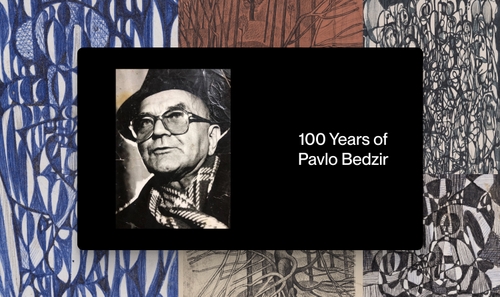
Table of Contents
This year marks the centenary of Pavlo Bedzir’s birth—an occasion to reflect not only on his artistic journey, but also on the man himself, the mentor, and the quiet yet profound influence he had on those around him.
Pavlo Bedzir (1926–2002) was an outstanding Ukrainian artist and philosopher whose work continues to resonate far beyond the borders of Zakarpattia and Ukraine. He was more than a painter or graphic artist; Bedzir was a thinker who transformed visual form into a philosophical language, using art to explore the structure of the universe, the nature of being, and humanity’s inner path.
To mark this anniversary, we look not only to his life and creative legacy, but also to living memory. We spoke with Pavlo Kovach, one of those shaped by Bedzir’s presence and ideas. His reflections will accompany our exploration of Bedzir’s life, work, and lasting influence.
Roots in Zakarpattia: Early Life and Formation
Pavlo Bedzir was born in 1926 in the village of Kalyny, in the Tyachiv district of the Zakarpattia region. His early childhood unfolded within a landscape of forests and mountains—an environment that would later become central to his artistic symbolism. Until the age of ten, he lived in Kalyny, after which his family moved in 1936 to Svoboda (today Badov, part of the village of Danylivka).
In 1944, Bedzir graduated from the Mukachevo Urban School and continued his education at the Mukachevo Trade Academy. It was during this period that his interests in yoga, philosophy, and visual art began to take shape. He studied drawing and painting in the workshop of Vilmosh Berec, where he gained a foundation in technical discipline while beginning to look beyond purely academic approaches.
In 1946, Bedzir entered the Uzhhorod Art and Professional School, studying under influential teachers such as Fedir Manailo and Ernest Kontratovych. These years were formative, situating him within the Zakarpattian art school while encouraging a broader engagement with European and global artistic movements.
My first visit to Pavlo Bedzir took place in 1978, at his home, which also served as his studio. At the time, I was a third-year student. From then until 2002, we were friends and colleagues. In the beginning, I studied graphic art, painting, philosophy, and yoga. Bedzir never said that I was his student, but I was constantly learning from him—and I continue to learn even today.
War, Return, and a Shared Creative World
From 1947 to 1950, Pavlo Bedzir served in the army. After demobilization, he returned to Uzhhorod, where his personal and creative life soon found stability. On June 19, 1952, he married Yelyzaveta Kremnytska, who would become not only his life partner but also a key presence in his artistic world.
In 1954, Bedzir began working in the workshops of the Art Fund, where his wife was also employed. This space evolved into a vibrant creative hub. Together with friends and fellow artists, they experimented, painted from life, debated ideas, and shared discoveries. Among those close to this circle was the artist Ferenc Seman.
According to Bedzir’s apprentice, these workshops were more than studios—they were places of concentration and silence, where conversation about art naturally flowed into discussions of philosophy, religion, and the structure of reality itself. Bedzir taught less through instruction and more through example, encouraging careful observation and deep inner attention.
I don’t know of any students of Bedzir, yet they always seem to appear from somewhere! Pavlo did not teach or mentor anyone directly, but in every possible way, he created conditions for the development of individuality.
The Tree as Philosophy
Throughout his life, Pavlo Bedzir explored nearly all major stages of global avant-garde movements—from Impressionism and Expressionism to Cézannism, Cubism, and Op Art. Yet his work never followed trends for their own sake. Each stylistic phase became a tool for deeper inquiry.
At the center of his artistic thinking stood one enduring image: the tree.
Reflecting on Op Art, he remarked that he no longer looked at the trunk or branches, but at the voids between them—spaces that carry as much meaning as form itself.
Even when depicting the human figure, Bedzir avoided naturalistic description. Instead, he focused on internal structure, rhythm, and constructive logic, treating the body as a system governed by universal principles.
Pavlo Bedzir was a person of the Universe, and as such he absorbed everything that was close to him in spirit. The third millennium was his Faith, his Hope, and his Love.
“From the Life of Trees” and the Graphic Legacy
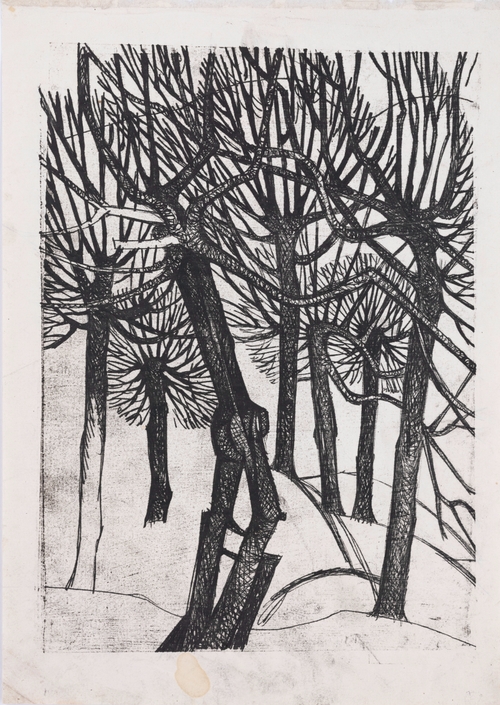
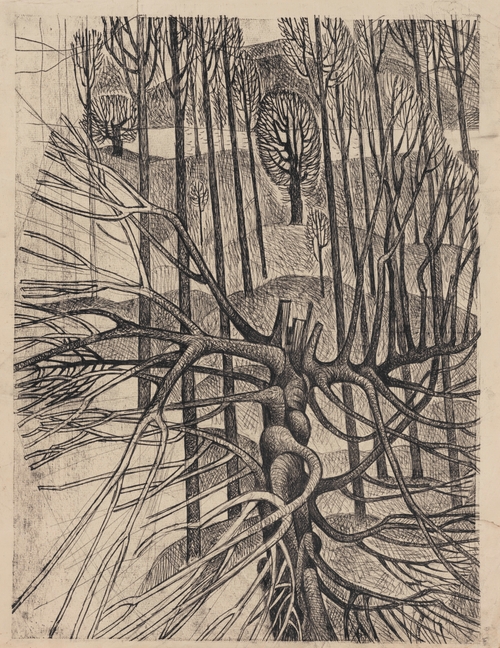
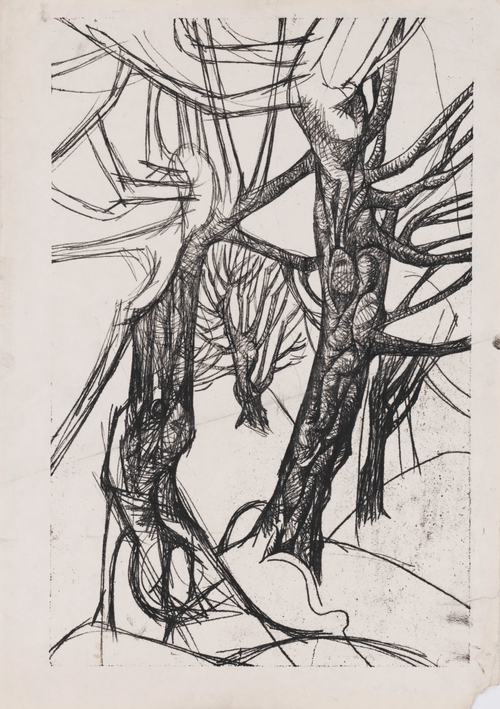
Bedzir’s most renowned body of work, the series “From the Life of Trees,” stands as a cornerstone of Ukrainian graphic art. Created mainly between the 1970s and 1980s, works such as Life of Trees 1, Life of Trees 3, Life of Trees 4, and Life of Trees 6 reflect a lifelong meditation on growth, time, and existence.
Other notable works include Composition 1, Mountain View, Studies 1 and Studies 2, A Forest, and the Op-Art. Pocket-Sized Format series. Across these pieces, Bedzir combined precision with contemplation, transforming simple natural motifs into complex philosophical structures.
One of his sayings was: "Burn everything that is yours — old and familiar — and light your own path into the future."
Legacy at 100
Pavlo Bedzir passed away in 2002 and is buried in Uzhhorod, beside his wife, Yelyzaveta Kremnytska. Yet a century after his birth, his presence remains vivid—within his works, within the memories of those who learned from him, and within the ongoing dialogue between art and philosophy that he so rigorously pursued.
As we celebrate 100 years of Pavlo Bedzir, we honor not only an artist of extraordinary depth, but a thinker who showed that art can be a discipline of consciousness—a way of seeing the world, and oneself, more clearly.