
Alina Zamanova: On Art Born in War

Anna Avetova

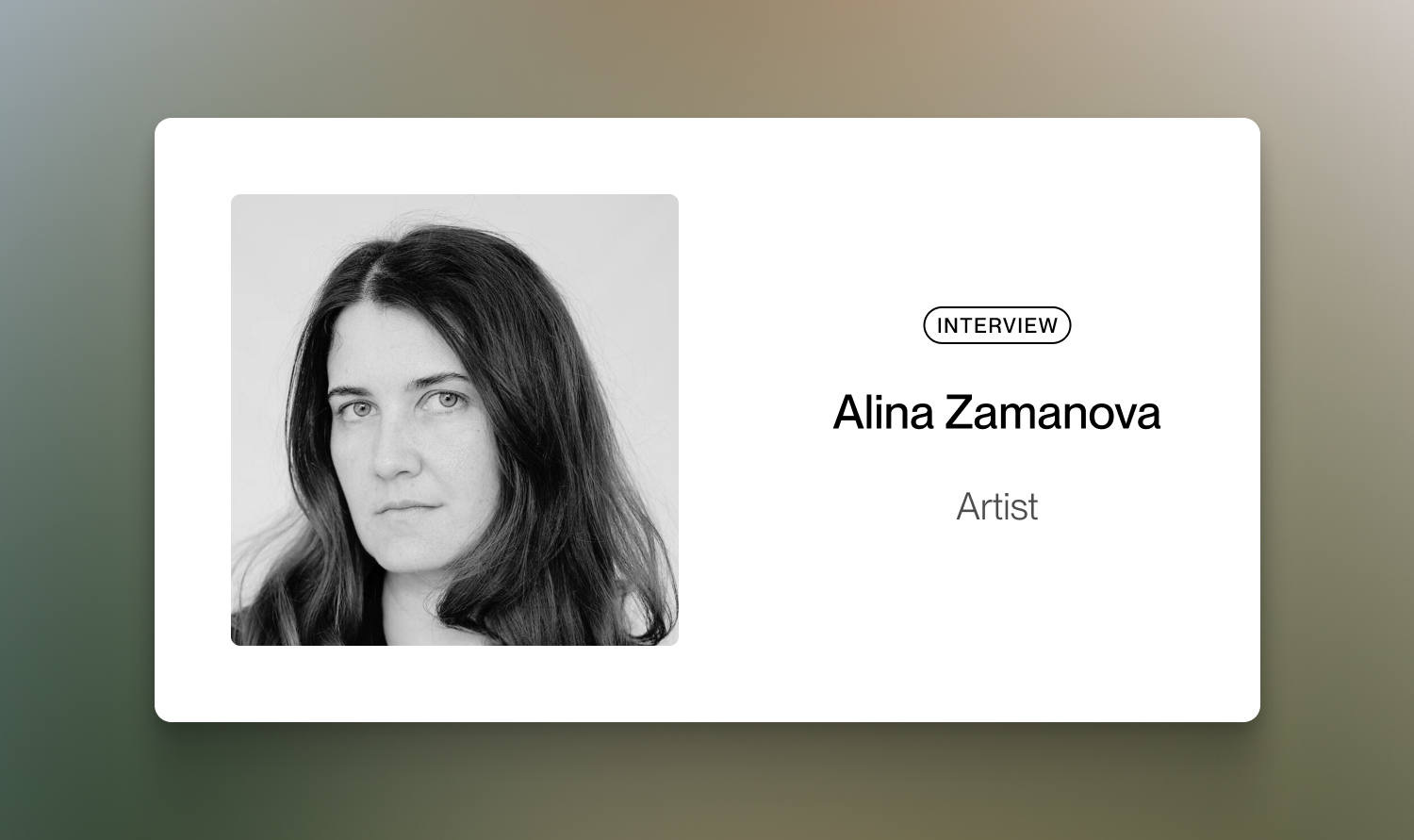
Table of Contents
- From Kryvyi Rih to McQueen
- Leaving fashion, learning oil
- Children, war, and “Our Children Are Fighting Too”
- Working with soil, building a diary of days
- Sculpture, Bucha, and what cannot be finished
- Residencies, European audiences and speaking across bubbles
- Life before and after, and what comes next
In the new episode of the UFDA Podcast, host Anna Avetova talks with Kyiv‑based artist Alina Zamanova about growing up in Kryvyi Rih, choosing art almost by accident, learning oil painting from YouTube, and how the full‑scale invasion split her life and practice into a sharp “before” and “after.” Their conversation moves from fashion houses in London to children’s improvised rituals in a Carpathian village, from clay dug out of Ukrainian soil to large‑scale portraits and sculptures that try to hold the weight of war.
From Kryvyi Rih to McQueen
As a child in Kryvyi Rih, Zamanova simply knew she liked to draw. When her mother sent her to enroll herself in music school, she happened to walk into the wrong corridor and ended up registering for art school instead. That accident set the tone: she learned the basics of drawing, still lifes and composition in a fairly traditional way, then continued in Kyiv at the National University of Technologies and Design, studying graphic design for a year. There she picked up fonts, composition, anatomy – a solid but not always exciting foundation.
London opened something else. At the University of the Arts, she moved into fashion illustration, a programme that mixed drawing with photography, media and cultural studies. Every two months students wrote long essays, culminating in a dissertation at the end of the third year. Despite the conceptual side, she always gravitated back to drawing by hand; everything she did was “made manually.” That attention to line and surface eventually led her into the studio of Alexander McQueen, where she interned on the textile team in 2013.
At McQueen she was hired to work on prints – drawing and developing textile placements that were then scanned and prepared for production in India and Italy. The team felt like a small family, she recalls, and she stayed for six or seven months. It was intense work, not at all the glamorous stability it might seem from the outside: nights in the studio until four or five in the morning, constant deadlines. She also learned the entire pipeline of textile design, from sketch to finished fabric. Visa rules, however, made it almost impossible to stay on. As a non‑British graduate competing with many qualified local designers, she found herself pushed out by bureaucracy rather than by lack of skill. She tried elsewhere – even passed interviews at Vivienne Westwood – but the same problem persisted.
By 2015, after finishing her studies and chasing jobs, she returned to Ukraine. Looking back, she admits that staying in London would have meant a different life – a “stable” job, at least on paper – but also acknowledges how brutal the fashion rhythm felt: endlessly fast, built on the constant consumption of resources, human and material. Over time, this speed and surface began to repel her. She realised she needed her own studio, her own pace, and a space where she could move away from illustration for brands and towards painting on canvas.
Leaving fashion, learning oil
Back in Kyiv, she continued for a while with fashion‑related work and collaborations: scarves, T‑shirts, small capsule collections. She even launched a light clothing brand for a year, but found the logistics and pressure overwhelming. Gradually, she stepped away from the fashion system and turned towards what she calls fine art, even if she hesitated to claim the title of “fine artist” at first. What she did know was that she wanted to work on canvases, not just on paper or textiles.
Oil paint, however, was almost a foreign language. She was used to acrylics, pastels and pencil – media that dry quickly and reward precision. Oil’s slow drying time, layering and technical rules intimidated her. So she did what many of her generation do: she went to YouTube. She found an American painter offering an online course, bought it, and learned the basics of alla prima, layering and mediums from video lessons. From there she experimented, talking to other artists about which oils and mediums they used, discovering walnut oil, Liquin and different transparent gessos, and slowly teaching herself how to control transparency and movement of the paint.
She describes this period as a process of constant looking and learning: each new painting carried traces of what she had understood – or misunderstood – from the last. Works from 2023 and 2025, she notes, already feel like they belong to different “schools” inside her own practice, even though no academy shaped them. When asked whether she feels the lack of a full academic art education, she answers that, thanks to her early training in Kryvyi Rih and Kyiv, she at least had a basic understanding of anatomy and structure. In London she was surprised to find that many classmates on her fashion illustration course couldn’t draw the human body at all. The real shift came not from technique but from the British pedagogical approach: instead of imposing one correct way to draw, teachers encouraged experimentation, critical thinking and working “outside the box.” That freedom, she says, balanced out the rigid structures she had absorbed earlier.
Children, war, and “Our Children Are Fighting Too”
The full‑scale invasion in 2022 cut her life into a very clear “before” and “after.” She says both her life and her art divided along that line. The themes she worked with earlier – bodies, beauty, ugliness, self‑acceptance – now feel like a ghost version of herself: real, recognisable, but distant. She does not disown those works; she still sees herself in them and knows many people miss that period of her painting. At the same time, she cannot force herself to return to that register when everything around and inside her has changed.
The new work emerged unexpectedly in the Carpathians. A week before 24 February, she and her partner were considering moving to Irpin. At the last moment, guided by instinct more than logic, they decided instead to go to a village in the mountains. She took with her boxes of earth and clay she had collected from different parts of Ukraine – from the blue‑clay quarry in the village of Stayky to her grandmother’s black soil in Kryvyi Rih – intending vaguely to experiment with them later. When the invasion began they found themselves in isolation, glued to phones, helping to evacuate friends, shouting at acquaintances abroad to donate money, living in a constant mix of fear, anger and exhaustion.
In that village they also helped organise a small volunteer centre, distributing food and clothes to displaced people arriving from other regions. There were many children, both local and newly arrived. She remembers how local kids, who were themselves internally displaced, came every Thursday to help pack heavy bags for other families. Once she dug clay out of the ground, cleaned it, and brought it for the children to model small protective talismans together. Out of these encounters came stories that would not leave her.
One girl, she recalls, took a small pinwheel toy and ran with it for a long time. When Alina asked why she was running so long, the girl answered that as long as she kept running and the pinwheel kept spinning, “our people” would win the war; if she stopped, Ukraine would lose. When the child finally tired, Alina offered to take over for a bit, then handed the toy back when the girl was ready to “continue the work.”
This kind of child logic – magical, heartbreaking, deeply serious – led to the painting Our Children Are Fighting Too, created during evacuation in the Carpathians. The work, which later won the Europe prize in the Art for Change competition at Saatchi Gallery in 2023, shows children as active participants in the war, fighting in their own world even if they do not fully understand the geopolitics around them. For her, the piece became a way to say that children are not just passive victims; they carry responsibility and trauma that will echo through their whole lives, and society must be ready to support them, as well as their families and veterans, long after the war ends.
From that period also grew a large multi‑portrait work painted on an old window frame she salvaged in the Carpathians. Someone had thrown the window away; she asked the owner if she could buy it, and he told her to take it for free. When she looked at the frame, she felt as if faces were already looking out at her. Over a year and a half she painted each pane with a child’s face drawn from different stories of displacement, loss, evacuation and survival. The gazes are direct, “straightforward,” she says, to create an immediate connection with viewers. She deliberately avoids making the portraits exact likenesses, out of ethical concern: she wants to speak about a shared trauma, not expose an identifiable child to re‑traumatisation.
Working with soil, building a diary of days
Those boxes of soil she had carried to the mountains also began to find their form. Inspired in part by seeing works by Wangechi Mutu in New York, which incorporate earth from Nairobi, she wanted to integrate Ukrainian ground into her own paintings and panels. With the help of a researcher in the United States who studies soil, she developed a way to process earth into pigment: washing it, letting it settle like cream, separating out impurities, drying the residue into powder and then mixing it with transparent gesso. The result is a kind of earthen ground that she applies to wooden panels, turning them into both surface and substance of the work. Different places produce different colours; each panel carries the geography of its origin.
During the first months of the invasion, as faces around her changed and fear reshaped expressions, she began to paint a series of small self‑portraits on these prepared panels. She describes them as a visual diary of the days of full‑scale war: each portrait linked to a specific day, emotion and state of mind. When these pieces are shown abroad, viewers often notice the numbering more than the image: Day 16, then Day 1251. The sheer length of time – when expressed in days rather than months or years – hits differently. For her, too, the numbers alter perception: the sixteenth day once felt like the thousandth, and now the thousandth can feel like a whole lifetime.
The panels are also, she feels, about standing “firmly on her own ground.” She connects her gradual psychological stabilisation – after years of panic attacks and difficulty integrating – with the experience of living and working in Ukraine rather than abroad. In Western art centres, she says, the rhythm can be “stupidly fast,” leaving little space for artists to pause and critically reassess their own work. By contrast, in Kyiv or the Carpathians, time and space, however precarious, allowed her to slow down and look at her practice more honestly.
Sculpture, Bucha, and what cannot be finished
At some point she felt compelled to move into sculpture, despite having almost no technical training. She went to a sculptor at the National Academy of Fine Arts and Architecture in Kyiv to learn the basics of building an armature. With that minimal guidance she embarked on an extremely ambitious project: a life‑size sculpture of a woman, intended as a monument to survivors of the mass rapes and sexual violence in Bucha and Irpin. Volunteers she knew had told her, in fragments, what these women had endured. The stories, she says, “burn into you for life.”
For a year she worked on the sculpture, which occupied an entire room in her flat. It refused to resolve. When she returned from another period of travel and looked at it again, she realised that the only part she truly liked was one hand. The rest felt wrong. One day she simply destroyed the entire piece, unable to live with its presence any longer. Out of the broken clay, however, came another work: a painting of a child found dead under the ruins of a bombed building, their body turned away, hand raised as if to shield themselves. For her, the gesture is not only a defence against explosions, but also – painfully – against “all of us adults,” against what adults have done and failed to prevent.
Throughout the conversation, she returns to the idea that adults have “failed” children, that a deep sense of guilt runs through her generation. Even without children of her own, she feels a responsibility and sorrow for the world that has been handed to the youngest.
Residencies, European audiences and speaking across bubbles
Zamanova’s work has taken her into European galleries and residencies, including a stay at the 37xResidency in Margate, UK, where the changing light and seascape reminded her why Turner painted there. The weather, unexpectedly sunny, and the white interiors of the house created a vivid, almost electric light that seeped into her paintings as transparent, moving colour. She decided to work more abstractly there, focusing on movement and atmosphere rather than literal landscapes. Part of her reasoning was strategic: she noticed that communication with European audiences about war through figurative, explicitly narrative images can be difficult. Sometimes, she feels, a different visual language – more oblique, more abstract – opens a “new little box” in viewers’ minds, allowing them to approach Ukrainian experience from another angle.
Her experiences with audiences vary by place. In Belgium, where she showed at Mulier Mulier Gallery in Brussels and previously in Mechelen, she encountered a high degree of empathy and curiosity. People from different backgrounds – including those working in European institutions – asked not only about her paintings, but also about how the war affects Ukrainian society and what people are learning or losing through it.
In the UK, responses have been more mixed. During the 37xResidency and other stays, she often felt that people’s first reaction, upon hearing she was from Ukraine, was to tilt their heads and see her primarily as a victim. She pushes back against this framing, insisting that Ukrainians are not “just victims” but people defending their homes – fighters, not passive sufferers. This reframing is important to her not because she wants to appear strong, but because she sees how easily Western compassion slides into a kind of condescending pity that can re‑traumatise Ukrainians rather than support them.
She is also cautious about how much to force when circumstances resist. She tells Anna about a pre‑war exhibition that was meant to happen in London: her paintings were shipped from Kyiv, then returned broken under the rain, glass shattered. By the time she reached London herself, the UK was entering lockdown and the show was cancelled. In panic, she and the gallerist moved the exhibition into the gallerist’s flat, but very few people could come. Looking back, she wishes she had not tried so hard to “break” reality to make the exhibition happen; sometimes, she has learned, it is better to accept that something “is not going” and stop.
Life before and after, and what comes next
Before the war, much of Zamanova’s work revolved around the body: its beauty, strangeness, distortions, the tension between ugliness and desire. She explored how women see themselves, how social expectations carve into skin and psyche. Those concerns have not disappeared, but they now feel woven into a much larger fabric of survival, grief and responsibility. She speaks candidly about her earlier psychological fragility – panic attacks, difficulty integrating – and about how the war, paradoxically, forced her into a stronger version of herself. The “old Alina,” she suggests, may need to be released; the new one is tougher, less inclined to compromise with systems that do not serve her.
Anna asks whether it is acceptable for Ukrainian artists to show work abroad that does not explicitly address the war. Alina answers without hesitation: yes. Each artist has their own method and their own path. Sometimes you need a direct statement; sometimes you need to speak through other themes, other forms. She is wary of exhibitions in Ukraine that repeat “war, war, war” in a way that feels exploitative rather than thoughtful, especially if traumatic images are used mainly to attract foreign visitors. At the same time, she recognises how important many recent shows have been in re‑thinking Ukrainian history, especially the 1990s, and in cleaning away Soviet propaganda.
Abroad, she believes, there is value in mixed exhibitions: Ukrainians shown alongside European or American artists, not in isolated “Ukrainian bubbles.” Such formats, she argues, create bridges where experiences can be shared, questioned and understood together, rather than shouted across a divide. She also stresses the importance of teaching European audiences how to talk about Ukraine: casual turning away from difficult topics, or framing Ukrainians only as pitiable victims, is not just insensitive but actively harmful.
Looking ahead, both she and Anna wonder what a future “after the war” will look like. They talk about addiction to cortisol, the way bodies collapse when soldiers or civilians finally reach safety, and about the unknown psychological landscape that awaits. For now, Zamanova continues to work from within the storm: painting, sculpting, scraping earth from the ground, and building, piece by piece, a record of how it feels to live, think and make art inside a war that has already lasted more than a thousand days.