
Artem Humilevskyi: From Agribusiness to Global Art on the UFDA Podcast

Anna Avetova
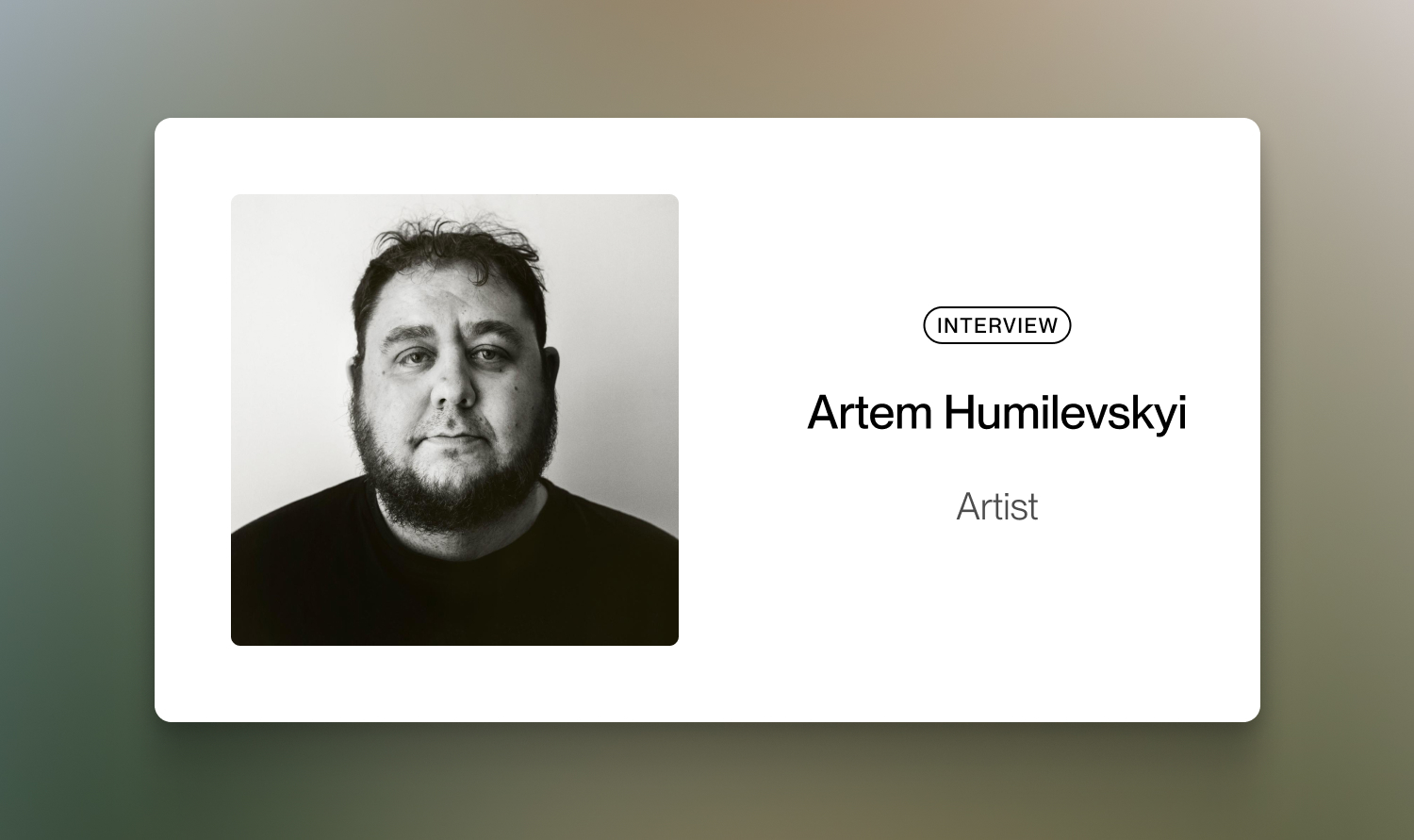
Table of Contents
In this episode of the UFDA Podcast, host Anna Avetova speaks with photographer and visual artist Artem Humilevskyi — author of the series GIANT and Roots, winner of international awards, and one of the most striking voices of a new sincerity in Ukrainian photography. The conversation starts with a joke about “sex, drugs and rock ’n’ roll” and quickly moves to ambition, trauma, algorithmic art, and why, in art, persistence can matter more than talent.
From Agribusiness to GIANT
Artem did not come to art through an academy, but from agribusiness. He worked in agriculture from warehouse loader to manager, all the while feeling a vague “search” he couldn’t yet name. He opened a photo studio almost by accident, “while smoking hookah with friends,” knowing nothing about exhibitions or the art world, and immediately switched on his managerial mode: looking for people who understood exhibitions, he joined Serhiy Melnychenko’s school and experienced a “mind blown” moment when he realized how little he knew about photography.
GIANT was born there — a series of self‑portraits that, as Artem says, marks “the birth of the artist Humilevskyi.” The first image appeared during the pandemic, when he wandered around his home with a camera and suddenly realized that “the least explored object” was himself. But the real challenge was not taking the picture; it was posting it. His finger hovered over the “publish” button for six hours as he feared the reaction of his very business‑oriented audience, and then discovered that all the disasters he imagined existed only in his head.
GIANT brought him hate, thousands of unfollows, and just as many new followers, and then international recognition, including the Global Peace Photo Award and major festival and museum shows. On the podcast, Artem honestly admits that from this moment on, GIANT became the locomotive of his career — and that he was genuinely afraid of becoming an “artist of one project.”
From Self-Irony to Roots: The War and a Shift in Tone
With the full‑scale invasion, the tone of his practice changed radically. If GIANT was about lightness, self‑irony, and bodily freedom, at some point Artem realized he simply could not continue this series honestly; in the new reality, it felt too “bright.”
This is how Roots emerged: a project in which the artist no longer focuses only on himself, but works with culture, identity, and the trauma of war. Visually, GIANT and Roots are related — a naked body in the landscape, a sense of ritual and folklore — but the logic is different. GIANT was born out of quick, almost diaristic gestures, while a single photograph from Roots can take weeks of preparation: looking for locations, objects, and the right light.
In the conversation, Artem describes his method as something between research and intuition. Ideas grow out of personal experience, are nourished by reading, films and other artists’ work, yet always leave space for a “magical vibe”: a semi‑documentary, semi‑fictional folklore, where an invented wedding ritual looks like an authentic tradition that never actually existed.[see-zeen]
“Scars”: A Painting Drawn by the War
A separate part of the episode focuses on Artem’s new project, Scars, where he steps away from photography and returns to his teenage experience as a programmer. This is algorithmic art: code he wrote lives on a server connected to real‑time data on air raids across Ukraine and builds an evolving visual canvas.
Against a dark blue background are star‑like points of Ukrainian cities, triangles marking points of launch, and coloured lines tracing the trajectories of missiles and drones. Each new strike glows red for 24 hours before “baking into” the overall image as one more scar. Artem collected statistical data and embedded it into the DNA of the work; from that point on, he refused to interfere. The painting is drawn by the war, not by the artist.
The server will run until the war ends. Then Artem plans to stop the process, export the final state with hundreds of thousands of coordinates and turn it into a large‑scale physical print — a “painting drawn by the war.” For now, Scarsexists as code art that can be shown on any screen, and on the podcast Artem talks about early invitations to show it abroad and about how difficult it is to communicate the project on social media because “you simply can’t explain it in 15 seconds.”
Work, Ambition, and Self‑Promotion
Another important line of the conversation is about the art market, career, and how to build visibility. Artem is candid: he started late, already in his thirties, and from the very beginning, understood he “didn’t have much time to climb to Olympus,” yet wanted it badly. So he consciously decided to “use every opportunity” — from small local galleries to major awards.
Behind this is a daily routine people rarely talk about. For months, he could spend three to five hours a day on building his website, submitting to open calls, writing to galleries, and maintaining communication, while simultaneously making new work. On the podcast, he formulates his position clearly: in today’s world, persistence is more important than talent, and the myth of the genius discovered overnight by “a guy from New York” is a romantic story that paralyses many artists.
He recalls how saying yes to a “small” show in Cherkasy led to an invitation from the Odesa Fine Arts Museum, and then to meeting Magnum photographers who flew in specifically to see his exhibition — a chain of events that would have been impossible had he turned his nose up at a regional gallery. For him, this is proof that the hierarchy of “big/small” institutions doesn’t work in a straight line, and that an artistic biography is built from dozens of “minor” decisions that are easy to say no to.
When it comes to self‑promotion, Artem speaks with the same directness. He understands marketing mechanics but is afraid of adapting his work to the market, so he avoids aggressive sales pitches, rarely pushes his work explicitly and mostly responds to collectors’ interest instead of chasing them. At the same time, he dreams of teaching a course on self‑promotion for artists — but with a focus on protecting artistic freedom rather than on “optimizing the product.”[everythingtosea]
The Ukrainian Scene, Institutions, and the Local Market
On the global stage, Artem does not see himself as a “major player” yet, but rather as someone who has climbed the first steps of a long staircase. The experience of a festival in France, where people queued for an hour to see Roots, became proof that Ukrainian art can do more than illustrate a country at war: it can generate deep empathy and resonance through its visual language.[festival-circulations]
Speaking about Ukrainian photography, Artem points directly to its weak spots: institutions, education and the market. Comparing Ukraine to Lithuania, he notes that both started from similar conditions, but Lithuania began to work systematically with visual culture much earlier, and now the level of visual literacy and the strength of professional unions there are noticeably higher. His personal joy is every sale in Kyiv or any other Ukrainian city; the internal market is symbolically more important to him than selling a work abroad.[euneighbourseast]
He imagines a future where his series — GIANT, Roots and the algorithmic Scars — are studied in schools and art programmes as examples of a “new sincerity” in Ukrainian art, where the focus is not on the naked body per se, but on an honest way of working with vulnerability, identity, and time.
Art as a Way to Endure the War
Towards the end, the conversation comes back to the war, the body, and the future. Artem stresses that for him art is neither an end in itself nor an escape from reality, but a way to speak with the viewer here and now, to work with trauma without exploiting someone else’s pain, and to remain free in his choice of medium — from self‑portrait to code.
Anna and Artem laugh a lot, talk about the “power of intention,” about how a dream of a giant banner at PinchukArtCentre unexpectedly came true a couple of years later, and about why it is so important not to treat art with arrogance — neither as an artist, nor as a curator. Behind the humour, there is a serious feeling: Ukrainian photography today is not only searching for a new language, but building a new ethics — an ethics of work, sincerity, and responsibility for what, and whom, we choose to show.