
Artist Mitia Fenechkin: How a Cold Email Opened Doors, What NFT Taught Him, and Living with Impostor Syndrome in Art

Anna Avetova
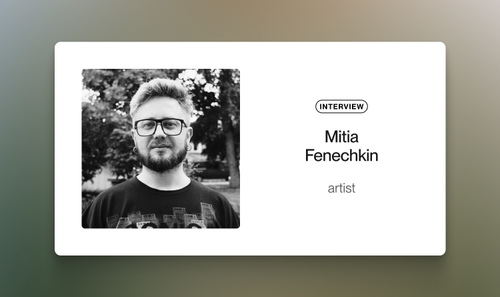
Table of Contents
In a new episode of the UFDA podcast, artist and illustrator Mitia Fenechkin talks about how the full-scale invasion changed his practice, why he chose a pause instead of automatic productivity, and how an art book assembled from “old” drawings became both a personal archive and a fundraising tool. The conversation touches on impostor syndrome, IT and game development, music covers, NFTs, and the role of digitisation in preserving works created before and during the war.
From IT and Cassette Covers to Contemporary Art
Mitia describes himself simply as an artist-illustrator, without overemphasis on labels. For a long time, his practice existed on the periphery of what is usually called the “art world”: he drew covers, personal illustrations, abstract art books, and posted images on Instagram, but had almost no direct connection to institutions or professional communities.
His relationship with visual culture started early through music. In the early 2000s he wrote songs, recorded them on cassette tapes with friends, and created covers by hand: drawing, shrinking on a home printer, inserting them into plastic boxes. Later came “Zapaska”, the band Orchestra Che, and other Ukrainian musicians whose album visuals he developed. A turning point was a cold email to the management of Okean Elzy offering to create a cover: spontaneous, without prior connections, and successful enough to become part of his biography.
Interest in contemporary art as a field arrived relatively late. After work in an IT company, he saw a piece by an international artist online, initially “didn’t understand at all” what it was, checked the price and realised that art could be a separate, serious territory. Exhibitions, lectures and encounters with works in real space gradually turned casual illustration into a more conscious artistic practice.
Full-scale Invasion and the Logic of Pause
Before 24 February, Mitia mostly created single images and small series that did not require long-term planning. The full-scale invasion forced him to rethink that approach: war brought not only new topics, but also a different way of structuring work.
He says that with the invasion came project thinking: series replaced isolated drawings, context became part of the internal logic of works, and the question “what exactly happens inside the drawing” became more important than its formal attractiveness. At the same time, he is cautious about speaking of art as therapy. Drawing with pencils is a long, labour-intensive process; large sheets cannot be “undone” or easily corrected. In the studio he often feels anger and nervousness rather than calm, yet admits that transferring aggression, fear and tension onto paper may be his version of “dry therapy”.
One of the key elements of the conversation is his current self-imposed pause. For about a year, he has not been working on big personal projects, focusing instead on commissioned work: book covers, illustrations, collaborations. At some point, he realised that he was beginning to repeat himself — not so much in ideas and storylines as in technical solutions and approaches — and did not want to “hammer” the same visual language for years just because it already works. Instead, he chose to step back and look at his own practice “from a different angle”, searching for a new way of speaking that would match the current reality.
Mitia speaks openly about impostor syndrome. He rarely feels fully satisfied with his work and constantly thinks that he could have approached things more deeply and done them better. There is also a tension between ambition and time: with only a few hours per week left for his own projects amid job and life commitments, progress is inevitably slow, and he tries to accept this pace instead of demanding impossible productivity from himself.
The Art Book as Archive and Fundraising Tool
The story of his art book begins with loss. At some point, his main Instagram account was stolen; attempts to recover it failed. He returned to an old account and decided to “reactivate” it by posting older works that few people remembered, many of which contained Russian-language inscriptions. Preparing them for a new audience, he digitised the works, erased the text, and rewrote it in Ukrainian — not just as a translation, but as a rethinking of context. Out of this process emerged the idea of compiling an art book, a selection of works from nearly a decade, regrouped into loose series with updated captions and a new narrative framework.
The first print run of 300 copies was tied directly to fundraising. Initially, 100% of the proceeds were donated; in the end, the project raised about 150,000 UAH for the “Come Back Alive” foundation. Later, Mitia started keeping part of the sum to offset production costs while continuing to direct the rest to current military needs, turning the book into a long-term instrument of support.
The art book also highlights the importance of digitisation. For Mitia, scanning and photographing works is not just about reproduction quality, but about their survival in wartime. Large-format pencil drawings (up to 1.5 × 1.2 meters) are particularly vulnerable: they are difficult to store and transport. High-resolution digital copies, including those created in collaboration with UFDA, become a way to preserve both detail and scale — and to keep the works accessible even if the physical originals are endangered.
Between Game Development, Music Covers, and NFTs
Outside the studio, Mitia works at Plarium on the game Raid, managing external concept artists. This job connects him to a different side of visual production, with a high level of technical skill among colleagues, constant feedback and critique sessions, and strict deadlines governed by tools like Google Calendar. He notes that many artists with classical education find it difficult to accept criticism, while in game development there is “a queue for critique”: artists actively seek feedback from more experienced colleagues, seeing it as a resource rather than a threat.
Originally, working digitally all day became one of the reasons he moved toward analogue: after hours in Photoshop, the desire to draw by hand, on paper, increased. Today, he uses digital tools strategically rather than as a default medium. Music remains an important line in his practice: from early cassettes to contemporary bands, he continues to work with album art, balancing the musician’s vision, the mood of the music, and the realities of modern platforms where covers must “read” at thumbnail size.
Mitia’s NFT experience came largely during the peak of the market, including joint projects with photographer Sergey Melnitchenko. He admits that back then he did not fully understand who buys NFTs and why, yet sales happened and the format became part of his practice. His attitude toward artificial intelligence is similarly pragmatic: he compares it to Photoshop, a tool that once also provoked resistance among artists who preferred only traditional media. In his view, AI will not “replace artists” in general, but may replace those who refuse to learn and to integrate new instruments into their workflow, especially in IT, game development, and digital art.
Language, Responsibility, and “No Cultural Front”
One of Mitia’s works bears the phrase “there is no cultural front”. It is not a denial of cultural resistance, but a critique of a popular metaphor. He insists on the difference between the front as a real place where people with weapons risk and lose their lives, and cultural work, which is important and meaningful but exists in another dimension. For him, especially in a traumatised society, precision of language matters: phrases about the “cultural front” can unintentionally blur the difference between those who are literally under fire and those who speak, draw, write or document.
The war has also forced him to pay more attention to politics and biographies. He no longer views art separately from the position of its author: there are bands whose music he liked, but after reading their statements about the war, he no longer could listen to them in the same way. This sensitivity to context is part of a broader sense of responsibility — for one’s own words, for how artworks will be read, and for what they support or normalise in a time when so much is at stake.
Mitia is skeptical about calling himself a “successful artist”. He feels that he is only at the beginning of a path toward the level he sees in admired Ukrainian colleagues. For him, success lies less in status than in the ability to keep working despite limited time, to support the army and other initiatives through art, and to complete projects instead of endlessly postponing them. His personal philosophy can be summed up as “less talking, more doing”: the art book exists precisely because he decided not to overthink, but to act — to assemble, print, show and donate.
UFDA continues to document such stories — about pauses and returns, about analogue drawings and digital archives, about artists who negotiate life between the studio, war, and the rapidly changing technological landscape.