
Borys Hrynyov and Maryna Koneva: Who Shapes the Canon, Why Private Collections Matter, and What Comes Next for Ukrainian Art After the War

Anna Avetova
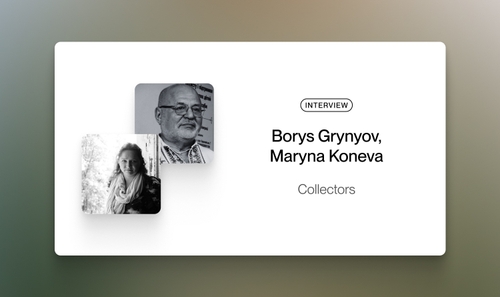
Table of Contents
In a new UFDA podcast episode, Ukrainian collectors and cultural workers Borys Hrynyov and Maryna Koneva talk about what it means to build a living art collection during a full‑scale war — and why they see their work as a long‑term responsibility rather than a private hobby.
From private passion to a public institution
For many years, the Hrynyov collection existed largely out of public view, growing through studio visits, exhibitions, and close relationships with artists. The turning point came in 2016, when a large exhibition at the Yermilov Centre in Kharkiv, accompanied by a substantial catalogue, marked the transition from a private archive to a public institution. Since then, the collection has been systematically documented, digitised, and made accessible online, with Koneva overseeing the continuous expansion of its digital presence.
Hrynyov insists on one core principle: the collection does not sell works. Instead, he and Koneva treat it as a long‑term commitment to Ukrainian art history, steadily acquiring new pieces, lending them to exhibitions in Ukraine and abroad, and donating selected works to museums — from regional institutions such as the Poltava Art Museum to major international venues like the Centre Pompidou in Paris.
Evacuation, risk, and the logistics of rescue
When Russia launched its full‑scale invasion, the collection suddenly became a logistical and ethical challenge: how do you protect thousands of works spread across vulnerable buildings in a frontline region? One of the spaces housing the collection was damaged by an explosion; broken windows and ruptured heating pipes quickly turned the storage into a flooded, unsafe environment for art. With materials in short supply — even basic packing tape had disappeared from city shops — Koneva and a small volunteer team had to improvise, wrapping large canvases in Soviet‑era carpets and loading around 2,000 works into a modest van to move them out of danger.
Today, parts of the collection are dispersed across other Ukrainian cities and in Europe, temporarily relocated for safekeeping. For Koneva, this experience became a lesson in preparedness: she jokes that once the works return to Kharkiv, she wants a storage room filled from floor to ceiling with tape, plastic, and cardboard, so the next emergency will not begin with a search for basic supplies. The evacuation also reinforced a broader point: even the most carefully built collection is fragile in wartime, and preservation requires both infrastructure and quick, sometimes improvised decisions.
Rewriting labels: visibility, Pompidou, and Ukrainian authorship
Before the 2020s, Ukraine’s presence in major Western collections was not just limited — it was often mislabelled. Hrynyov recalls that works by Ukrainian artists in the Centre Pompidou and other institutions were routinely attributed to “Russian” or “South Russian” art, following narratives pushed by Russian gallerists and curators. The multi‑year process of donating a large body of Kharkiv photography to the Pompidou became, in part, an exercise in correcting this record: insisting on Ukrainian authorship, contextualising artists like Boris Mikhailov within the Kharkiv School of Photography, and demonstrating that his practice emerged from a dense local environment rather than an isolated “genius” story.
The donation itself required collective effort. Because the Pompidou cannot accept gifts directly from private individuals, a club of collectors and institutions was formed to formally transfer the works. The war altered the timing: while the legal handover took place in 2021, the public presentation of the “Ukrainian rooms” in the Pompidou was accelerated after the full‑scale invasion, when the museum decided it could no longer postpone showing Ukrainian art. For Hrynyov, this shift is emblematic: where Ukraine once was invisible, it now commands attention — not only through its military struggle, but also via its artists, collections, and exhibitions.
Donating, exhibiting, and rooting audiences at home
While international visibility matters, Koneva emphasises that work inside Ukraine is equally urgent. Since 2023, the Hrynyov collection has been running a long‑term collaboration with the Poltava Art Museum, producing a series of exhibitions under the umbrella of “ancestral memory”. The latest project, titled “And There Will Be People on the Earth” (after a line by Taras Shevchenko), brings together six very different artists to reflect on the relationship between people and land, disconnection and rootedness, and the erasure and recovery of cultural memory.
These exhibitions combine photography, painting, and graphics, including works by key figures of the Kharkiv School of Photography such as Yevhenii Pavlov and Oleh Malyovany. Each show is accompanied by donations of works to the museum’s permanent collection, expanding public holdings beyond capital‑centric narratives. For Koneva and Hrynyov, such gestures are not charitable “extras” but core to their understanding of collecting: a collection that never leaves private storage, they suggest, fails in its responsibility to both artists and audiences.
What does it mean to collect now?
Asked about “underrated” artists in their holdings, Hrynyov resists rankings altogether. For him, inclusion in the collection is already a form of recognition, and public lists of “top names” risk turning art into a competitive sport. Instead, he and Koneva talk about the importance of supporting younger artists early, when their language is still forming and recognition is far from guaranteed — for instance, through collaborations with emerging photographers from Mykolaiv and by serving on juries that can give them visibility and a place in significant collections.
Hrynyov’s advice to new collectors is both practical and counter‑intuitive. If you are collecting “for money”, he says, treat it like a high‑risk financial instrument and be prepared for a long and uncertain game, especially in a country where the art market is still underdeveloped. His own model is different: buy works you are ready to live with in your memory rather than on your walls, think in terms of future exhibitions rather than interior design, and accept that a serious collection will demand time, labour, and care — “like a child you always have to look after”.
In this sense, the conversation with Hrynyov and Koneva mirrors many of the themes explored in UFDA’s episode with artist Mitya Fenechkin: the long shadow of war, the role of digitisation and archives, the ethics of visibility, and the tension between survival, responsibility, and artistic ambition. Together, these episodes map out how Ukrainian art is being preserved, re‑read, and re‑situated at a moment when both its vulnerability and its global significance have never been more apparent.