
Gallery Founder Natalka Yakymovych: Why Serpen in Berlin is Still a Newborn, How she Left Television, and What Ukrainian Art Needs to Grow

Anna Avetova
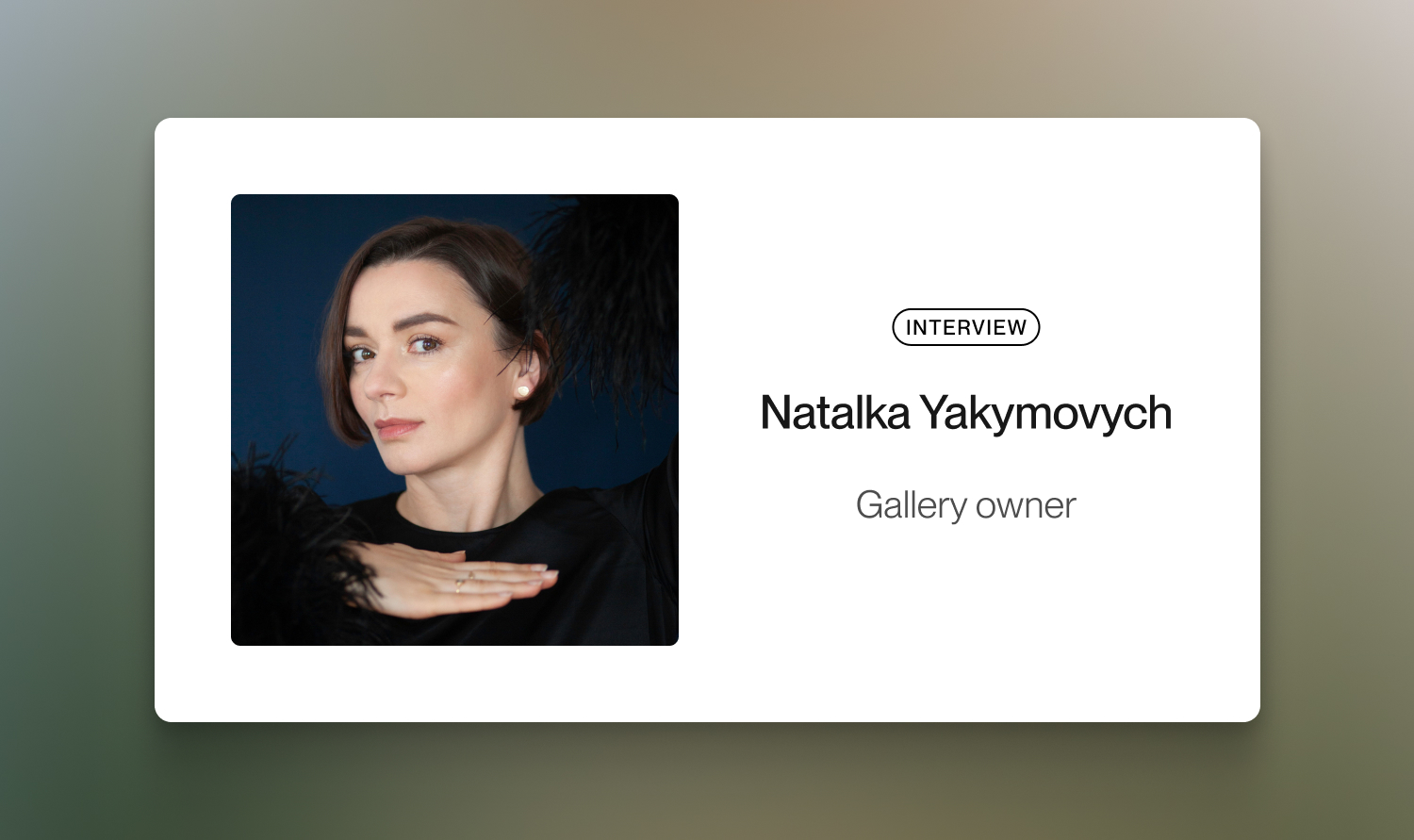
Table of Contents
- From television news to a Berlin gallery
- Why she would not launch an art TV show
- Serpen as a newborn with big ambitions
- Learning that sales do not come immediately
- Working with artists: no to “brilliant but toxic”
- Ukrainian artists in Berlin’s crowded landscape
- Pricing, perception and the problem of “too cheap”
- Physical space versus online presence
- Looking ahead: fairs, light and a long horizon
In a new episode of the UFDA podcast, host Anna Avetova speaks with journalist and curator Natalka Yakymovych, founder of Serpen Gallery in Berlin. The conversation ranges from her decision to leave television after the full-scale invasion to the realities of running an independent gallery focused on Ukrainian art, the slow economics of the art market, and how to build healthy relationships with artists while starting almost from scratch abroad.
From television news to a Berlin gallery
For many years, Natalka worked in television news as an anchor and reporter, driven by a very direct, almost romantic motivation: she entered journalism because she wanted to change the world for the better. Over time, however, the daily routine of news production — “the same thing over and over again,” with very limited agency over what and how is told — led to deep disappointment in the format.
She gradually moved into documentary filmmaking and advertising, shifting from fast news cycles to longer, more reflective forms. The turning point came with the full-scale Russian invasion, when she relocated to Berlin. At first, she imagined the move as temporary and tried to keep managing a Ukrainian team from abroad, but soon realised this felt fundamentally unfair. The decision to resign from television production, she says, was not the result of a long strategic plan but an emotional step that acknowledged a new reality: “If I am abroad, I cannot keep directing people who stayed in Ukraine.”
Why she would not launch an art TV show
When asked whether she would create a television format about art today, Natalka answers directly: no. For her, art remains a niche field that does not attract a broad TV audience, especially in Ukraine, where public investment in culture has historically been low and is unlikely to grow quickly even under optimistic scenarios.
She notes that international examples — specialised art channels, state-supported cultural programming — depend on substantial, long-term funding and clear public interest. In Ukraine, such conditions have rarely existed. High-quality art documentaries require time, access and serious budgets; they cannot be produced “on enthusiasm alone” without compromising quality. As a result, if she had a hypothetical unlimited budget, she would still prioritise projects that either directly support Ukrainian art — for example, documentaries about artists — or investigative formats that address questions of cultural heritage and ownership, such as the whereabouts of Taras Shevchenko’s original works or the fate of paintings once taken on “loan” by officials.
Serpen as a newborn with big ambitions
Serpen Gallery, which Natalka founded in Berlin, is still very young: in her own metaphor, if galleries mature after about two years, Serpen is a newborn that “doesn’t even know how to walk yet”. The project is unusual in that it operates without sponsors or grants; she is effectively a one-person team, responsible for everything from strategy and artist relations to social media, lectures, client communication and cleaning the space.
Despite this, Serpen has already hosted 14 exhibitions in the gallery space alone, along with a series of parallel projects: a sculptural collaboration with URC for Café Kyiv, the “Taste of Art” partnership with premium German kitchen brand Bulthaup, and multiple events designed to draw new audiences into the gallery. Events, she notes, are essential for visibility and community-building but extremely energy-intensive. Her long-term vision for Serpen is clear — she can imagine where she wants the gallery to be in ten years — but she stresses the importance of not rushing, of accepting that growth in the gallery world is slow and resource-demanding.
Learning that sales do not come immediately
One of the most unexpected lessons for Natalka was that gallery sales often do not happen during the exhibition itself, and that working at break-even — or even at zero visible financial return — is initially normal. She entered the business aware that it would not be easy, and that the gallery world is high-margin in theory, but still experienced a strong sense of disappointment after the first year: enormous effort and personal investment did not immediately translate into either sales or recognition from artists and audiences.
She illustrates the long horizon with a story about a show with artist Illya Chichkan. During the exhibition, not a single work from the series sold, despite his existing network in Berlin. Months later, a collector bought the entire series of eight works at once. In another case, a large piece from a young-artists summer show remained unsold and stored away, only to be purchased much later by a friend who had remembered it and assumed it was already gone. These stories shape her understanding of the gallery as “a long game”, where the success of a project is often visible only retrospectively.
At the same time, some highly visible and popular exhibitions can be financially disappointing. A project with a French artist, for example, brought in more than 800 visitors and intense engagement over a month, but due to pre-existing agreements with his main gallery and manager, Serpen’s share of sales was very modest. The experience was professionally valuable and energising, yet “not about money at all” — a reminder that visibility and financial sustainability do not always align.
Working with artists: no to “brilliant but toxic”
For Natalka, the quality of human relationships is as important as the quality of the work. She is explicit about one principle: she does not work with “bad people”, regardless of talent. Given that Serpen runs entirely on her own energy and funds, she sees no reason to “babysit” artists who behave disrespectfully or violate agreements.
She describes herself as open and direct: she does not pretend to be an established authority, recognises her own blind spots as someone relatively new to the commercial art field, and expects the same honesty in return. If a serious breach of trust occurs — even if apologies follow — she treats it as a red flag and prefers to end collaboration rather than accumulate negative emotions. Some artist relationships flow easily without formal contracts; others require more structure. In each case, the key is mutual understanding and a shared sense of responsibility.
Her criteria are not about creating a hierarchy of “good” and “bad” artists on the market; rather, they acknowledge that people are different and that not every combination works. In a context where the gallery itself is what “keeps her going” and gives a sense of mission, she refuses to let personal conflicts overshadow the work.
Ukrainian artists in Berlin’s crowded landscape
Operating in Berlin brings both advantages and challenges. On the one hand, Ukrainian artists are competitive in terms of execution, conceptual depth and pricing; Natalka notes that after visiting three other openings on a single gallery night, she felt genuine pride in the quality of the Ukrainian artists she represents and the way Serpen’s exhibitions look. On the other hand, Berlin is a city with more than 700 galleries and countless independent spaces, with a population comparable to Kyiv. The competition is intense, and many local galleries maintain a presence in Berlin but sell most of their works elsewhere, particularly in cities like Frankfurt.
Language remains one of the biggest obstacles. Natalka does not yet speak German and is only beginning to study it, which complicates deep integration into local networks. Even reaching a basic level such as B1 would, she believes, change her experience of the city and the market. At the same time, she feels there is still a great deal of untapped potential: a growing interest in Ukraine and in Ukrainian artists, a small but real group of non-Ukrainian collectors who follow Serpen, and regular requests for catalogues and updates on specific artists’ new works.
This mixture of opportunity and structural difficulty reinforces her sense that everything in Berlin happens slowly. Media are interested in her story partly because she is an outsider who received no state support and built the gallery independently. That outsider status creates both disadvantages and unique openings that she tries to use thoughtfully.
Pricing, perception and the problem of “too cheap”
The question of pricing for Ukrainian art abroad is complex. Natalka disagrees with the idea that Ukrainian artists are always “much cheaper” than their European counterparts; everything depends on the artist and their trajectory. However, she recognises a structural imbalance: a painter like Oleh Tistol, who has represented Ukraine at the Venice Biennale, may still be priced significantly lower than a German artist of comparable status.
In Germany, pricing often follows a formula: factors such as education, number of exhibitions and work size feed into an index that determines the price. For Natalka, this approach misses a key truth — that art is not mathematics. She knows German artists whose works have become expensive according to the index but who have not sold anything for years, while a Ukrainian artist of equal or higher calibre remains far more affordable.
She also points to a paradox she observed during Berlin Art Week, when Serpen showed recent graduates from the Academy of Arts. Many visitors liked the works but lost interest upon seeing the (modest) prices, reading them as a sign that the art was “too cheap” to be serious. For these collectors, higher prices would have signalled higher status. At the same time, some Ukrainian visitors in Berlin still find entry-level prices of 300 euros unaffordable or unreasonable, expecting works for 50 euros while spending similar sums on dinner. The gallery thus stands between different value systems, trying to set prices that respect both artists and collectors without falling into purely symbolic or purely transactional logic.
Physical space versus online presence
Serpen occupies a historic gallery space on Auguststrasse, one of Berlin’s traditional gallery streets. The location, with its generous rooms and central position, plays a crucial role in how people encounter the work. Visitors who know the gallery only from social media are often surprised by the scale and quality of the physical space, expecting something smaller and more modest.
For Natalka, the physical gallery is irreplaceable, especially for audiences who are just beginning to engage with art. Experienced collectors and interior designers can sometimes buy online, choosing works from photos and measurements, but for newcomers, it is essential to see the works in person, understand their materiality, and talk to someone in the gallery. She is cautious about selling older or technically delicate works purely online, knowing that minor imperfections visible in person might disappoint a buyer who expects a “luxury unboxing” experience similar to fashion or design purchases.
At the same time, she recognises that the Ukrainian art ecosystem — from framing and packaging to shipping and restoration — is still developing. High-quality packaging, custom boxes and conservation-grade materials significantly increase costs; this affects both pricing and the gallery’s ability to meet the expectations of buyers accustomed to premium service. For now, she tries to balance transparency and realism: explaining what is possible, where compromises are necessary, and why sometimes it is better to invest in the artwork itself rather than in elaborate packaging.
Looking ahead: fairs, light and a long horizon
Participation in art fairs is part of Natalka’s long-term plan, but not an immediate priority. She is preparing to take part in a fair in Berlin as a kind of training ground, already noticing how every detail — from lighting to furniture — adds new costs on top of the booth fee. Given the current price range of artists she represents, she doubts that large, expensive fairs in other countries would be financially justified in the near future without substantial sponsorship. For many established German galleries, she notes, fairs are more about prestige and visibility than about direct profit.
Instead, her next steps are concrete and grounded: improve the gallery’s website, upgrade the lighting to better professional standards, and continue building a stable base of collectors and collaborators. She jokes that if Serpen is not a “wunderkind”, then looking toward major international fairs makes more sense on a five-year horizon, not immediately.
Throughout the conversation, one thing remains constant: a combination of clear-eyed realism and stubborn optimism. Natalka knows that running Serpen is exhausting, financially risky and emotionally demanding. Yet she also experiences it as a mission — a way to support and show Ukrainian art in a city where “everything exists and there is room for everyone”, and where her newborn gallery is slowly learning to walk, and eventually, she hopes, to run.