
"The Only Thing That Makes Us Equal Is Vulnerability": A Conversation with Kateryna Lysovenko

Lesia Liubchenko

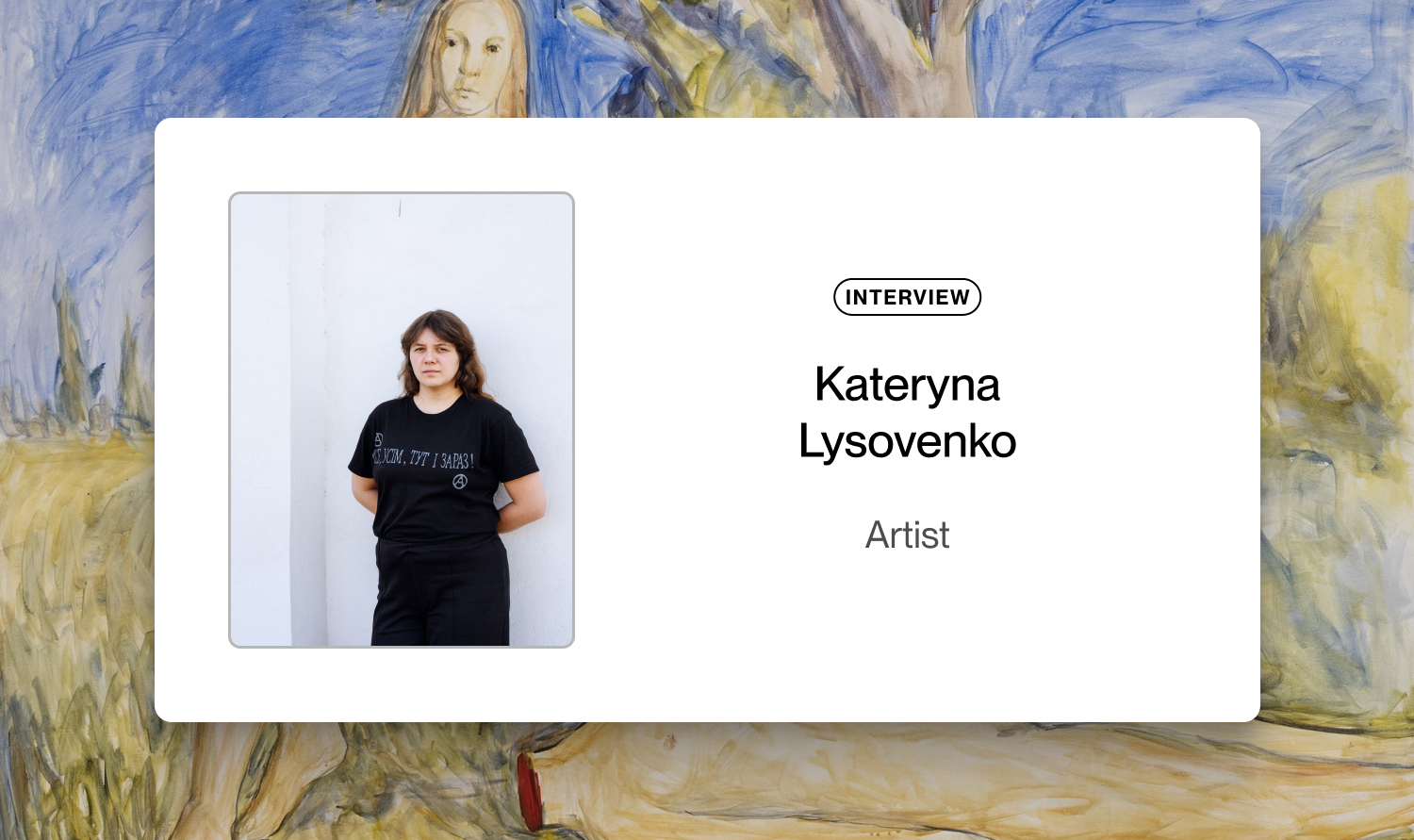
Interview conducted by Lesia Liubchenko, Content Lead of UFDA.
This interview is also available in Ukrainian. Click here to read it.
In Kateryna Lysovenko's painting, the body becomes a site where personal experience meets grand history. Her works bring together a feminist perspective, religious imagery, and a political reflection on violence, war, and human nature. In this conversation, the artist speaks about the differences between art education in Ukraine and Austria, working within an international context, the transformation of her artistic language after 2022, and why it is important for her today to "paint vulnerability".
Lesia: You studied both in Ukrainian art institutions and at the Academy of Fine Arts in Vienna. In your opinion, what is the fundamental difference between approaches to art education in Ukraine and in Austria?
Kateryna: I should clarify that I only studied at the Academy in Vienna for a year and a half before leaving. I realized that I had already gained what interested me, and given my work and raising children, I don't currently see an opportunity to continue my studies. As for differences in approach, I can only compare the Ukrainian institutions where I studied: the Grekov Odesa Art School and the National Academy of Fine Arts and Architecture in Kyiv. I also spent a year at the Faculty of Art and Graphics at the South Ukrainian National University in Odesa.
The problem is that our state academies remain, to a large extent, unreformed since Soviet times. The main goal of both the college and the academy is to teach the technique of painting or sculpture in a specific manner. There is what is called a school. At the Kyiv Academy, no one will say outright that we study socialist realism — they say we have "our own school". But in essence, it is still socialist realism. You enter and are expected to learn the methods of this school, to become a good student of it. And when you try to experiment, teachers of the old guard will tell you: "Once you've finished your studies, then you can experiment. For now, your task is to master the craft. You'll have time to find yourself later".
At the same time, there were exceptions among the faculty — Nazar Bilyk, Andrii Tsoi, Andrii Bludov. These are artists who experiment themselves, and they showed us alternative ways of working, encouraging us to search for our own path. But such people are rather rare cases. Some of them, like Taras Kovach, do not even work at the academy as teachers. It is difficult for them to remain within the system. So exceptions exist, and they help sustain it, but the structure itself has not changed.
In reformed educational systems — such as in Poland or Austria — the situation is different. Art schools and colleges provide fantastic technical training in painting and sculpture, offering a strong material base. The role of the academy (both classical and contemporary), however, is to give a young artist space to search for themselves.
A contemporary academy should function as a laboratory. It should provide both material resources and an environment where, over five years, you can research, make mistakes, and develop your own artistic language. People graduate ready to work with galleries and contemporary institutions, because during this time they are essentially studying contemporary art.
Here, by contrast, a person spends five years struggling against the system, suffering, and trying to become a worthy representative of the so-called school. Interestingly, when Ukrainian students enter Western academies, they sometimes lack precisely this kind of "discipline". There, a professor will never tell you exactly how to do something. It is your task to understand how you want to work. After a rigid system, this can create a sense of disorientation, as if you were a child again. But that is precisely the task of an artist — to find yourself, to construct something out of this emptiness, or to find collaborations, people you can work with.
The Austrian Academy also gives you the opportunity, if needed, to acquire a specific skill — say, sculpture or life drawing — by taking the appropriate courses. Or you can choose something else entirely. It truly is a laboratory. Of course, there are formal requirements — you need to earn a certain number of credits per semester to move on. But how you get there is entirely up to you.
Lesia: When it comes to professional opportunities, what exactly can Vienna and the Austrian context more broadly offer you as an artist — in terms of paid work, exhibition opportunities, or further development of your skills?
Kateryna: The career situation of a young artist is more or less the same everywhere. Art does not start bringing in money right away. It's not like you decide to become an artist and opportunities and money suddenly start falling from the sky. Both in Austria and in Ukraine, there is a long period — five to seven years — before your practice begins to yield any financial results.
Globally, the statistics are similar: only about 3% of art school graduates make a living exclusively from their art. Everyone else combines their artistic practice with side jobs — often in the creative industries, design, or teaching. So the overall model of how an artist sustains themselves is quite universal.
In Austria, it's not easy either. If you're in your early twenties, newly enrolled in an academy and still developing your practice, you will almost certainly need a part-time job. Sometimes the academy itself can offer some work, but there are many applicants, so most students look for jobs on their own.
If you arrive with an already established practice, another problem arises: in a new place and a new context, no one knows you. You essentially have to start from scratch — build connections, attend openings, introduce yourself, and develop a new network. You have to go through this process all over again. It's a difficult experience, and it's not just mine — many people who relocate feel the same way.
At the same time, Austria has a system of grants and scholarships. You can apply for residencies, funding, and support from various institutions. But again, there are many applicants and limited spots. And here, just like in Ukraine, those who are already known tend to be selected. If you're still a no-name, your chances are slim. In a way, it's a kind of lottery.
What truly distinguishes Austria is its cultural policy. There are more galleries, and the art market is more developed. Young artists immediately think of themselves within an international context and try to develop their careers across several countries at once. For example, when a major exhibition takes place in Austria, Poland, Germany, and so on, curators from neighboring countries may be specifically invited to attend (and this is often done not by the institution hosting the exhibition, but by the Ministry of Culture). Their travel and accommodation are covered so they can discover new names. It makes such a difference for artists trying to grow under these conditions.
In Ukraine, for a long time, the situation was different: you could create very strong projects, but they were mostly known only within your immediate circle — colleagues and friends. And that did not help you get invited to international platforms. Now, during the war, this has changed to some extent — there is more attention, more collaborations between Ukrainian and Western curators. But we still lack a clear strategy and the resources to work in this direction, to bring curators from abroad to Ukraine. This is something that, to a limited extent, is being done by PinchukArtCentre.
Lesia: I'd like to return later to the topic of European art institutions, but for now I'd like to move directly to your practice and to the works that were digitized by UFDA. I personally find your works where you sacralize experiences of mental disorders (and not only those), such as "Saint Panic Attack" or "Most Holy Postpartum Depression", very resonant. Could you tell me how the idea for this series emerged?
Kateryna: I'm in psychotherapy now, and I was in therapy back then as well. It was important for me to reflect on the connection between mental disorders and feminist issues. I would like to return to this topic in the future and develop it further in a new way.
For me, it is a very personal subject. Since childhood, I had certain psychological traits that made people see me as strange, and this led to bullying. Later, I learned that what I was experiencing actually had names — dissociation, panic attacks, hypochondria. And the very fact that these things could be named, that I could read descriptions of them, helped me a lot. When you understand what is happening to you, you realize that something can be done about it. And that it doesn't make you or others bad.
It seemed to me that in Ukraine many women experience various mental difficulties due to challenging life circumstances. My art is, to a large extent, built on trauma. I felt that this was my position — that I am someone who speaks from within trauma.
And now everyone has gradually started talking about it. With the beginning of the full-scale war, I saw how the theme of trauma became shared — how everyone began to experience psychological difficulties, how everyone became traumatized. And almost all art became art that speaks from a position of trauma, because many people gained this experience. It even gave me a kind of identity crisis (I'm joking), because now I'm no longer "the sickest child in the room". This condition has become collective — everyone has some kind of difficulty now, unfortunately.
I thought that articulating my own experience might help me connect with others and understand each other better. And to some extent, it does. But at the same time, mental disorders are very isolating. They make communication difficult, they create a sense of separation. Not everyone is ready to name or acknowledge their condition, to work with it. And not everyone is able to overcome that barrier and speak with others. Unfortunately, when you develop mental health issues, you can become isolated for a long time.
I don't have a clear answer right now as to what to do about it. It seems to me that the ability to try to move beyond one's own experience, to understand others, to put yourself in their place — that is, in a way, a sign of health. But now this topic needs to be rethought. Before, it was directly connected to my own life and my own struggles. Now, we are all in a situation of extreme survival and constant stress.
Lesia: In many of your works that feature mythological or religious motifs ("The Saintly Woman Shares Eyes with a Hero"), as well as pastoral ("Katia and Yan in the Briukhovytskyi Forest") and utopian ("Resting on the Monument of Friendship of People") themes, the nude body occupies an important place. What does corporeality mean in your artistic language? Or what did it mean at the time these works were created?
Kateryna: For me, painting is, first and foremost, a product of the human body. And in my practice, turning to the body is absolutely essential. The body is what experiences trauma, what lives and expresses its own subjectivity or, conversely, undergoes objectification. In that sense, the body is always political, and corporeality is political as well. And I wanted to work with that.
As Gilles Deleuze said, to paint flesh is, in a way, the very task of painting as such. Throughout history, this has been a classical concern for artists: to convey one's own sensation of flesh and to explore what it is connected to.
At the beginning of my practice, I worked more with the general idea of what the body is, what place it occupies within different ideologies, how the body of a victim, a hero, or a perpetrator is constructed. Over time, I became more focused on structural questions: how to convey different states of the body, its various positions within society, or how we look at the body more broadly and what it signifies.
To be honest, I don't really know what corporeality means in a generalized sense. For me, it encompasses everything; everything humans create is corporeal. Because we create it in relation to our bodies and through our bodies.
Lesia: In 2021, several of your large-scale works were presented at an exhibition at Voloshyn Gallery. In one review, they were described as an example of "tender monumentalism" — that is, a combination of altarpiece structure, sacrality, mythological elements, and at the same time the humanity of the figures, without excessive pathos. Do you feel this description is still close to your practice today, especially in a reality that has become more brutal?
Kateryna: It seems to me that this war has created a kind of void in all of us when it comes to believing in people. How do you love people now? Whom do you love, and whom do you not? How is it possible to love some and not others? Because this "tender monumentalism" was rooted in my belief that society could be strong, non-narcissistic, and gentle. The project was called "My Dream World Propaganda". I wanted to imagine a world without the figure of the victim — because there is nothing wrong with being, for example, a sheep or anyone else. Whoever you are should not be a reason for your destruction.
But now the war undermines these dreams. When you see the atrocities committed by Russians — from direct attacks, killings, and rape to missile strikes on civilian cities or even the deliberate attempt to freeze Kyiv — it creates total disillusionment and emotional swings. And yet, within this darkness, I also see the incredible strength of good people who fight and sacrifice themselves to protect others and make someone's dreams possible. Kindness becomes incredibly powerful in such times, but at the same time, brutality also reveals itself to the fullest.
My experience as a refugee and migrant in Austria also forces me to rethink humanity. For example, I see how people of different skin colors or from other cultural backgrounds live here, and at the same time there is quite strong Islamophobia. This country has already gone through fascism, has destroyed many lives, and knows how dangerous it is, yet the same kind of atmosphere as in the 1930s can still be felt. So, to be honest, I can no longer paint a world where everyone is kind and gentle. I have to rethink my views, because now it is difficult to say what a human being is and what is inherent to them.
I see that in any society there is always a group of people who agree with the majority because they want to feel right, to say what is expected, and there will always be a group that resists. Even in democratic societies, there are people who long for authoritarianism. Take Ukraine, for example — it has never been an imperial state. We have to acknowledge that it was authoritarian during the Soviet period, and that authoritarianism in Ukraine was also built by Ukrainians. But Ukraine did not have imperial ambitions. So it is possible to be a non-imperial nation.
My position now is that I paint vulnerability. It is important for me to find what makes us equal. Before, it was love and tenderness toward everyone: everyone deserves to be loved, to be happy. Now, it seems to me that what equalizes us are our insides — our guts and bones. Imperial and non-imperial nations share the same internal anatomy. Missiles kill everyone in the same way. The ideologies of imperial nations conceal mortality and vulnerability, promising only strength and the ability to kill others. But it is never the case that someone who goes to wage an aggressive war only kills and never dies themselves.
Travels through Austrian villages and cemeteries were a revelation for me. For us, they were Nazi occupiers, and we know how many Ukrainians and Jews were killed. But at the same time, I saw that the occupiers themselves also died — sometimes in large numbers, like flies. For example, in one Austrian village, out of 100 people, 50 were sent to war and died within five years. It seems to me that the ideology of imperial nations blinds people: it makes them think that only others will die, while in reality everyone dies — this is simply concealed. These losses are not discussed, even though they were someone's fathers and sons.
So now I think that the only thing that makes us equal is vulnerability. That is what I work with now, because I no longer know what else I can work with. Everyone's blood is red, and everyone feels this confusion: "What should we do?" This is not a naïve idea of equality, as if everyone were the same. Of course, people have different levels of power and resources. For example, Russia has more weapons, more people. But those who start wars always end up with wars at home. This mechanism keeps moving, and I don't believe it can be controlled. For me, vulnerability is also a kind of promise — that all of us are equally vulnerable.
Lesia: In your opinion, what makes your paintings strong statements? Is it color, technique, composition, or something else?
Kateryna: That's a very difficult question — what makes a work strong. It's hard not to slip into some kind of neurotic answer here. I simply set tasks for myself. It seems to me that it's important to formulate them clearly, not to overload a single work with too many objectives.
Lesia: By the way, you mentioned blood. And it seemed to me that over the past few years your relationship with color has changed. In works from a few years ago, there's a lot of blue or white, and overall they feel quite light. But now, on your Instagram, I see intense red works — bright, very striking.
Kateryna: It just happened that way. The technique presented in the works on your site emerged back in 2018–2019, and it was a conscious approach. By 2021, I had started to feel constrained by it, but I didn't change it. I was afraid and didn't know where to move next. When the war began, that approach turned out to be very effective, because it had been developed to speak about the dead and about violence — and so I stayed with it for another year.
And then it started to feel limiting again. At the academy, I studied oil painting, and I really love oil for its materiality and possibilities. Later, I wanted to pursue painting, but not in the way it was taught at the academy. I first worked with acrylic on paper, then returned to canvas, and eventually to oil.
It was a kind of post-academic quarantine, during which I limited my palette to four colors: red and yellow ochre, ultramarine, black, and white. Now I've returned all the colors to myself. For some reason, I feel drawn to painting in red. It's not always the case, and not all the works are red, but my new black is red. Perhaps because this color can convey pain, joy, pleasure, and life all at once. It suits this perfectly.
Lesia: I'd like to return to the question of Ukrainian and European contexts. Do you feel that abroad there is often an expectation that Ukrainian artists will produce a certain visual language of war? And, on the other hand, does it seem to you that in Ukraine, artists who exhibit abroad are burdened not only with representing national art, but also with a kind of mission — as if what they show must be exceptional, extraordinary, capable of convincing everyone?
Kateryna: I was often told — even by my contemporary art teachers — that something is expected of us abroad. But I see that, in reality, there isn't always a clear or specific expectation. Personally, I am not currently living in a war zone. And yet, it seems to me that we are still perceived abroad as carriers of an extreme, almost beyond-the-limit experience. In that sense, it's similar to how artists from other countries marked by war or crisis are perceived — we are neither the first nor the last. Our art is viewed through this filter, regardless of what exactly we do, even if we already live abroad and have the experience of displacement.
In discussions about those who have left, you sometimes hear the argument that if you move abroad, you automatically become, say, an Austrian artist. But that's not really the case. Here, you are still perceived as a Ukrainian artist, as someone who carries a particular history and set of contexts. People often already have a formed image of this war, or certain biases, and they will look at your work through their own lens — through their own thoughts and understanding of what is happening.
In my view, both in Ukraine and elsewhere, many people no longer believe they can truly communicate this experience to others. During the first year of the full-scale invasion, we tried to explain, to make things understood, but it changed very little: the war continues, and nothing seems to stop Russia. So there is a sense in Ukraine that this experience cannot really be shared, that it is, to some extent, hermetically sealed. Of course, there are exceptions, but overall this is the attitude I observe.
Right now, I am reading many diaries from the time of World War II. One writer, a former concentration camp prisoner, wrote that trying to imagine this experience from the outside is like a blind person trying to describe colors. Some things can be imagined, but others cannot. There are things that simply cannot be understood without living through them.
So it seems to me that this is not a moment when we should expect that such an experience can be fully explained or conveyed. In Ukraine, people often look at those who are abroad through the lens of their own experience. And people abroad look at those living in Ukraine through theirs. Whether this kind of mutual determinacy can be broken through at all — I honestly don't know.
Lesia: Do you feel a difference between collaborating with Ukrainian institutions and Western ones? If so, what does it consist of?
Kateryna: First of all, there is a difference in working communication. In the West, people rely much more on email — almost everything is discussed via e-mail. At first, this felt unusual to me, because in Ukraine correspondence tends to be much less frequent.
As for curatorial control, to be honest, there is no clear-cut difference — it all depends on the individuals involved. I've had curators in the West who exercised quite a strong degree of control over the process, and others who fully trusted what I was doing. The same applies in Ukraine: there are curators who intervene more, and those who give the artist complete freedom. Many Ukrainian curators also work abroad, so these approaches often overlap.
Perhaps a more tangible difference lies in financial resources. In the West, artist fees are more often part of the structure, whereas in Ukraine they tend to be either significantly lower or absent altogether.
Another important aspect is exhibition catalogues. In the West, they are regularly published after exhibitions, while in Ukraine this happens much less often — again, due to limited funding. As a result, many strong projects remain largely in memory and are sometimes documented much later, in the form of retrospective publications.
Lesia: Sometimes press releases for exhibitions don't include photographs or any images, only a textual description. In that case, it can be quite difficult to imagine what was actually shown — especially if you don't have the opportunity to visit the exhibition in person.
Kateryna: It seems to me that exhibitions abroad receive more media coverage, perhaps also because the budgets are larger. Magazines are published, and there are more articles about exhibitions and artists. In Ukraine, this exists as well, but it seems that more is written about art abroad. At the same time, the situation here is gradually changing: there are authors who write about art on a regular basis — for example, Katya Yakovlenko and Oleksii Minko.
Lesia: If it's not a secret, which private or institutional collections currently hold your works? Are any of them accessible to the public?
Kateryna: My works are in various private collections, some of which are open to visitors. They are also part of public collections: at the Museum of Modern Art in Warsaw, the Ludwig Museum in Budapest, Neue Galerie Graz, the Stedelijk Museum Amsterdam, the Odesa Art Museum, and also the Museum of Art in Łódź, which holds two of my works.
Lesia: Last year, we spoke with Oleksandr Kryzhanovskyi, and he mentioned that, in his view, Austrian collectors tend to buy mainly domestic artists, only rarely turning to foreign ones. Have you noticed such a tendency?
Kateryna: Only two Austrians have bought my works. One of them owns works by other Ukrainian artists as well, while the other is connected to art fairs. In fact, Austrians don't buy only Austrian artists — they also collect international ones — but, in my view, they do so for two main reasons.
First, it's a matter of taste. There is a distinct aesthetic in Austria that leans toward abstract art. There is also a local school and tradition dating back to the 1970s–80s, and collectors are shaped by this background. So they tend to buy works that align with it. Second, it's about recognition. Austrians often purchase something already well established — works by artists with a recognized status.
So Austrian collectors tend to buy either what fits their taste or what already has an established position. This is less about the artist's nationality and more about an investment-oriented approach to collecting.
In the West, very few people buy a work simply because they like it. Purchases are usually driven by specific reasons. Every serious collector has a curator for their collection, which is developed as a coherent project with a concept and a clear structure. So acquisitions are not random or spontaneous, but planned and structured.
Lesia: By the way, how have you defined your own "red lines" when it comes to working with institutions or curators? What are you not willing to agree to in a collaboration?
Kateryna: If these people are connected to the Epstein files, to dirty money, or to Russian money. I had a conflict with the curator Katya Inozemtseva, even though the funding was German and it was a German museum. She was one of the invited curators. Before that situation, I didn't sit around researching people online. Now I do look into where someone has worked, what they've said, what kind of statements they've made.
In Katya's case, it seemed to me that we were on the same wavelength, that she understood me. But it turned out otherwise… To realize a project that wouldn't provoke anger among Ukrainians, she would have needed to involve Ukrainian curators and publicly apologize for statements she made back in 2017.
In short, there are many "red lines". I think it's easier to say that I want to work with ethical curators.
Lesia: So, people who won't expose you to reputational risk?
Kateryna: I was actually thinking about this… In fact, not exactly. Of course, it's a complex issue, because reputational risk is tied to values we share or to social values in general. It seems to me that reputational risk is a very broad framework, because it manifests differently in different societies. So it's important to rely on your own ethical framework, rather than only on external reference points.
It's interesting that almost any action can carry reputational risks: speaking about Ukraine or about something else — any of this can provoke a negative reaction from people who don't want to engage with topics like war, militarism, or others. Even when you do something important for many people, it's impossible to please everyone. People are different, and so are their values.
Lesia: And what about subjects or modes of expression that you would consciously never turn to — some kind of internal boundaries within your practice?
Kateryna: There are things I simply don't feel and can't imagine. I've thought about this. I haven't experienced what it's like to sit in a freezing apartment, so I wouldn't make a work about it. I haven't experienced the moment when someone is trying to kill me, for example. I did experience violence and a threat to my life during the first week of the full-scale invasion. At the same time, because I have experienced violence in my life, I can imagine what a person might feel when they are being killed face to face, without the mediation of missiles — and I can convey that in my work.
In short, my boundaries are the limits of what I can understand and imagine… Sometimes you can work intuitively — something ephemeral pulls you in a certain direction, you don't fully understand what it is, but you begin to work. But when it comes to experiences where I don't feel grounded, I won't engage with them.
Lesia: Thank you for your openness. I'm very sorry that you went through violence.
Kateryna: It's okay.
Lesia: You actively share your works on Instagram, and it seems that for many artists today it has become a kind of exhibition platform in its own right. What value does it have for you, especially in comparison with a traditional exhibition space?
Kateryna: Instagram, or any similar platform, allows you to show your work to many people at once. This is especially important when it comes to politically urgent work that responds to what is happening here and now — you can share it immediately, without waiting four months for an exhibition to open. And people who won't be able to travel to another country to see the show still have a chance to see at least something. Of course, a small image on a phone can't convey a two-meter painting, but it gives at least a partial sense of it.
Lesia: You mentioned that you've been reading many diaries from World War II lately. More broadly, what do you rely on today in your reflection on art? Literature, art historians, philosophers? What do you turn to most often?
Kateryna: For me, reflecting on art is not only about everything I've read or heard — not just books or advice from mentors. Conversations with colleagues are also important — we live through this experience together. I enjoy listening to interviews with artists I admire, as well as podcasts made by my friends.
A number of critical and feminist philosophers are important to me, because they engage with the kinds of topics I work with. Since the beginning of the war, I've had trouble concentrating — as, I think, many people have. So close reading has become difficult: sometimes I can go almost a month without really reading anything. When I feel my focus slipping, I switch to something easier.
I read a lot of women writers, including Susan Sontag, Virginia Woolf, and others. Recently, I read a wonderful book by Linda Nochlin, "On the Body", which deals with the fragmented body and modernity. It's a very important work, and Linda Nochlin herself is an important figure for me as both an artist and a feminist.
I also read various articles — both Ukrainian and international. Even when it's hard to concentrate, I try to keep reading, because for me it's a kind of mental hygiene.
Lesia: So, for you, literature is a tool that allows you to revisit and rethink what currently demands inner reflection.
Kateryna: I try to find different kinds of books. Some resonate with what is troubling me now — for example, those same diaries from the time of World War II. Others were written in more peaceful times — slow, expansive novels created before World War I. Both are important. Large-scale novels help restore a kind of burned-out sensitivity. And then, when such a book begins to feel empty — when you can no longer tune into it or grasp what the author is writing about — you turn to diaries instead. They offer a sense of a direct, quiet human voice, someone living through their own time. And that voice resonates with what unsettles me now.
I'm drawn to reading those who reflect on events in their own voice, without filtering them through large theoretical frameworks. Of course, analyzing war through the theories of Karl Marx, Jacques Lacan, Sigmund Freud, and others is also interesting. But right now, I'm more interested in a personal perspective: what people thought on their own, why war happens, why people act the way they do.
It seems to me that in our world (and this is something written about by Marx, Lacan, Freud, and others), everything that is possible can happen. If it is possible for one country to attack another, it will happen if the conditions for it exist; if a missile can hit a target, it will. In such moments, reality feels exposed — almost as if it moves beyond ideology, beyond everything. Reality is far larger and more terrifying than the words we use to describe it. And it is precisely this exposed quality of reality that I want to approach now, to think about how to think about it.
Lesia: And when it's difficult for you to work, what usually helps you keep going despite everything?
Kateryna: The fact that when I don't work, it feels even harder. When it's difficult to work — for example, when I feel tired of a particular project — I try to switch to something else. Or simply to understand what's going on: maybe I'm overheated and just need a couple of days off. Sometimes the work itself is very demanding, and then it's better to do something smaller and more spontaneous — something I feel like doing right now. Often it's just the difficulty of the task or simple exhaustion. And sometimes it's fear: you have an idea, but you're afraid it won't work out. That, too, can make it hard to work.
Want to read the interview with Kateryna Lysovenko in Ukrainian? Click here.