
Lesia Khomenko: On the Journey from Kyiv Art Academy to New York

Anna Avetova
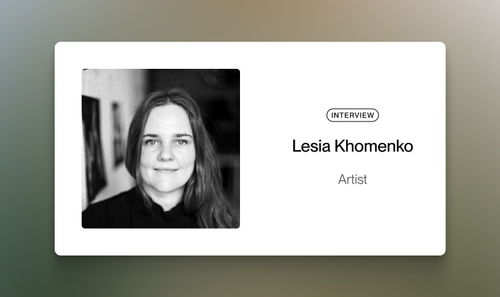
Table of Contents
- After the station: when the body says “stop.”
- Deadlines, panic, and the fear of the blank
- New York, FOMO, and a long-run practice
- “Imaginary Distance”: a mid-career exhibition
- From experiments to an artistic programme
- From “periphery” to a new visibility
- Commerce without creative compromise
- Galleries, tours, and endings without drama
- Archives, blockchain, and the “person-institution”
- A city where everyone works
n a new episode of the UFDA podcast, artist Lesia Khomenko speaks about living between New York and Kyiv, creating a monumental work for Kyiv’s central railway station, and preparing a mid-career exhibition at PinchukArtCentre that gathers twenty years of her practice. It is a conversation about surviving extreme pressure, refusing easy compromises, and holding onto a long-term artistic programme when life constantly pushes you off balance.
After the station: when the body says “stop.”
Lesia admits that after her most recent large-scale project she simply collapsed: for a week she could barely get out of bed, and the day of our recording was her first “proper” day back on her feet. The massive public work at Kyiv’s central station — a 21-by-12-metre painting based on real footage of people on an escalator — became the final sprint in an already exhausting marathon.
The scariest moment was not the technical risk of installing a canvas of that size, but the day chosen for it: they began hanging the work immediately after the funeral of artist Davyd Chychkan. Moving straight from the cemetery to the station, between personal loss, collective grief, and the necessity to “just keep working”, she felt she was approaching an almost physical breaking point. For several days her body refused to cooperate: shaking, a fear of being ill, and then a slow, stubborn return to the studio routine.
Deadlines, panic, and the fear of the blank
The station project and the trench painting for the exhibition “Imaginary Distance” at PinchukArtCentre unfolded in parallel and under severe time pressure. The institution provided exactly what she needed: an institutional framework, production support, and a museum context that could hold works of such ambition.
At some point Lesia and her team drew up a detailed step-by-step schedule and realised that the real time available was much shorter than it had felt in theory. Panic attacks became, as she puts it, “like an itch”: a constant background she tried to ignore. The format — 21 metres by 12 — meant she literally could not see the painting as a whole. The half-length figures nearest to the viewer were six metres tall; from her own height she could not see them entirely, which created a persistent sense of losing control over the image.
To avoid last-minute surprises, she invited friends with a drone to film the work from above while it was still on the floor. Almost nothing had to be corrected, yet the feeling that “everything could fall apart at the very end” stayed until the opening. In parallel, she had to cancel a series of interviews: after one or two media appearances, a 12–14-hour workday in the studio simply became impossible.
New York, FOMO, and a long-run practice
Today Lesia is based in New York, working full days in the studio while keeping close ties to Ukrainian institutions and projects. The city is both a dream and a pressure cooker: an endless list of openings, talks, and social obligations, and a constant FOMO shared by almost everyone around her.
Her answer is simple and strict: work early in the morning, not late at night. During the most intense deadlines, she shifted to a “5 a.m.” schedule instead of staying in the studio until 3 or 4 a.m., because the next day would otherwise be lost to recovery. She calls herself a workaholic and insists that without calculating one’s strength in long run mode the practice will burn out quickly. In this sense New York reminds her of pre-invasion Kyiv — a place where everyone “overworks by default” — only here the density of players and events is even higher.
“Imaginary Distance”: a mid-career exhibition
Parallel to the station work, Khomenko was preparing a solo exhibition at PinchukArtCentre that she describes as a mid-career show rather than a retrospective. Curated by Björn Geldhof, “Imaginary Distance” brings together more than fifty works from 2005 to the present, tracing her evolution while refusing a simple chronological narrative.
For Lesia it was crucial to show painting without the usual impulse to “hide” it in installations or overloaded spatial scenarios. She wanted a certain minimalism and focus on each individual work so that catharsis would come from painting itself — from the scale, the brushwork, the surface — rather than from a mass of elements. Among the pieces on view are recent monumental canvases and “archival” works like the Superstars series (2005), based on snapshots of late-night gatherings of a young Kyiv art community.
She had deliberately kept these early paintings in her archive for years, waiting for the right moment to show them as time capsules. Now only part of the series is exhibited; the rest can reappear in another twenty years, marking both duration and consistency in her programme.
From experiments to an artistic programme
At the beginning of her career Lesia worked across many media: video, performance, installation, photography. Her long involvement with the R.E.P. group effectively gave her a “second biography”: collective, multimedia, politically charged projects developed alongside her individual painting practice.
Gradually she began to filter ideas more rigorously and to ask which of them really belonged to her own programme. Deciding to focus on painting was not a renunciation of experimentation; it was an admission that this is where she can produce her strongest work. Over time this gave her the confidence to let even the brightest ideas go if they did not fit that long line — to say “no” not because something is weak, but because it is simply not hers.
From “periphery” to a new visibility
A few years ago Khomenko wrote about the marginality of painting and of Ukrainian culture itself, stuck in a peripheral position with limited access to global infrastructure. Looking at Ukraine from New York in 2026, she believes this description no longer works. The country has been redrawing the global security architecture, and culture cannot remain in the role of an afterthought.
The full-scale invasion pushed many Ukrainian artists into international visibility — often through tragic circumstances, but with very concrete aesthetic and ethical consequences. Structural problems remain: there is still a dramatic lack of contemporary visual arts education and of stable systems of support and archiving. Yet access to information is now far wider than when Lesia started in 2005, and global competition shows that uncertainty and precarity are not uniquely Ukrainian conditions but a shared feature of the profession.
Commerce without creative compromise
Asked about “commercial” versus “institutional” artists, Lesia responds with disarming clarity: she does not create works specifically to sell, but she collaborates with galleries that sell what she makes anyway. Six years of teaching were a conscious decision to have a financial backbone that allowed her to avoid artistic compromises. She does not see sales as shameful; on the contrary, if you are proud of your work, being paid for it is simply part of a professional life.
Her teaching included very pragmatic components: courses in 3D and other tools that would give students skills to earn money while continuing their own practices. In her own generation, occasional commissions — anonymous commercial painting jobs done in a week — helped her and her peers survive a month without thinking about money. The danger, she notes, is letting such work swallow the practice entirely, as happened to many talented artists in the 2000s when the first local art market boom arrived.
Galleries, tours, and endings without drama
Two galleries have been particularly important for Khomenko: Voloshyn Gallery in Kyiv and, until recently, Friedman Gallery in New York. With Voloshyn she continues to work closely: the gallery has been moving fast onto the international fair circuit, placing works in museum collections, and preparing her solo exhibition in Miami.
Her collaboration with Friedman Gallery, on the other hand, was central to the emergence of the touring show “Women at War”, curated by Monika Fabijanska. The exhibition, which brought together Ukrainian women artists responding to war, travelled across university museums in the US and Canada and became one of the earliest visible Ukrainian projects in the American context after the full-scale invasion. Later the gallery’s programme shifted more decisively towards non-white and decolonial positions, and Lesia’s work no longer fit this frame. The collaboration ended slowly, without conflict — as a natural closure of a fruitful chapter.
Archives, blockchain, and the “person-institution”
Archiving is a sensitive subject for Lesia. She has watched important institutional websites disappear and digital collections survive only thanks to the personal dedication of specific people. The example she often recalls is the Centre for Contemporary Art (the former Soros Center) in Kyiv, where the archive depended on directors who kept the institution alive on sheer enthusiasm even after funding ended.
One model she admires is that of curator Monika Fabijanska, whom she describes as a “person-institution”. For every project, Fabijanska maintains not only a well-structured online presence but also PDF documentation and printed sets of materials in several copies — a low-tech but very reliable backup in case websites and galleries close down. It is a reminder that digital storage alone is never enough.
In this context the UFDA’s interest in blockchain feels close to Lesia’s concerns. The idea of linking high-resolution images and authorship data to a ledger that cannot be altered or erased offers one answer to the fear of disappearance. Yet she underlines that technology is only half the story: any long-term archive also needs legal frameworks of responsibility and succession — clear answers to the question of who will be obliged, in ten or fifty years, to migrate the data to whatever medium comes next.
A city where everyone works
The conversation returns, in the end, to New York as a city where almost no artist lives without some kind of day job. Fully “full-time” artists do exist, but they are exceptions; most people combine studio work with teaching, design, technical jobs, or entirely different professions. In parts of Europe the situation is somewhat softer — strong grant systems in places like Germany allow more artists to focus primarily on their practice — yet financial instability remains the rule rather than the exception.
What has changed, Lesia notes, is the climate of solidarity. In New York, in Europe, and increasingly in Ukraine, artists share contacts, recommend each other, open doors instead of guarding them. Within this landscape her own story is that of an artist committed to the long run: someone who accepts that the profession is “never sweet”, builds a programme that can withstand massive canvases and fragile archives alike, and keeps working between cities, institutions, and time zones without letting go of painting.