
Liona Radchenko: How Art Holds Us Together During the War

Anna Avetova
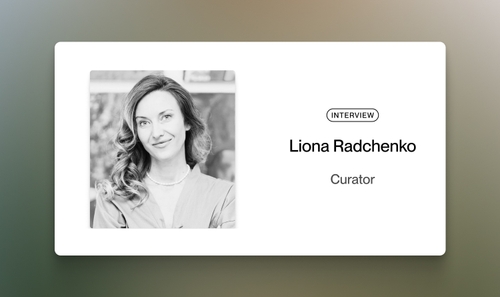
Table of Contents
In a new episode of the UFDA podcast, cultural theorist and curator Liona Radchenko talks about what it means to live and work between Zaporizhzhia and Dnipro during a full-scale war. She describes a life in constant motion, a nomadic routine shaped by lectures, exhibitions, and community projects in two cities that now sit close to the front line — and yet feel unusually alive culturally.
From the television studio to the exhibition hall
For more than twenty years, Liona’s professional world was television: scripts, filming days, studio lights, news cycles. Over time, the format began to feel too narrow for the kind of conversations she wanted to have about art and society. Step by step, she moved from talking about culture on screen to creating cultural events herself — first small projects, then full-scale exhibitions and long-term initiatives.
Her early curatorial work grew out of local realities: ecology, industrial landscapes, public space in Zaporizhzhia. Instead of simply covering events, she started inviting artists, organising shows, and testing how art could open up difficult topics for local communities. That shift — from observer to organiser — still defines how she thinks about her role today.
Life between Zaporizhzhia and Dnipro
Liona half-jokingly calls herself a nomad: her life stretches across the 70 kilometres separating Zaporizhzhia and Dnipro. One day she is giving a lecture, the next she is preparing an opening, answering emails on a train, and trying to be present for both family and audiences in two different cities.
Zaporizhzhia, often seen from the outside only through the lens of industry or frontline news, appears very differently in her stories. She talks about new art spaces, festivals, visiting writers and theatre troupes, and the sense that a real cultural boom is taking place despite constant air raid sirens. Dnipro adds another layer: its institutions, activists, and artists help form a network that challenges the idea of Kyiv as the sole cultural centre.
War, words, and care for the audience
The full-scale invasion did not stop Liona’s work; it intensified it and changed the questions she deals with every day. Exhibitions about war, loss, memory, and resilience became more frequent, and the audiences arriving at openings came with very fresh, personal wounds.
In this context, language gained new weight. Liona speaks about an inner filter that is not about silencing herself, but about choosing words carefully in front of people who may have just lost someone, or who live under constant threat. She reflects on the language of communication, on complex figures from the past, and on how to speak honestly without pushing the audience away. For her, this is part of curating — not an add-on to it.
Between education and “cultural front”
Alongside exhibitions, Liona spends a lot of time preparing lectures and public talks that introduce contemporary art to audiences outside of Kyiv. These are often people encountering certain artists or ideas for the first time, in cities that rarely used to be in the spotlight of the art world. She sees these meetings as a way to give people both tools and language for what they are experiencing.
At the same time, she is cautious about the popular metaphor of the “cultural front”. Liona insists on distinguishing between those who literally fight with weapons and those who work with meanings and images. Culture can support, document, and give shape to collective experience — but it does so in a different register, and precision in how it is described is a form of respect for those at the actual front.
A chorus instead of a monologue
When Liona talks about Ukrainian art today, she often returns to the image of a chorus. Artists across the country, with very different practices and backgrounds, now sound together rather than alone, and their voices are shaped by shared realities of war and uncertainty.
She rejects the idea that Ukrainian culture is secondary or “catching up” with someone else’s standards. Instead, she points to its ability to respond quickly, to work under constant pressure, and to speak from direct experience. In this polyphonic landscape, curators like Liona act as connectors: they bring cities into dialogue, link institutions and grassroots initiatives, and make sure that what happens in places like Zaporizhzhia and Dnipro is visible far beyond their borders.
Through UFDA, these stories, exhibitions, and fragile ecosystems do not disappear into the noise of the news cycle. They become part of a growing digital archive of how art in Ukraine helps people stay together — even when everything else is trying to tear them apart.