
Mariia Matiienko Joins UFDA

Anna Cherevko

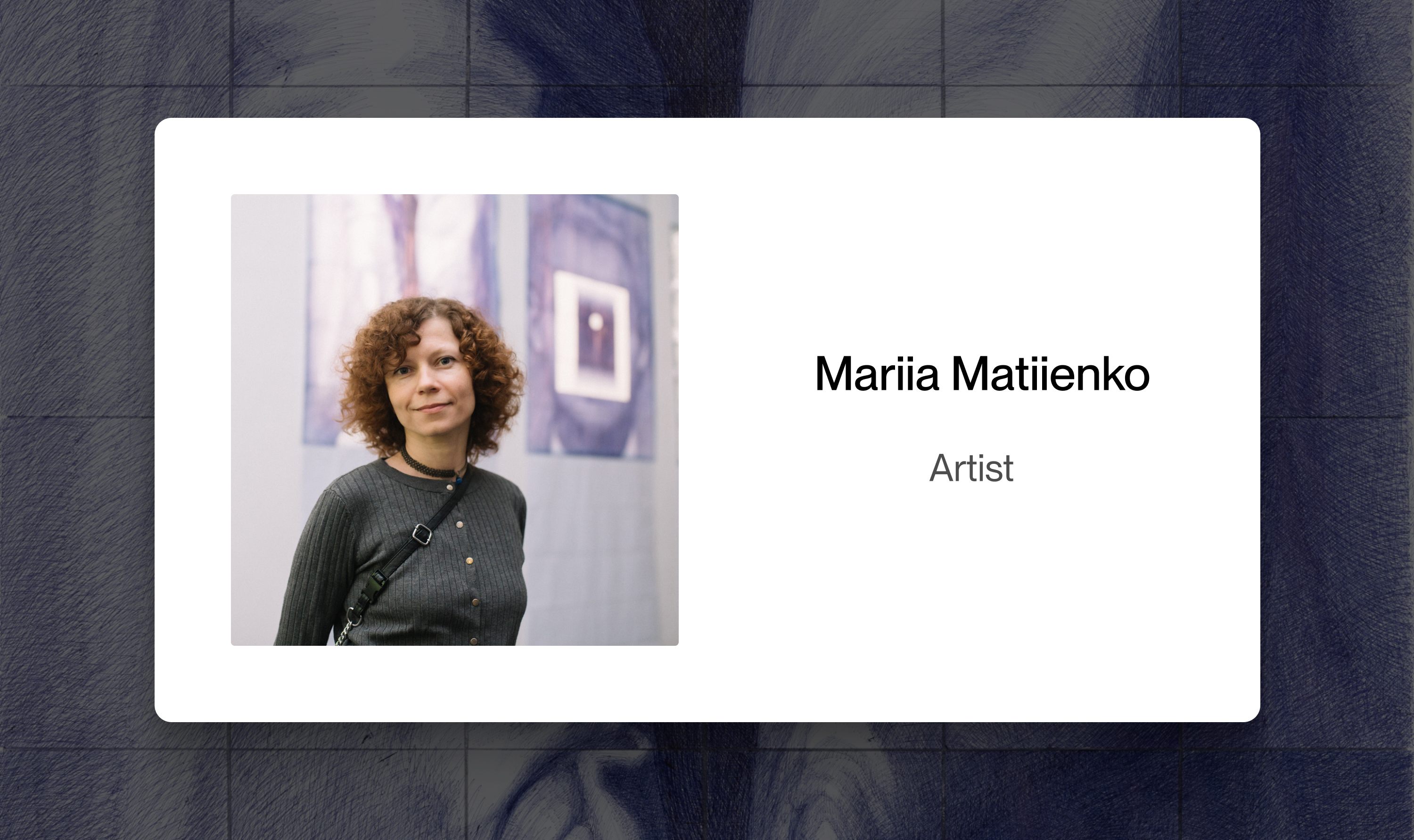
Table of Contents
We are pleased to announce that Mariia Matiienko has joined the Ukrainian Fund of Digitized Art! The UFDA has digitized 17 of her works, which are now preserved in the highest possible resolution and made available to audiences worldwide.
Mariia Matiienko: Between Line and Thought
Mariia Matiienko was born in 1980 in Kyiv, Ukraine. In 2003, she graduated from the National Academy of Fine Arts and Architecture (NAOMA), where she studied at the Faculty of Architecture.
In 2007–2008, she completed an internship in Germany and Switzerland, focusing on contemporary abstract painting and organic design.
In 2013, Mariia Matiienko's works were included in a group exhibition at Venezia Gallery di Giorgio Ghidoli in Venice. Since 2015, the artist has regularly participated in the A4 Project at the Karas Gallery in Kyiv.
Since 2017, she has been a regular participant in group exhibitions and happenings at the "Ukrmakrovsesvit" Gallery in Kyiv, Ukraine.
Her body of work includes drawings made with ballpoint pens on paper. All her pieces are created using ballpoint pens on A4 office paper, taped together to form sheets measuring 180 × 127 cm. Among Mariia Matiienko's original drawings digitized by UFDA are "Good Mood" (2020), "Absolute Output" (2021), "Camera Obscura" (2022), "Breathe In" (2023), "Area of Cooperation" (2023), "The Yellow House. Treatment with Bromine" (2024), and many others.
Mariia Matiienko's Art Style
At first glance, the artist uses the simplest materials — a ballpoint pen and sheets of office paper taped together to form larger surfaces. Yet these modest elements create a powerful psychological effect. As countless small strokes merge into a complete image, they generate a delicate tension between seeing and understanding, confronting the viewer with a subtle illusion of reality.
Mariia Matiienko creates calm yet immersive reflections on cycles and repetition. Each line captures a moment that lasts forever, impossible to erase or alter. The taped sheets of office paper serve both as a canvas and as a record — a reminder of the everyday life we once saw as stable.
In her practice, the process is as important as the result, making each work feel open-ended and never truly complete.