
Nina Murashkina: Erotica Without Vulgarity and the Art of Being a Witch

Anna Avetova
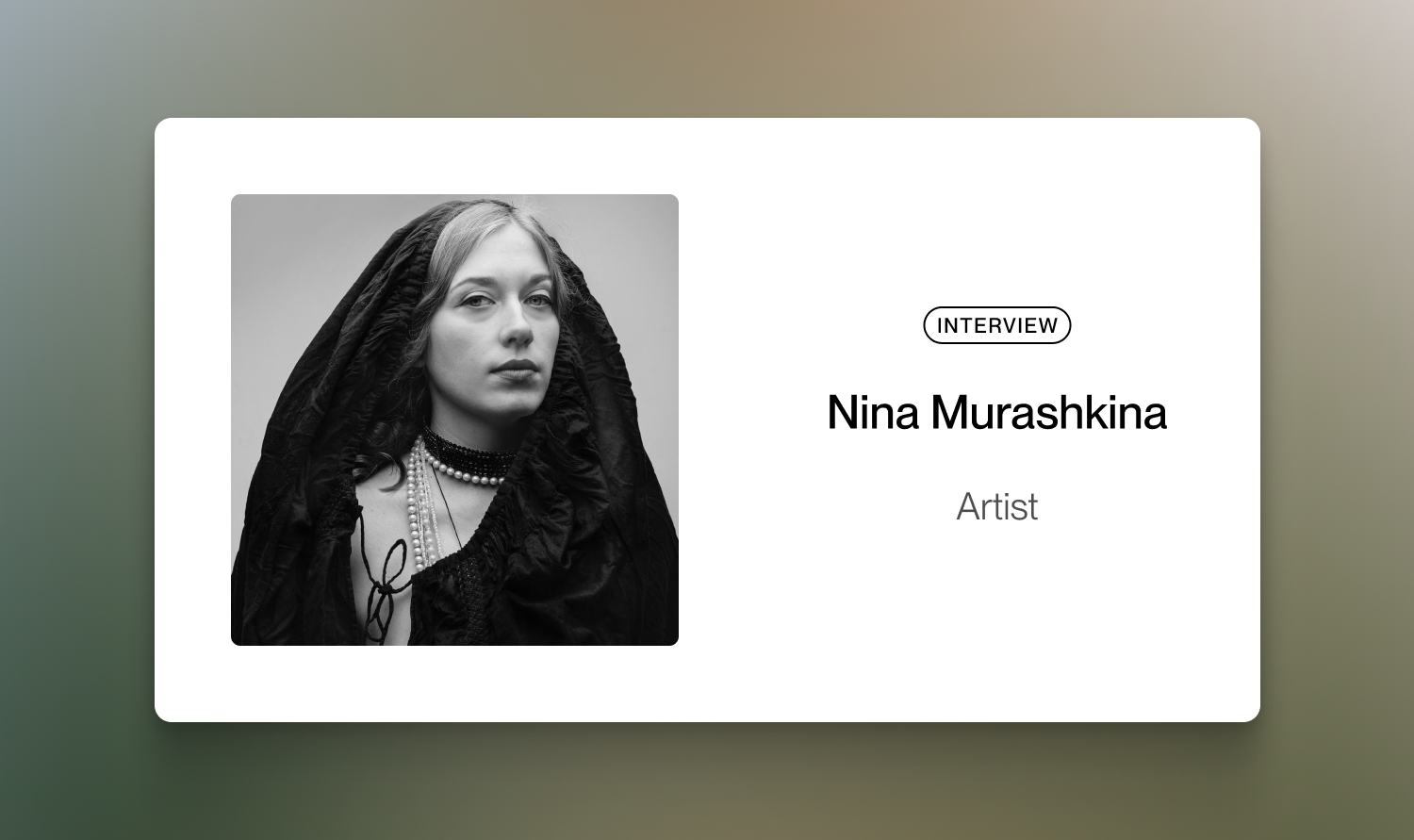
Table of Contents
- Donetsk: Greyness, Miners, and Rock ’n’ Roll
- Harassment, Theatre, and Refusing to “Pay with Your Body”
- From Icons and Kharkiv to Kyiv and Catalonia
- Europe, Magic Feminism, and the Right to Be Yourself
- Sex in the Gaze: Eroticism Without Pornography
- Ceramics, Jewellery, and Goddesses: Working with Xavi
- Recognition, Awards, and Different Audiences
- War, Intuition, and Refusing the Apocalypse
In this episode of the UFDA Podcast, host Anna Avetova speaks with artist Nina Murashkina — known for her distinctive erotic imagery, ceramic goddesses and “magic feminism,” and for a path that leads from childhood in Donetsk to life and work in Catalonia. The conversation touches on childhood memories of miners and rock music, experiences of harassment in Ukraine, the sense of freedom in Europe, collaboration with her sculptor husband, and why Nina consciously avoids the topic of war in her art, leaving space for hope instead.
Donetsk: Greyness, Miners, and Rock ’n’ Roll
Nina was born in Donetsk, the “land of miners,” where her childhood was shaped by two very different worlds: black coal dust on the one hand, and the brightness of rock culture on the other. As a child, she watched miners coming up from underground with black “eyeliner” around their eyes — traces of coal that don’t wash off immediately — and thought about what it would be like to draw something on her own face. At the same time, theatre and rock music were part of her life: her father played in a rock band, owned professional equipment, and performed at concerts and weddings. Five‑year‑old Nina would secretly sneak into his shows, despite her mother’s warnings that it was “dangerous.”
She dreamed of becoming a rock star, took guitar and singing lessons, until she heard a recording of her own voice and admitted that her rhythm was “a little late.” In parallel she was studying in art school, and at some point it became clear: music would not be her profession, but visuality and theatricality would definitely stay.
Harassment, Theatre, and Refusing to “Pay with Your Body”
As a teenager Nina worked as an assistant to an icon painter in Makiivka, doing serious church painting and simultaneously seeing “the other side of the church” — corruption and messy, very human passions. At eighteen she realized she could not “pray it all away” inside such a system and wanted to move into the art world, where she would create her own narratives rather than serve someone else’s dogma.
Later, trying to enter Kyiv’s gallery circuit, Nina faced direct sexism and devaluation. In one episode she recalls on the podcast, a well‑known gallerist looked through her works and told her it would be “better to find a husband and build a family” than to pursue an art career. In another — at a theatre in Chernivtsi — the director leaves her alone with the head of the theatre “to negotiate a budget for costumes,” he locks the door, and Nina, in the very last moment, literally runs away: into the restroom, through the backstage exit, to the hotel. The costumes are later made from whatever materials were already in stock.
She talks about this without pathos, with humour, but very clearly: life is short, and she would rather be “a witch living on the edge of the village by the forest” than someone who agrees to pay with her body for professional opportunities.
From Icons and Kharkiv to Kyiv and Catalonia
Nina’s education is a long path through different cities and contexts: Donetsk, Kharkiv, Kyiv, studying as a stage designer, working in theatre, and later moving to Kraków and Catalonia. She emphasizes that she always chose cities strategically: places with a museum of contemporary art, a design museum, and active institutions she wanted to enter.
Each move came with careful research of the local context: who is already working with figuration, the body, eroticism and gender; what exactly they are doing; and where her own voice could sound different. In Ukraine, two important reference points for her were artists Vlada Ralko and Eugenia Gapchinska — two very different models of female presence in art, alongside whom she was building her own, third trajectory.
Europe, Magic Feminism, and the Right to Be Yourself
A turning point came with European residencies and encounters with gallerists who made it clear that there are no “inappropriate” topics in art, and that many borders exist only in our heads. In Catalonia, Nina says she literally felt her lungs open: no one asks where your husband is, why you don’t have children, and when you will finally “settle down.” If the work is strong and well‑made, it gets attention, regardless of how erotic the imagery is or how flamboyant the artist herself appears.
She calls her position “magic feminism.” She doesn’t join radical 8 March marches in Madrid with huge banners, though she sees and understands them. Instead, she builds her own pantheon of female figures — goddesses, witches, lovers, warriors — that address violence, harassment, and the right to one’s own body and money through myth, eroticism, humour and beauty. Her feminism is not about hatred; it is about a woman’s right to be how she wants to be.
Sex in the Gaze: Eroticism Without Pornography
Another line of the conversation is about the body and the line between eroticism and pornography. Nina has around ten years of art education behind her — from Donetsk and Kharkiv to Kyiv — including copies of classical painting and a very attentive relationship to materials and quality. She thinks not only about the image, but also about how the work will look in twenty years and whether it can be restored at all.
She is not interested in the “act” in a pornographic sense; she is drawn to the “before” — the look, the gesture, the tension in the air between two people. In this sense, a phrase from gallerist Tetyana Myronova became key: “Sex is in the gaze.” It is precisely this in‑between state — flirtation, falling in love, that sudden spark — she tries to capture in her works. This is why even her boldest scenes feel intelligent rather than vulgar: the viewer clearly senses eroticism, but not disgust.
Ceramics, Jewellery, and Goddesses: Working with Xavi
In recent years, ceramics and jewellery have joined her painting practice. Nina creates porcelain miniatures, brooches and rings as an “accessible entry point” into her world for new collectors — at the price of one trip to the supermarket. For her it’s both a continuation of her personal love of jewellery and a way to let people literally wear her art on their bodies.
Another important direction is her joint sculptural work with her husband, sculptor Xavier Escala. They both believe that every woman is a goddess, and together they create ceramic figures‑sarcophagi that open to reveal the heroine’s inner world. Nina is both muse and model for these sculptures; each piece is born out of long, daily breakfast debates about pose, expression, character and composition.
For Nina it is crucial that, in Xavier’s practice, the female body is not a consumable object but something divine. Their relationship and collaboration rest on this: they both avoid vulgarity and build complex, sensuous yet dignified images.
Recognition, Awards, and Different Audiences
In Ukraine, Nina has taken part in many exhibitions, biennials and projects, but has almost no formal prizes. More tangible “recognitions” came from Europe and Australia: the “Best Design of the Year” exhibition at the Design Museum of Barcelona and awards for her ceramic series and joint sculptures with Xavier. Often these are symbolic rather than monetary, but for her they form a sense of support and visibility.
She compares Ukrainian, European and American audiences. She loves Americans for their speed in deciding “buy / don’t buy” — sometimes in under two minutes; Europeans for their attention to quality and materials; and Ukrainians for a small but loyal niche community that has followed her for years. At the same time, Nina is honest: her themes will always be “too sharp” for part of the Ukrainian field, and that’s okay.
War, Intuition, and Refusing the Apocalypse
Before the full‑scale invasion, motifs of apocalypse, catastrophe and dark futures often appeared in her work. After 2022, when “darkness came into life” literally, Nina consciously stopped working with war in her art: she admits she simply cannot handle it emotionally and doesn’t want to break down mentally. Instead, she deliberately sets herself and the viewer on the idea that “it will end and things will get better,” and holds onto this inner setting as her way of staying sane.
In the final part of the episode, Anna asks about myths around artists. Nina mentions one of the most persistent: that art “isn’t serious” until there is money, TV and newspaper coverage. In her Catalan village, people long treated her as a woman with a “hobby” until local TV ran a story about her; suddenly, the same neighbours began to look her in the eye and start small talk. She states this without resentment, more as a diagnosis of society, and continues doing what she does best: building her own magical, feminist universe — with witches, goddesses, eroticism, and a woman’s right to be herself, even if, once upon a time, people like her were burned at the stake.