
Sasha Maslov: on archives, heritage, and why Ukraine needs an institution like the Ukrainian House of Photography

Anna Avetova

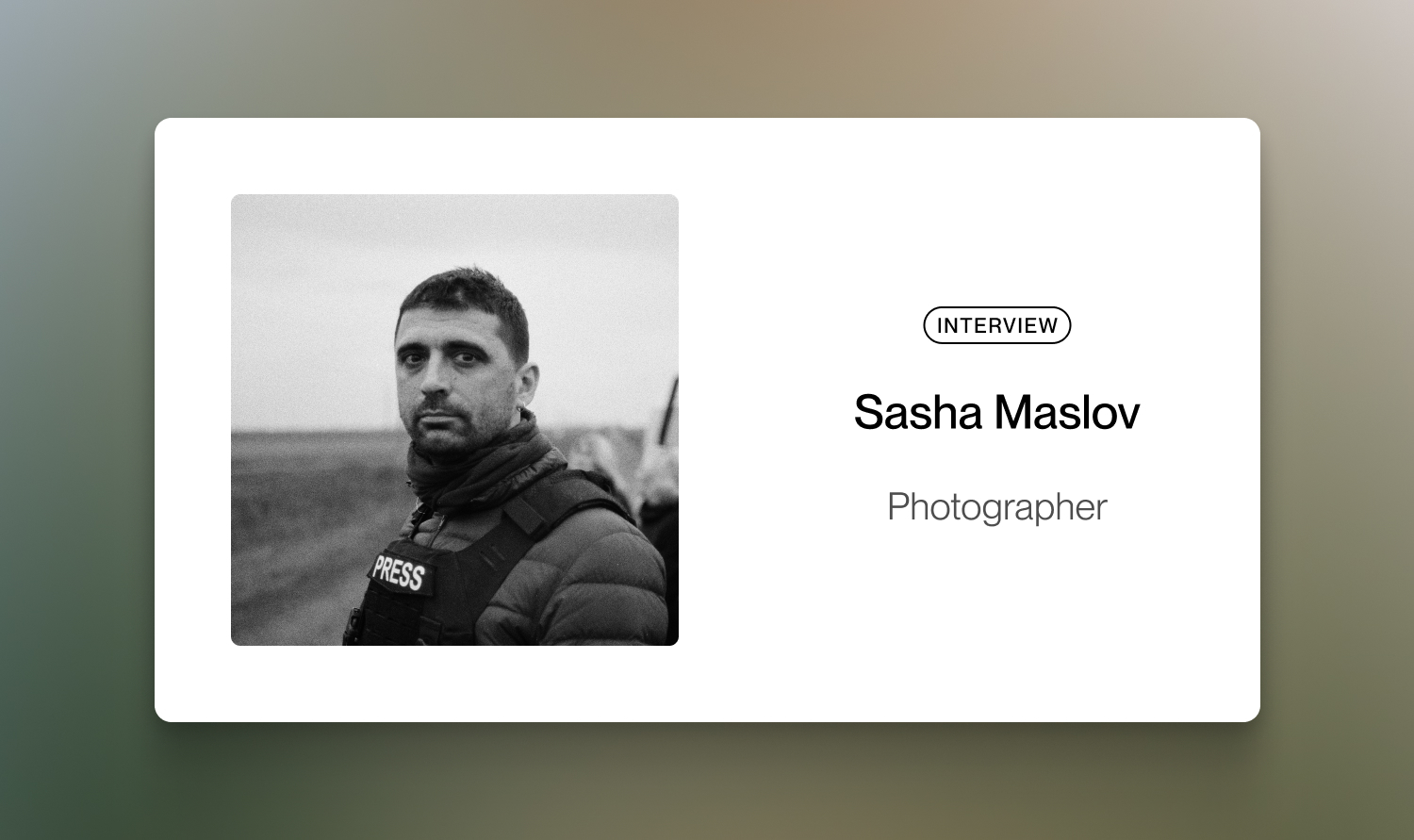
Table of Contents
- Two cities, one biography
- Nostalgia for Obama and a new authoritarianism
- How to drop off a portfolio when the internet doesn’t fix everything
- David Lynch, Elon Musk, and the silence after the shutter
- When an assignment is just work – and when it’s a story
- A war it was easy to forget
- Why Ukraine disappears from front pages
- Dropping anchor in a city of sirens
- Ukrainian House of Photography: an institution that doesn’t exist yet
- UFDA, blockchain, and what cannot be faked
- Learning to speak not about “me”, but about “us”
On a Monday evening in Kyiv, with the week just starting and nothing having had time yet to disappoint, Sasha Maslov logs into the UFDA Podcast. On screen, he looks exactly like someone who is used to being on the other side of the camera: slightly ironic, attentive, careful with his words. He immediately warns that he does not like to talk about himself – but an hour later it turns out this is no longer entirely true. Or at least not as true as it used to be.
Two cities, one biography
If you ask him to describe himself in a single line, he will say: Ukrainian‑American photographer. Not as a gesture of political correctness, but as a literal fact: he has spent roughly half of his life in Ukraine and half in the United States.
His first America was not New York, but summers in Ohio, where part of his family lives. A teenager from Kharkiv learns English by watching Friends, washes dishes in a fast‑food place, and adjusts to a world he had previously only seen in films. Ukraine does not disappear: friends, school, and early attempts at photography keep him rooted in Kharkiv reality. But in the 1990s “staying” rarely sounded like an ambition. In a city where the main dream is to leave, the United States takes the shape of a shared fantasy: a place where things will finally be “normal”.
When, in his early twenties, he moves to New York, that feeling is still with him. Behind him is a bundle of myths about the American Dream; ahead lies a city where those myths will slowly have to be taken apart.
Nostalgia for Obama and a new authoritarianism
The New York he arrives in is the late 2000s: the financial crisis, the election of Barack Obama, a strange mix of anxiety and hope. For someone with liberal views, it is a time that now is easy to idealise. It feels as if the idea of gradual progress was still believable.
Then Donald Trump changes everything. Not only politically, but on the level of how America itself feels. Maslov speaks about “a new, not yet fully described form of authoritarianism” in which the words of the president and the output of his administration cannot be read by old rules. For those who once lived inside that news cycle every day, there is almost a sense of relief in watching it from afar, not from inside a New York newsroom.
The America he moved to no longer feels like a country of dreams. More like a place where the dream has been revealed as dependent on elections, algorithms, and very concrete people in power.
How to drop off a portfolio when the internet doesn’t fix everything
Maslov tells the story of his entry into the industry almost like an anecdote from another era. There is no “quick” breakthrough: only a student‑migrant in New York who wants to get closer to the editors, artists, and “power players” he admired from afar.
He chooses portrait photography and keeps three idols in mind – Arnold Newman, Irving Penn, Richard Avedon. The logic is simple: if you love that school of portraiture, you go to the place where it was once born.
What happens next now sounds almost like folklore: portfolio drop‑off days. Photographers carry printed books to magazine and newspaper offices, leave them in the mailroom with a photo editor’s name on them, and come back a week later to see whether anyone opened the folder. Fingerprints, pages pulled for photocopying, soft bends in the paper – these are good signs. If the book lies as perfectly flat as when you left it, you try again in a month.
At the same time, he starts writing every morning to The New York Times picture desk: a short “I’m available today”. At seven in the morning you have to get up, send the email – and you can go back to sleep for a while. On one of those days he wakes up at ten, opens his inbox and sees several messages from an editor, the last one in all caps: “DO YOU WANT THIS ASSIGNMENT OR NOT?”. It is a concert and portrait of Natalia Lafourcade. That is his first jump into “big” photography: a mild hangover, a loft with eight roommates, and a chance he almost slept through.
David Lynch, Elon Musk, and the silence after the shutter
Over the years, his list of subjects has come to include many recognisable names – from film directors to billionaires. Asked whom he wanted to photograph most, the answer is unsurprising: David Lynch. For a boy who once watched Twin Peaks in Kharkiv, being in the same room with Lynch is a moment when a personal, cinematic history suddenly collides with a professional one.
With Elon Musk the story is more complicated. It is 2016, at The New York Times building. Musk, fresh from a meeting with Trump, arrives for an on‑stage conversation with an editor and then a brief shoot. Even then, Maslov says, there was something unsettling in how the entrepreneur behaved and how his entourage functioned. What later would become visible to the wider world was already present in small gestures and offhand remarks.
Sessions like these show how preparation works for him: sometimes there is time for a concept, references, a team. Sometimes you arrive half an hour early at an unknown location, look around, and in a minute decide how to make a portrait that is honest and still usable for a specific page.
When an assignment is just work – and when it’s a story
Maslov does not romanticise every frame. There are shoots where he knows clearly: this is craft, not high drama. A developer’s portrait for a real‑estate section is about “muscle memory”: you understand what kind of image the publication needs and you produce it quickly and professionally.
Other situations are different: when the person in front of you has lost someone in the war, or when the entire story rests on a fragile balance of trust. There the camera stops being a neutral object. It becomes part of the conversation between you – often a wordless one. Technically, he has simplified over the years, but the emotional work has only become more complex. The simple scheme “show up – shoot – leave” no longer holds.
A war it was easy to forget
One of the most honest moments in the conversation is when he talks about 2014–2015. Yes, he came to Ukraine then and photographed the war in the Donbas. And then he stopped. Not because it ended, but because it slipped from the front page. “I’m as guilty in this as many others,” he says, meaning the world’s ability to get used to someone else’s war.
On 24 February 2022 he is in his New York apartment, at a party, in the middle of music and alcohol. A friend gets a call from his wife in Kyiv, and within a minute every phone in the room is showing the same thing: rockets, headlines, messages from Ukraine. People are still dancing, lights are flashing, but for him the evening becomes a fault line: life before and after.
He still does the commercial shoot scheduled for the end of February. At the same time he calls his family, persuades his mother to leave Kharkiv, coordinates volunteers, looks for transport. A few weeks later he is in Europe: meeting relatives in Poland, finding them a place with friends, then going on to Ukraine himself.
He had not planned to become a war photographer. The first wartime assignments come slowly – some from editors, some from his own initiative. That is how he ends up between trenches, bombed‑out apartment blocks, people who just weeks earlier looked like statistics in a ticker.
Can photographs stop a war? No. But, Maslov says, they can stop it from turning into an abstraction for those who live far away. They influence not generals but readers; not orders but ideas of what is acceptable.
Why Ukraine disappears from front pages
When we talk about “fatigue with Ukraine” in the West, he suggests another frame. It is not so much an emotion as the mechanics of the news cycle. A newspaper cannot hold all the world’s tragedies at the top of attention at once. If something explosive happens in Israel or inside the US, even a massive strike on a Ukrainian city may end up lower on the page – not because it matters less, but because attention is finite.
This is not an excuse, just a description of the battlefield on which the Ukrainian narrative now competes. And understanding that, paradoxically, helps not to read every change of headlines as a personal betrayal.
Dropping anchor in a city of sirens
Despite everything, Maslov’s decision is to stay. Most of his time he now spends in Kyiv. Together with his friend and partner Valentyn Kozhan he has opened a studio – not only as a place to shoot, but as a gesture: “I’m here for the long run.” In a city where many people live with half‑packed suitcases, that looks almost radical.
In parallel, he is finishing a book on legacy and heritage in wartime: on what we preserve, what we lose, and how people and institutions look at this. It is an attempt to record not only destruction, but also the invisible daily decisions: what to evacuate from a museum, what to digitise, what to leave where it is, at one’s own risk.
Ukrainian House of Photography: an institution that doesn’t exist yet
His most far‑reaching project now is the Ukrainian House of Photography (UHoP). Together with curator Kateryna Radchenko and director Marc Wilkins, he has been working on the concept for several years; now, it seems, it is time to act.
They want to create in Kyiv a physical place where photography is not just “pictures on a wall”, but a way of thinking about the country. The project has three big pillars.
The first is popularisation: making photography intelligible and interesting not only to professionals. Exhibitions, talks, public events – anything that can teach people to look at images more carefully, to question them rather than simply scroll.
The second is archiving. UHoP plans to work with “white spots”: diaspora albums, state security archives, family photographs that can tell history differently than textbooks do. The idea is not just to put these images on a shelf, but to return them to the public through shows and books.
The third is education. From photojournalism to fashion, from the history of the medium to curating – Maslov sees all of this as part of the future programme. He wants the House to become a place where photographers learn to think about their work structurally, and where curators and critics get an environment in which they can grow.
UFDA, blockchain, and what cannot be faked
Towards the end of the conversation we switch to UFDA – the Ukrainian Fund of Digitized Art. I briefly explain what it is: the largest institution in Ukraine that systematically digitises art and fixes those records on the blockchain so that they cannot be quietly altered or appropriated by someone else. This includes regional museums and contemporary artists alike: from the collections in Sumy to new works that, until recently, existed only in a single studio.
Maslov listens, smiles, and says frankly that he is no expert in this field. His experience is more about working with established museums and publications, where the rules of the game are given. But he grasps the idea of blockchain‑based records intuitively: if life and culture are moving into digital space, questions of authenticity and authorship will have to be solved there as well.
He suggests that the Ukrainian House of Photography will also, sooner or later, face these topics as part of its broader conversation about archives. Digital tools, he says, should strengthen long‑term care for images rather than replace it. Blockchain does not work on its own: behind it there still have to be people and institutions who understand why they are doing this.
Learning to speak not about “me”, but about “us”
At the end I joke that today he spoke about himself much more than in the interview we mentioned at the beginning. He laughs and says: “Not about myself – about projects, yes.”
The Ukrainian House of Photography has already forced him to become someone he never was before: a fundraiser, a networker, the person who keeps explaining the same idea to new listeners. And it turns out this process can even be enjoyable. The more he shares the vision, the more often unexpected people, contacts, and opportunities appear from nowhere.
For a photographer who once measured success by fees and bylines, this is a shift. The centre of gravity is moving from “I” to “we”, from an individual career to shared infrastructure. In a country at war, an institution is always a bet on the future. And Sasha Maslov, it seems, has finally decided to make that bet.