
WAONE: On 90s Graffiti, Spiritual Practices, and How Not to Lose Yourself Between Success and Time

Anna Avetova

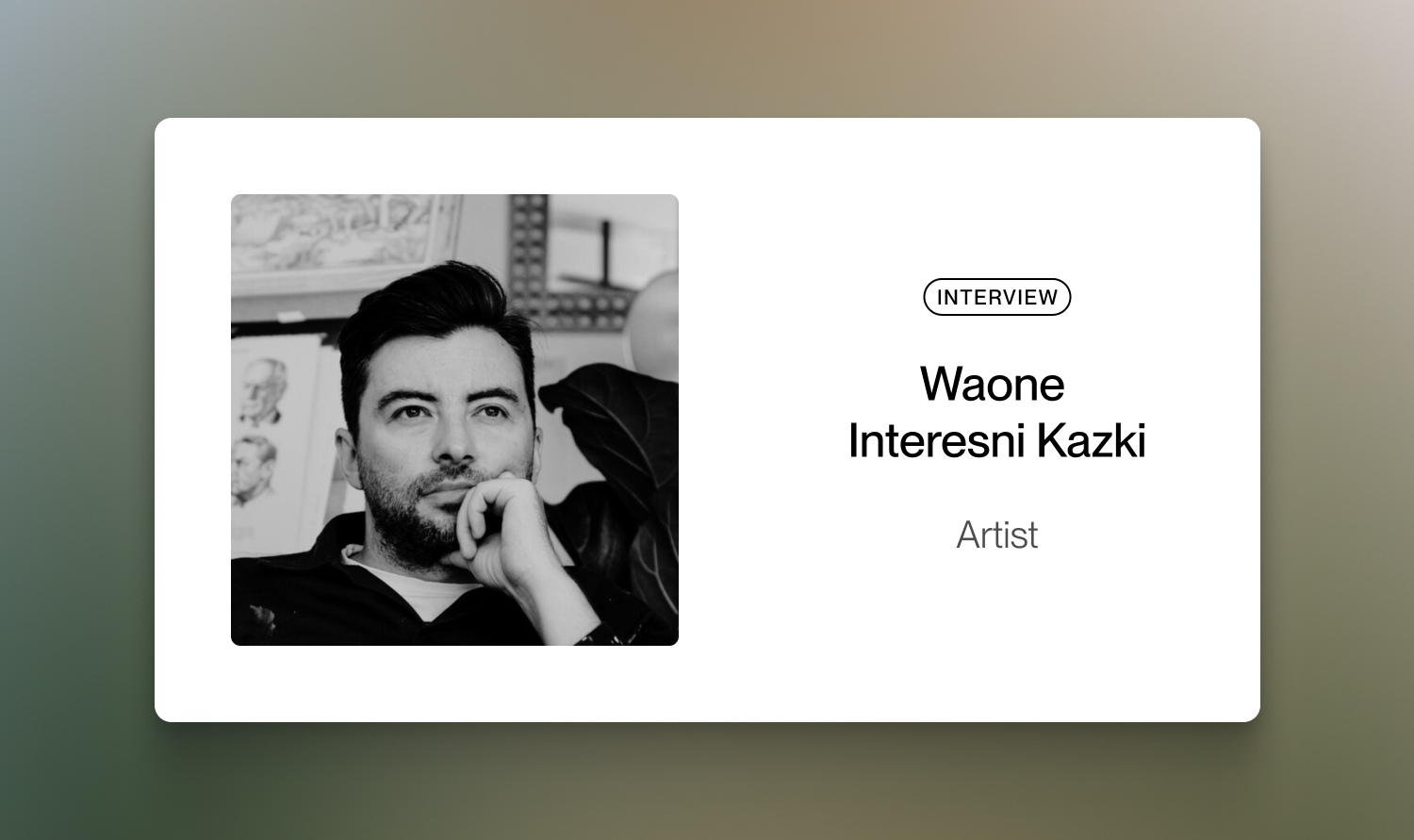
Table of Contents
- “Genius”, ego, and the problem of the crown
- Murals, control, and the limits of perfection
- From Ingenious Kids to Interesni Kazki
- Spiritual practice and images that “come from somewhere else”
- Street art booms, busts, and saying no
- From walls to canvases, and the long road to “overnight success”
- Digital Originals, NFTs, and trusting professionals
- New materials: ceramics, bronze, textiles
- Saying no, planning forward, and going with the flow
In the final episode of UFDA Podcast’s second season, host Anna Avetova talks with Kyiv‑based artist and muralist Volodymyr Manzhos, better known as Waone of the legendary duo Interesni Kazki. The conversation moves from 1990s graffiti and first murals to spiritual practices, Digital Originals, and why, after 25 years of painting walls around the world, he now turns down most mural offers in Kyiv.
“Genius”, ego, and the problem of the crown
Avetova opens by sharing how followers reacted to the announcement of the episode: “He’s a genius, he’s not human, he’s a superhuman.” Waone laughs this off and says he does not really feel that way himself. He sees mostly what still needs to be done and admits his inner bar is always set very high.
He remembers a period during the peak of Interesni Kazki’s mural boom when some people jokingly called him and his then‑partner AEC “princesses” – too demanding, asking for “too many conditions.” Over time, though, those who worked closely with them understood why: to create something truly high‑quality, you cannot approach it superficially. The risk of believing your own hype, he says, is real; he has seen street artists who rose very fast and disappeared just as quickly. For him, being an artist is above all a test of time: you can be successful today and forgotten tomorrow.
Murals, control, and the limits of perfection
Talking about murals, he describes a crucial lesson: the idea of making the “masterpiece of a lifetime” on a wall is usually important only to the artist, not to the commissioners. No festival or project, he says, is really prepared to give an artist unlimited time and budget. At one point, he and AEC pushed their process to the extreme – a maximum of a month per mural. Those who paid for it were, as he puts it, “holy people.”
His longest mural was on Striletska Street in Kyiv, where he acted simultaneously as curator, investor and painter, working 45 days on a single wall. He did it because he needed to; no external project would have allowed that timeline. The result, however, went almost unnoticed by the local community. The lack of reaction hurt so much that he decided not to paint in Kyiv anymore for a while. Even now, he says, any mural he paints in Kyiv is the exception, not the rule.
When asked what would convince him to take on a mural today, he mentions three things: a serious budget (both fee and production), an experienced organising team that has done this before, and enough time. If a festival or city wants a cheap, fast wall from organisers who are learning on the job, he refuses. After years of teaching people how to do murals properly, he feels that chapter is closed.
He also stresses the responsibility that comes with putting work into public space. From the beginning, he and AEC were conscious that a mural is something people see every day. Over time they learned to study local culture, myths and context before starting a project – whether in Mexico, India or elsewhere – and to tune their colour palette to the surrounding architecture so the work would harmonise rather than scream like an advertisement.
From Ingenious Kids to Interesni Kazki
Waone’s entry into art began in the late 1990s through graffiti. Like many teenagers, he channelled adolescent maximalism into painting walls and trains with the Ingenious Kids (IK) crew in Kyiv. At that time there was no internet as we know it; knowledge circulated via imported magazines and VHS tapes brought back by friends from Europe or the US.
Initially IK was all about letters and hip‑hop style. By 2003–2004, tired of spraying letters, he and AEC began experimenting with walls that had no text at all, only characters and narratives. In 2004 in Yalta, after winning a graffiti festival, they found a location and painted what would become their first “non‑graffiti” mural: a wall of figures without any lettering. Looking back, he calls it the first mural of its kind in Ukraine and, possibly, in the post‑Soviet region.
The IK acronym was originally explained as Ingenious Kids, later re‑interpreted many times. Around 2005, as their style evolved into surreal, narrative scenes filled with symbols, myths and science, AEC suggested a new reading: “Interesni Kazki” – Interesting Tales. It fit what they were doing: visual fairy tales on city walls. The phrase, sometimes mistaken for a Russism, was in fact attested in Ukrainian dictionaries when they chose it.
Spiritual practice and images that “come from somewhere else”
Avetova asks about another, more private layer of his life: his long‑standing interest in spiritual practices, meditation and what might loosely be called inner work. For years he rarely spoke about this in interviews. Recently, in a filmed conversation with entrepreneur Andriy Fedoriv, he realised how deeply these practices have shaped his art – even if he once thought they were separate.
He emphasises that he never approached meditation as a tool to boost creativity or career. It was and remains part of his lifestyle, something he does “as much as is practical, without fanaticism.” At times, he admits, he tilted too far into it; now he tries to keep a balance. Looking back, he can see that his symbolic, surreal imagery is tied to this inner focus, even if he still resists over‑explaining the meanings.
Questions like “what does this guy smoke?” have followed him since the early years. He responds simply: he has never used drugs and barely drinks alcohol. For him, the source of images is not substances but decades of practice and a mind saturated with visual information.
When he sits down to work, there is never a truly “blank canvas.” Behind each new piece stand 25 years of drawing, painting and looking. Early on, like most artists, he began by imitating heroes and learning through copying. Over time, through constant practice, his own authorial style emerged. He realised it not when he personally “felt unique,” but when journalists and viewers began to talk about “Interesni Kazki style” as something instantly recognisable.
Street art booms, busts, and saying no
The Kyiv mural boom of the mid‑2010s – with projects like ArtUnitedUs and Mural Social Club bringing around 120 murals to the city in a single year – appears in the conversation as a turning point. Many residents initially welcomed the colour and spectacle; later, criticism grew about visual noise and lack of integration with the city.
Waone reveals that he was a co‑founder of one of these projects, invited explicitly as a curator and “filter” to control the quality of works and artists. When he saw that his advice was increasingly ignored and quality slipping, he left. From that point, he watched the explosion of walls with growing ambivalence. He notes that among the dozens, some murals are good, but they are exceptions. The overall result, he suggests, shows what happens when the drive for quantity overwhelms care for context and craft.
Today, he feels that perhaps the city does not need more murals at all – “not good ones, and especially not bad ones.” The urban environment is already overloaded with unregulated advertising and clashing colours. Without strong curation and respect for architecture, another painted wall can easily become just more visual pollution.
From walls to canvases, and the long road to “overnight success”
From the outside, it can look as if his transition from murals to gallery work was smooth and fast: paintings sold out, waiting lists formed, international shows appeared. He corrects that impression. Between the moment when no one was interested in buying a work for 300 dollars and the moment when collectors queued for canvases, he counts roughly fifteen years.
What people now see as “easy progress” in painting started long before the end of the Interesni Kazki duo. Early on, what he made on panels was “mixed media, not really painting” in his own view. Oil painting as a serious practice came only after 2012. The apparent boom of recent years, he insists, is the cumulative result of two and a half decades of steady work, not a sudden effect of the full‑scale invasion or the global spotlight on Ukraine.
When asked whether recent global attention to Ukrainian art – like Pompidou curators saying every major institution should now have Ukrainian artists in their collections – has made things easier, he answers bluntly: no. He has not felt any special advantage because of his nationality. Sales have grown, but he attributes that to his own trajectory, not to geopolitical fashion.
Interestingly, since around 2019–2020, more of his collectors have been Ukrainian than foreign. For him, this is a sign that local audiences and buyers are finally recognising artists who were once known mainly abroad. At the same time, he is cautious about exhibitions: he rarely agrees to show more often than once every 1.5–2 years, and only if the next project can be a step up, not just “another show for the sake of a show.”
Digital Originals, NFTs, and trusting professionals
The podcast also touches on his experience with digital formats. He has been experimenting with digital work and NFTs since the early pandemic years, creating both natively digital animations and high‑resolution scans of analogue works.
Recently, one of his digitised paintings – captured at ultra‑high resolution as a Digital Original via the UFDA x Digital Original standard – sold on the Digital Original storefront platform. Another Digital Original, created with UFDA, was auctioned to support Ukrainian cultural preservation and, remarkably, sold for more than a physical work of his that had appeared at Christie’s.
Avetova asks whether he was sceptical at first when UFDA approached him with the idea of digitisation and blockchain. He says no: he already knew the team, trusted their professionalism in both art and technology, and was curious about the experiment. The Digital Original concept – where a single, museum‑quality scan is tokenised as a unique asset on the blockchain – still feels somewhat abstract to him, and he admits he does not always know who the collectors are. But he sees this as part of the evolving ecosystem rather than a replacement for physical work.
New materials: ceramics, bronze, textiles
Beyond painting and digital work, Waone is actively expanding his material vocabulary. He has already worked with original graphics, sculpture, ceramics and bronze. A recent and particularly exciting direction is large‑scale ceramic work.
Inspired by traditions like Portuguese azulejos, he is currently developing a project in Kyiv that will consist of a mural assembled from hand‑painted ceramic tiles: each tile painted with ceramic pigment, fired, glazed and then installed on a wall like a puzzle. It is, in his words, a way to create public art that is not a conventional mural and not a moveable canvas either. Smaller test pieces – ceramic miniatures – are already finished; the full installation is planned for this February.
There are also upcoming collaborations in textiles. He has already worked with Ukrainian clothing brands such as Syndicate on garments featuring his imagery and hints at a new collection in progress. For him, these applied formats are less about fashion as an industry and more about finding new ways for his visual world to inhabit everyday life.
Saying no, planning forward, and going with the flow
Asked how he handles the flood of proposals that come with visibility, he admits he has developed a strict internal filter. Messages that begin with “we already have a mural design and just need you to paint it on a wall” go unanswered. Projects that “needed to be done yesterday” are also an automatic no.
Right now he prefers not to overplan. The war, he says, makes long‑term scheduling feel fragile. At most, he allows himself to dream and set a ten‑ or twenty‑year horizon, then build his daily practice in that direction. Concrete projects – like the yet‑to‑open art centre in Kyiv where he is slated to have the first solo show and install the new ceramic mural – remain tentative until the space is ready.
As the episode closes, Avetova thanks him for an unexpectedly open and reflective conversation. For listeners, the portrait that emerges is less of an unreachable “genius” and more of a working artist who has spent 25 years drawing, painting, thinking, saying no, starting over – and who now, in the midst of war, continues to build a practice that looks both backward and far ahead.