
Yevgen Nikiforov: On Mosaics, Bus Stops, and Ukraine’s Archive That Could Disappear

Anna Avetova

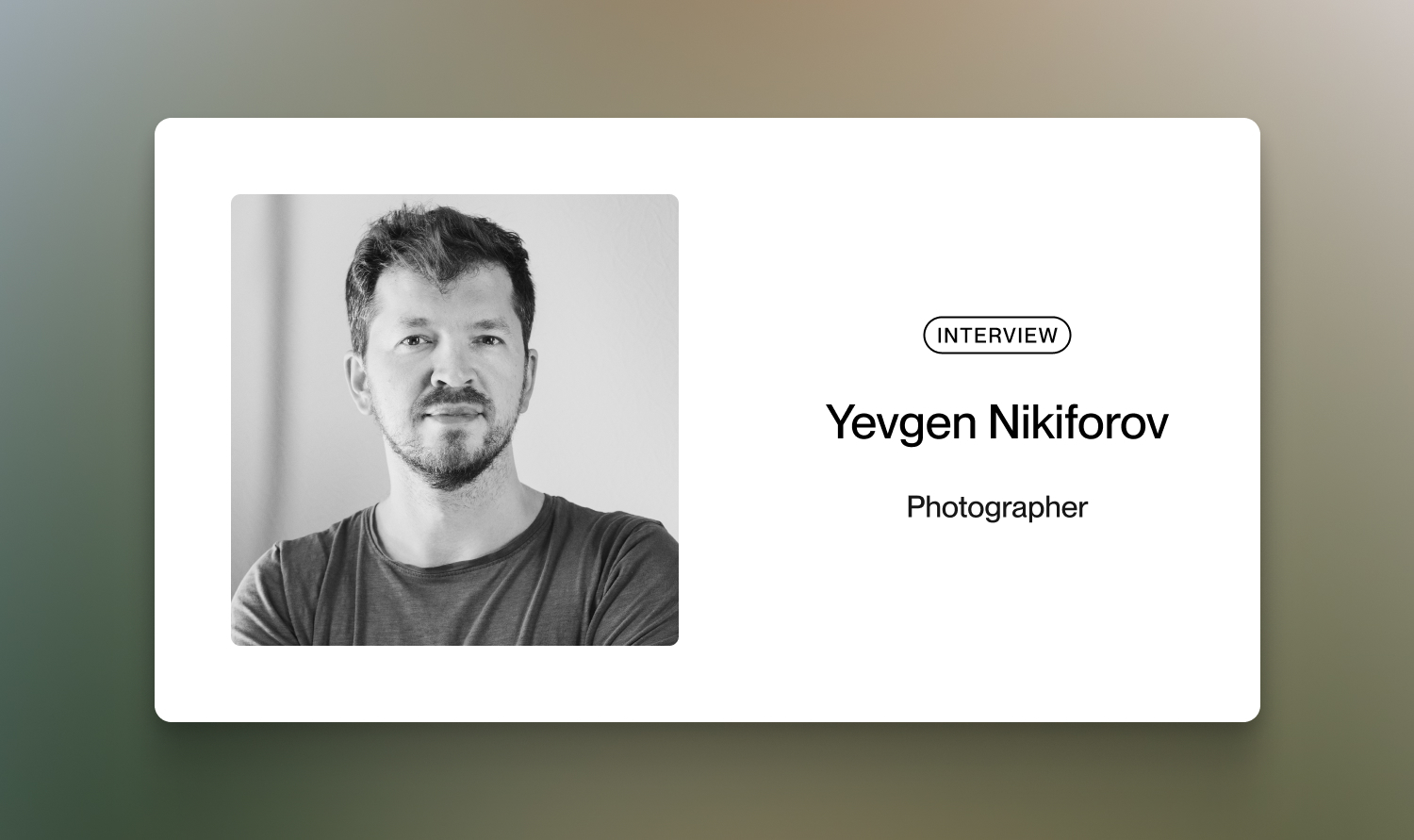
Table of Contents
- From city photo studio to New York Times assignments
- Turning to monuments: mosaics, bus stops, and a missing archive
- Where the archive stands now
- Joining UFDA: digitization as a “perfect match”
- Digital archives, AI, and what comes after scanning
- War, access, and the changing conditions of fieldwork
- Ethics of photographing war
- Looking ahead: after liberation
In this episode of the UFDA Podcast, host Anna Avetova sits down with photographer Yevgen Nikiforov and follows, almost as if leafing through an old contact sheet, how a simple teenage offer from his father slowly turned into more than twenty years in photography. Their conversation moves from the noise and smoke of Maidan, which pulled him away from weddings and fashion into documentary work, to the long, patient years of building a visual archive of Soviet mosaics and bus stops across Ukraine, and then further into the ethics of war photography and the stubborn act of continuing to document art while the country is under attack.
From city photo studio to New York Times assignments
Yevgen begins by going back to the early 2000s. His father worked as a photographer in a city photo studio and, when his son was eighteen, offered him a very straightforward deal: a way to earn his own money, a simple camera, access to the local civil registry office, and a stack of his own old photo books from Soviet times and from abroad. He calls this his first and only “photo school”: he started shooting portraits and weddings while studying finance at university, teaching himself everything because, back then, there was practically no photographic education around him in Ukraine. Weddings, he admits, he really did not like, but for a student, a day of shooting that could bring 500 or even 1000 dollars was hard to refuse, and it allowed him to combine work and study.
For about half a year he tried to work in a bank, testing out how it would feel to live a life in an office, but it did not work at all; it simply was not his environment. Then, in 2009, a grant gave him the chance to go to Israel for a year and study at a local photo school. For the first time he had teachers, classmates and a community, and he could join good local photographers on real assignments. After Israel he moved to China for a year, living between Shanghai and Hangzhou, shooting what he calls fashion: portraits of models in studios, commercial work that rested on a very strong technical base in studio light and Photoshop.
When he returned to Kyiv, Maidan began, and his life shifted sharply. He started going to the protests every day, photographing what was happening and posting images with short captions on Twitter. At some point a new American media outlet noticed his feed and wrote to him, offering small assignments: they would give him a topic and he had a day or two to photograph it. The difference in payment was enormous – while Ukrainian media at the time paid 40–50 dollars for a reportage, the American outlet paid around 500 dollars for a material with text – and this pushed him to work much more systematically. The more he photographed and published, the more people contacted him with new tasks.
Turning to monuments: mosaics, bus stops, and a missing archive
From Maidan, his eye slowly shifted to the city space itself. He watched how the centre of Kyiv and other cities were changing, how public space was being transformed from day to day. At the same time, the topic of decommunisation began to appear in the air, and he started to photograph objects that, in his view, could soon be destroyed: mosaics, reliefs, and other works of Soviet monumental art. At that moment, the law on decommunisation had not yet been signed, and it was not clear how it would be written or interpreted in practice.
Curators Liza Herman and Olha Balashova approached him with a proposal to photograph mosaics for their book on Ukrainian art of the 1960s, and this order deepened his interest in the topic. While working on it, he realised that no full archive of these works existed: there was no single place where one could find out how many mosaics there were, where they were located, who the authors were. There were only fragmentary pieces of information in libraries, archives and private collections. To understand what actually existed, he had to start building this archive himself, assembling it piece by piece.
He describes a clear seasonal rhythm. In the “bad light” season – summer and part of spring – he stayed in the cities, went to archives and libraries, talked with artists and their relatives and planned routes for future trips. In autumn, winter and early spring, when the sun is lower and the trees are without leaves, he travelled across Ukraine and photographed. He noticed that strong summer light did not fit this work: photographs from May and June later looked alien in the series. Leaves often completely covered mosaics, and he had to wait for winter to photograph them normally. Over time he created a huge map in Google Maps, with thousands of points and notes not only about where exactly to stand with the camera, but also at what time of year it was better to come to that place.
In 2015, publisher Osnovy and Dana Pavlychko proposed turning his existing archive into a book called Ukrainian Soviet Mosaics, which later became Decommunized: Ukrainian Soviet Mosaics as decommunisation progressed in parallel with the work on the book. At first they planned to finish it in six months, but this turned out to be completely unrealistic for such a project; in the end he worked on it for about a year and a half. He had collected so much material that stopping at that point seemed pointless. He decided to continue working on the archive further, because he felt he had only reached a certain level and did not want to stop there.
Where the archive stands now
In the last year and a half, Yevgen has been working on two new books with Osnovy: one more book about mosaics and another about bus pavilions in Ukraine, about the architecture of bus stops across the country. During the previous year, he travelled a lot in order to finish shooting for both books and, at the same time, to better systematise the archive. He says that he has shot a huge amount, but in order to bring the archive into full order, he would need around five years of work. Now he cannot simply give his hard drive to someone and say, “This is my archive, work with it”, because it is only partially systematised and still requires a lot of effort.
At the same time, he points out that the archive cannot be considered complete. He did a lot, but physically it was impossible to cover all the works and all the cities, to find everything. In parallel, he knows many other researchers who have also been searching for mosaics and other monumental works, often focusing on their own regions: Chernihiv, Odesa, Vinnytsia and so on. In an ideal world, he says, it would be good at some point to connect all these separate archives, to unite the data for some future work, perhaps in the form of a large open archive or museum collection.
The urgency of this work has only increased. Dozens and hundreds of towns are now either inaccessible or heavily damaged, some almost wiped off the map, like Pokrovsk, Kostyantynivka and Bakhmut. It is “cool”, he says, that he and other researchers managed to photograph many of these works in time, because now at least some record exists and, one day, it may be possible to bring these materials together and pass them to a museum or make an open archive.
Joining UFDA: digitization as a “perfect match”
In parallel with this long‑term documentary work, Yevgen has for about fifteen years been taking on commercial assignments to photograph private art collections and museum holdings. This also began almost accidentally in 2007–2008, when a friend said, “Yevgen, you are a photographer, there is a collection that needs to be photographed.” At first, he thought that photographing art would be easy. It quickly turned out to be one of the most technically demanding types of work: the lens is round, the work is rectangular, there are all kinds of aberrations and distortions, and technically, it is very difficult to make a perfectly honest image. Over time, he developed himself in this direction, received more and more orders, and art documentation became one of his main commercial specialisations.
In winter he attended a UFDA presentation in Kyiv. He was struck by the approach and the level of standards UFDA had developed, as well as by how seriously the team thought about whether one can trust a digital copy of a work. He knows how many interventions other photographers often allow themselves when working with images. UFDA, in contrast, set itself the task of making a picture that is as close to reality as possible, even if it cannot be absolutely ideal, and this impressed him. The idea of preserving cultural heritage, and especially the open call for museums in dangerous zones to apply for digitisation of their collections, also felt very important to him.
At that moment, he had just finished work on books for Osnovy and was looking for a mission and work that would be meaningful to him. He even considered working as a photographer for the United Nations, but decided against it. UFDA turned out to be a place where everything he already knew about photographing art could be applied without additional training. For him, it was a “match”: digitization, high standards, and the goal of preserving Ukrainian cultural heritage.
Work with UFDA is also constant contact with artists. He says that each of us lives in their own “art bubble”, and he had his own. Many of the artists he photographs he already knew or at least knew their archives; others are completely new. Every shoot is a new acquaintance with an artist and their practice. In his words, even if an artist is only at the beginning of their career, it is still interesting; there is always something to learn, to listen to how they talk about their work, to look closely at techniques and media.
Digital archives, AI, and what comes after scanning
When Anna asks about the future of UFDA’s archive and similar projects, Yevgen immediately brings up the rapid development of artificial intelligence and image generation. The technologies UFDA uses are also about protecting information and creating a kind of blockchain‑based provenance: you can be sure that a work has a digital origin story and a recorded history. In his view, this is extremely important now, when images can be easily altered and manipulated.
He recalls taking part in a forum on digitalisation where a representative of a Czech art museum, with a collection of 400,000 objects, explained that they had been working on documentation and now digitalisation for almost 100 years, and have managed to photograph about a quarter of the collection so far. With today’s technologies, he says, museums could and should move faster and treat digitisation as a priority. The looted museums on temporarily occupied territories, for example in Mariupol and Kherson, show how important it is to have at least digital copies.
When the conversation turns to his own archive and whether it could be connected with UFDA and with blockchain, he answers that first he has to create a standard for how he manages his archive. Now everything is shot on different cameras and lenses and exported into different digital files; there is no single clear standard. To move his archive to another level, he would need to systematise the material and decide on a level of intervention and fidelity. It could be a good idea not only to have a digital archive, but to make it so that people can trust it as a record of works without Photoshop and manipulation.
War, access, and the changing conditions of fieldwork
Since the beginning of the full‑scale invasion, conditions for work have changed radically. Before 2022, he felt that the whole country was a fairly free and open space for a photographer. He did not feel any serious restrictions. Even shoots at, for example, a nuclear power plant could be arranged in some cases within one day if everything was done officially and transparently. If any questions or problems arose, it was usually possible to solve them quickly.
Now, because of security issues, it has become much harder to work. He knows of situations when people who photographed certain objects were found by security services within a few days and asked why they were at that location and why they were taking pictures. In this sense, it is difficult to work, and safety has to be taken very seriously. At the same time, access to many archives has not changed much inside government‑controlled territory, but dozens of archives and cities are now simply inaccessible or completely destroyed.
Institutional attitudes to preserving monumental heritage differ from place to place. He gives Lviv as a positive example: the city approached the protection of its mosaics very responsibly, covering works, putting up Blue Shield symbols and generally trying to shield cultural heritage objects. In Kyiv, the local scientific‑methodological centre for protection of cultural heritage is now describing works and documenting them, but these are still individual cases. In Lviv much was done “in bulk”, while in Kyiv it has to be done work by work.
However, neither documentation nor signs truly protect works from destruction by developers. Until there is serious responsibility and enforcement, the situation will not change, and mosaics will continue to disappear under insulation or as a result of reconstruction. He reminds Anna that very many works have been destroyed not by war but by neglect and redevelopment: when a building is insulated or demolished, a bus stop or a facade mosaic is simply destroyed. Cities like Cherkasy, which once had extremely rich monumental heritage, have lost a huge number of works since the 1990s and 2000s.
Ethics of photographing war
Although Yevgen is not working at the front now, Anna asks him about the ethics of photographing war: what is possible or impossible to shoot? He makes a clear distinction. In his view, it is necessary to photograph everything: all the horrors of war, everything a photographer sees and has access to. The question is not so much what you shoot, but what you then publish and how.
He believes that the key is self‑censorship, emotional intelligence and respect. Ideally, photographers should ask for consent from people in very vulnerable situations; at the very least, they should never use such images for personal hype or self‑promotion. If a person is against their image being published, in his view it should not be used. He notes that Ukrainian law already contains mechanisms that allow people to demand that certain images be removed or challenge their use, and, if necessary, hold photographers accountable.
Creative work, books, and the pull of cinemaCloser to the end of the conversation, Anna asks whether he still has space for more “creative” photography beyond archives and orders. He answers that for him, a slow architectural walk through the city with a camera is already a form of rest and meditation: making a good architectural shot is something he can allow himself on weekends, and it gives him balance. He has also worked with architectural archives in Germany, which may become important in the future.
Right now, most of his time goes into finishing books: one about bus stops, which should come out this year, and Ukrainian Soviet Mosaics Revisited, which is planned for next year. For him, working on these books – processing the archive, rethinking it, giving it a new life – is also creative work. Besides that, he has several stories he has been photographing for years that are waiting to be finalised and turned into books. He says that, for him, the book format is often more interesting than exhibitions.
He has also shot films. Through the My Street Films programme at the 86 Festival in Slavutych, he made short films such as Steelmakers, about mosaics in Mariupol, and Hiri moi hiri (“My Weights, My Weights”), about an experimental model village in Luhansk region. Later he filmed for architectural archives and made a short film about the Kyiv metro. He recalls the feeling when his film was first shown on a big screen at a major festival, and he suddenly found himself staying in the same hotel and walking the same corridors as directors who had been making films for decades. Cinema, he says, is a kind of magic and a “slightly addictive” experience to which he would like to return if there is the opportunity and a story that demands this medium.
Looking ahead: after liberation
When Anna reads out a listener’s question about what he would most like to photograph but has not yet been able to, Yevgen answers that, if we are talking about the archive of monumental art, these are the works in temporarily occupied territories. He would very much like to go there after liberation and document the consequences of occupation, to see what remains and what has been destroyed.
At the same time, he admits that it is physically painful for him even to look at images of cities he knows very well – Kharkiv, Kherson, Mykolaiv – as they look now. He remembers their streets and intersections from before the war and has seen them in different periods. Standing there with a camera, he says, would be both part of his work and something very hard to endure emotionally.
For now, he continues to do what he can: to digitize, describe, organise, and slowly bring his archive into order. It may not be complete and may still lack a final shape, but it already preserves many works that no longer exist physically. Together with UFDA and other researchers, his work points towards a future in which Ukrainian art is not only created and exhibited, but also preserved and remembered, even when the original walls and cities have disappeared.