
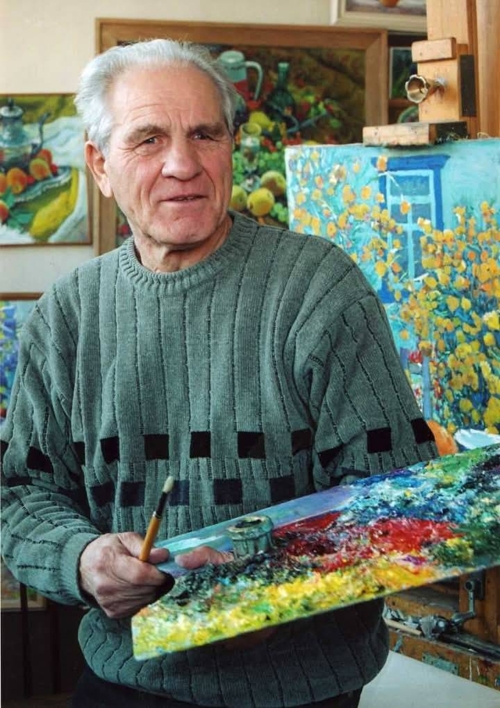
Mykola Maksymenko
Mykola Maksymenko biography
Mykola Maksymenko was a Ukrainian artist and a master of landscape and still life, distinguished by numerous accolades. He was named a People's Artist of Ukraine (1994) and was a laureate of the Taras Shevchenko National Prize (1994) for his series of works titled "Landscapes of Ukraine."
Summary of Mykola Maksymenko
Maksymenko’s paintings are preserved in more than 30 museums across Ukraine, as well as in private collections worldwide. The largest collection of his paintings is held at the Zhytomyr Regional Museum.
Biography of Mykola Maksymenko
The artist was born on December 31, 1924, in the village of Yaropovychi, Zhytomyr region. In the 1930s, fleeing from the famine, his parents moved to the Urals, to the city of Magnitogorsk. There, between 1941 and 1942, Mykola attended the studio of the master of book graphics, B. Dekhterev.
The future artist's youth coincided with the years of World War II. He joined the front as a volunteer. From 1942 to 1943, he was a cadet at the Tallinn Military Infantry School, which had been evacuated to Tyumen for training. He served as a scout. During one of the raids on the approaches to the Dnipro River, he lost an eye due to a shrapnel wound.
After being demobilized between 1946 and 1948, he worked in an art workshop in Magnitogorsk; he also studied in Moscow under the renowned painter Ihor Grabar. In 1948, he returned to Ukraine—initially to the city of Rivne, and later to Zhytomyr.
Since 1960, he was a member of the Union of Artists of the USSR, and in 1974, he was granted the title of Honored Artist of Ukraine. He was repeatedly elected to the board of the Union of Artists of Ukraine.
In October 1983, his first solo exhibition was organized in Kyiv, receiving high acclaim from both art enthusiasts and professional artists.
He shared close creative ties with legendary figures such as Mykola Hlushchenko, Serhiy Shyshko, and Tetiana Yablonska.
To mark his 90th anniversary in September 2014, a solo exhibition was presented at the "Dukat" exhibition club in Zhytomyr.
He passed away in 2016.
Mykola Maksymenko’s Famous Paintings: Colorful Still Lifes and Landscapes
The artwork of Maksymenko is characterized by sincerity, lyricism, and a profound love for his native land. His primary genres include the lyrical landscape (capturing the nature of the Zhytomyr region and Crimea) and still life, in which he depicted flowers, fruits, and everyday objects, emphasizing their physical texture and presence.
UFDA has digitized several of Mykola Maksymenko’s original paintings, including Spring in Bloom, Childhood Memory, Winter Day, and Winter Twilight. These works are now accessible to the general public in high quality on the foundation's website.
Mykola Maksymenko’s Art Style
The artist’s style is based on the principles of classical realistic painting with elements of Impressionism. He is renowned as a master of landscape and still life who expertly captured light, air, and the rich color palette of the Ukrainian nature.
The foundation of his work consists of an authentic depiction of nature, precise drawing, and harmonious composition.
The picturesque nature of his native land became the subject of his very first drawings. During his time at the front, he produced numerous sketches which, after the victory, were transformed into finished canvases where dramatic intonations prevail.
Over time, new themes appeared in his repertoire—nudes, interiors, and architectural landscapes. However, throughout his entire life, Maksymenko carried a love for landscapes and still lifes—the genres in which he reached true heights. The master often chose remarkably mundane motifs, but under his brush, they acquired a bright and joyful character.
In the late 1980s, Mykola Maksymenko made several trips to Crimea. This led to a true renewal of the painter’s creative method. New impressions were transformed into fresh compositions and coloristic solutions. The life-affirming worldview and optimism in his works from the Crimean period took on a more romantic and lyrical quality.