
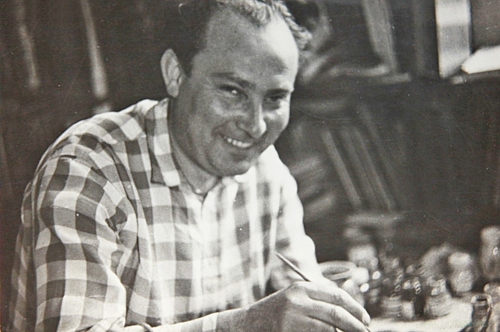
Volodymyr Sydoruk
Volodymyr Sydoruk biography
Volodymyr Sydoruk was a distinguished Ukrainian painter who created landscapes and paintings on historical themes. Many of his works carry historical and artistic significance, spanning Ukrainian history from the Kyivan princes to the present day.
Summary of Volodymyr Sydoruk
The artist is known not only for his paintings but also for his work in theatre, where he designed stage productions. Volodymyr Sydoruk’s paintings are held in many state museums of Ukraine, as well as in private collections both in Ukraine and abroad.
Biography of Volodymyr Sydoruk
The artist was born in 1925 in the city of Rzhyshchiv (now Kyiv Oblast). From 1939 to 1941 he studied at the Kyiv Art School, where his teachers were Ivan Khvorostetskyi and Yurii Kyyanchenko.
His years of study were interrupted by the events of World War II, during which the artist served as an artist at the Stanislav transit point of the regional military commissariat. After the war he settled in Stanislav, where he worked as head of the decorative workshop and as a stage designer at the theatre.
While working at the Stanislav Theatre, he designed productions of Stolen Happiness by Ivan Franko, Taras Bulba based on Mykola Gogol, and Nazar Stodolia by Taras Shevchenko.
In 1950 he accepted an invitation to join the Kyiv Cooperative Society of Artists and relocated to the city of Irpin. There he purchased a plot of land near the railway station, built a house, and lived in the picturesque Irpin until his death.
Volodymyr Sydoruk's original paintings were featured in republican exhibitions from 1954. The road to recognition was long — only in 1980 did the artist become a member of the National Union of Artists of Ukraine.
In 1995, an exhibition at the Ukrainskyi Dim presented over three hundred of the artist's works. The artist passed away in 1997.
Volodymyr Sydoruk's Famous Paintings: A Versatile Creative Legacy
He worked primarily in the field of easel painting, creating landscapes and paintings on historical themes.
Among his well-known landscapes are Kosiv (1954), Lake in Autumn (1954), Birch Trees (1965), Rakhiv Winter (1969), and many others. Beyond Ukrainian scenery, the artist also celebrated the beauty of other countries — he is the author of landscapes of Armenia (1970–1975) and Canada (1994–1995).
On historical themes he created the canvases Bohdan Khmelnytsky Before the Battle of Zhovti Vody (1969), Bohdan Khmelnytsky Greeting Moscow Envoys with Bread and Salt (1976), Khmelnytsky, Kryvonis, and Honta in the Battles near Lviv (1977), and Bohdan Khmelnytsky in the Battles for Kamianets-Podilskyi (1979).
The artwork of Volodymyr Sydoruk includes over 30 works on Shevchenko themes, some of which were connected to places associated with Shevchenko's life. In 1972 he created oil paintings in a mosaic style as illustrations for the poem Kateryna.
UFDA digitized Morning on the Blyzniuky (1985) by the artist from the collection of the Regional Communal Museum of Local History in Borshchiv. This painting is now available for viewing on the fund's website.
Volodymyr Sydoruk's Art Style
Like most masters of his era, Sydoruk worked within the realist school. Yet his works are free from excessive dry ideologisation — he gravitated toward a lively, poetic perception of reality.
The foundation of his practice was landscape. He created both large-scale, epic canvases and intimate, chamber studies. A special place in his output is held by his still lifes — expressive, vivid floral compositions.
In addition, the artist frequently turned to Cossack themes, the heroic past of Ukraine, and also fulfilled commissions for museums on historical subjects.
Sydoruk's paintings are recognisable for their rich, saturated palette. He loved painting from life, capturing the fleeting states of nature, sunlit reflections, and vivid contrasts. The artist worked primarily in oil on canvas or cardboard, and also frequently used gouache and watercolour for graphic sketches and studies. His brushwork is often bold, textured, and dynamic, lending his paintings a particular energy and sense of movement.