
On Rooting in Painting, Artistic Discipline, and the Importance of One's Own Studio: A Conversation with Oleksandr Kryzhanovskyi

Lesia Liubchenko
Interview conducted by Lesia Liubchenko, Content Lead of UFDA
For Oleksandr Kryzhanovskyi, painting emerges from inquiry, observation, and reflection on the world. His art is a way to make sense of life, his own role within it, and his interaction with the surrounding environment, combining a deep mastery of traditional techniques with contemporary themes.
In this interview, the artist discusses his academic experience from the perspective of both a student and a teacher, the importance of daily practice in any form, and building a personal brand through cultivating a broad network of connections.
Lesia: Oleksandr, you mainly work in painting (oil on canvas), graphics, and sculpture. What determines this choice? Is it important for you to experiment and try new things?
Oleksandr: I think experimentation is always present, but it isn't necessarily tied to the choice of medium. In my case, it is more about ambition. First, one needs to learn to work with the material — painting, graphics. Like most artists, I studied realistic, figurative drawing, conveying volume on a flat surface. This approach is simple and accessible: you don't complicate the process technically, you just come and start doing what you feel. For me, that's primarily convenient.
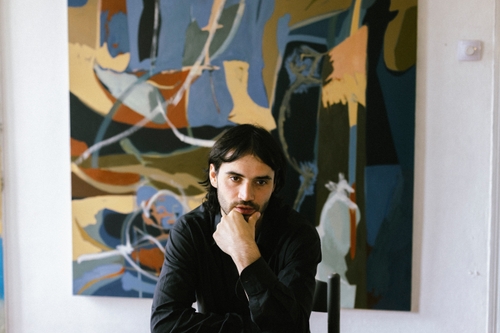
Painting is my main medium, and it's a rooted system I always return to. Whatever I do — sculpture, graphics, or wooden objects — painting remains the format in which my thoughts exist and where I can realize ideas. Not just realize, but discover something new for myself, while simultaneously understanding and not fully understanding the process, merging with it. It's less important for me to search for different means of expression — what matters is developing one method deeply and with perspective.
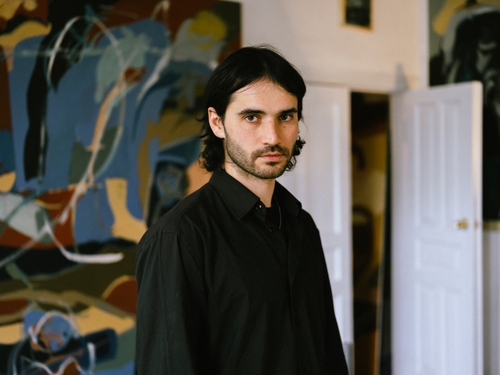
Other forms of artistic expression, such as video art, performative practice, or installation, I perceive more as collaborative fields. They require dialogue among several artists or even people outside of art — theorists, historians, technical specialists. For example, my colleague Vasia Tkachenko works simultaneously with cinema, photography, and music, and such practices naturally open space for collaboration. So if I ever consider realizing ideas in another medium, it would likely be in partnership with others to make the project broader and more dimensional.
Lesia: You mentioned Vasyl Tkachenko (Lyakh), with whom you share a studio. How did you find it, and how do you manage to coexist in one space? Does this proximity influence your work?
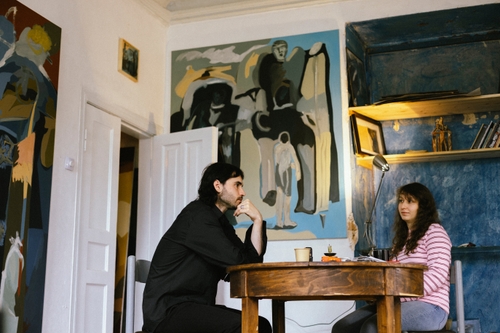
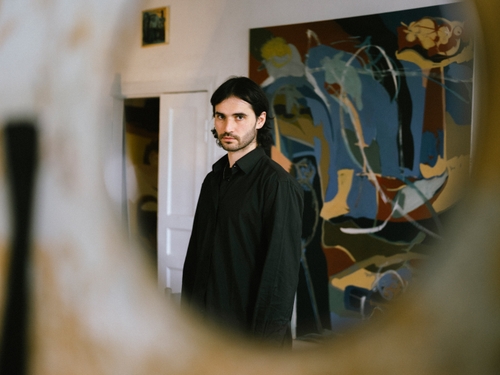
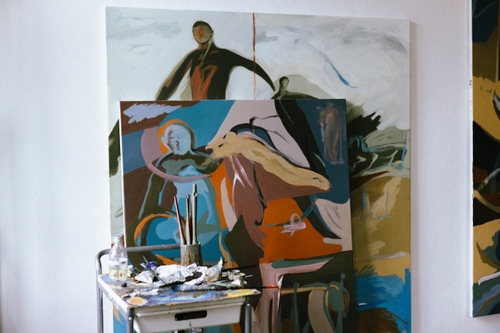
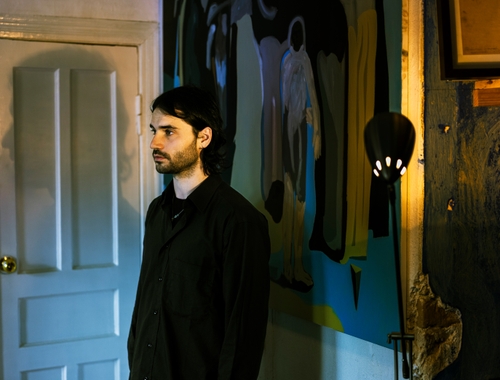
Oleksandr: After moving to Kyiv from Lviv, I spent a long time looking for a studio. I worked in various places for a year — six months in studios on Reitarska Street, then I moved to a velodrome in the state institution Kyiv Prombudproject, and only after that Vasia joined me. We had already worked together in Lviv before that. And about six months ago, we moved into this apartment that now functions as a workspace — it's a convenient format for working, communication and meetings.
We don't really have to "get used" to each other — it's not difficult. People sometimes ask me how I can work with someone in the same studio, and I reply: "With just anyone — not really, but with Vasia it's fine". It's our third year sharing the same space. We manage it easily; even if our ideas don't always overlap, we come to agreements with no issue, and it's convenient. Vasia is a good friend of mine, so everything is great for now.
Of course, in the future, I'd like more space: a larger studio with separate zones for different types of work. It's not an urgent need now, but eventually, each of us will probably have our own space for creativity. I think Vasia would also like that — to make music, shoot films, paint, meet people. But for now, the shared studio is a wonderful synthesis for both of us.
Lesia: You recently had exams at the Mykhailo Boychuk Kyiv State Academy of Decorative Applied Arts and Design, where you also teach. How did your teaching journey begin?
Oleksandr: When I moved to Kyiv, I was offered a teaching position at the Boychuk Academy while simultaneously studying in the postgraduate program. At first, I decided to just try teaching and ended up staying for a year. Now, I'm transitioning to postgraduate studies, where I've just had exams, to try writing a dissertation, systematize my knowledge and skills in one direction, develop a topic and follow it for a long time. For me, it's both a challenge and an interest.
I see how the education system in Ukraine works, and I understand that my presence there is not the worst thing that could happen to it. It's a valuable experience, and everyone at the Academy, both the rector and vice-rector, supports this, strongly encouraging young teachers and artists who combine their professional activity with teaching, where they can express themselves and share something more with the younger generation.
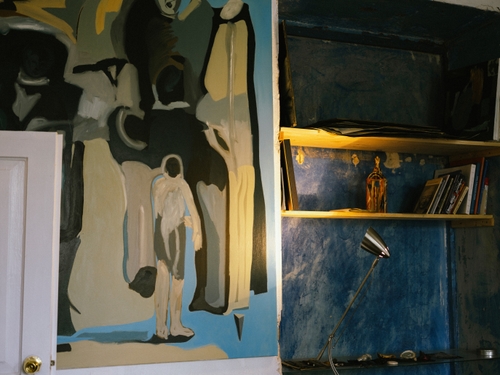
Lesia: You mentioned in one of your interviews that you chose glass art for your bachelor's major to be less influenced by academic tradition and to work more from yourself. What is your approach to teaching now? Have your views on academic tradition changed since then?
Oleksandr: Actually, I wanted to enter a classical academic school and study in Lviv for a very long time. And on my path I met the artist Serhii Matiash, my teacher, who graduated from Lviv National Academy of Arts in 1997. He was originally from Horlivka, Donetsk Oblast, and started drawing there at an art school, then entered the academy, continued his studies, and after graduating lived for a long time in Crimea. He was a person who embodied the diversity of approaches to solving various life and artistic tasks.
I worked with him for about a year in his studio, and it completely changed my perception of the academy. Not in a positive or negative way — it simply shifted my direction and made my vision more individual and independent. The academy could only become an addition — a place to communicate with people engaged in related fields. At that time, it seemed appropriate only under that condition. I no longer had illusions about it. When I eventually enrolled, I simply absorbed information.
Firstly, I already had a job — I worked in a bar, so I didn't have much time. I was already painting on my own and wanted to have my own studio. I understood that I would have one soon. I still wanted to graduate from the Academy of Arts, but… I was interested in it, yet I already felt that I didn't fully fit in. I didn't have that much time, nor as many opportunities, and the desire to be there constantly wasn't as strong anymore. Career ambitions began to appear.
So I asked where I could apply to discover something new, to find new artistic forms. Perhaps through material — ceramics, metal or glass. I was advised to choose glass, and that was probably one of the best pieces of advice I've ever received. The head of the drawing department said it was an excellent option.
Lesia: And quite an unconventional choice, compared to many of your colleagues.
Oleksandr: Yes, but if you look at art education in Ukraine, the glass art department at the Academy of Arts in Lviv is almost the only one that truly moved away from the Soviet mass-production tradition. It's fairly progressive: participation in exhibitions in China, collaboration with the Eugeniusz Geppert Academy of Art and Design in Wrocław, constant student trips abroad. The department's team is also made up of young people with whom it was interesting to talk not only about the technical possibilities of glass, but also about business — how to apply one's skills, how to develop an artistic practice in Ukraine within or outside the academy.
So I chose glass, studied for four years, and then decided to enter monumental and easel painting — essentially because my teacher had graduated from that department. When I enrolled in 2022, I studied with the same teachers as he did, only now they were in their eighties. I feel like studying with them completed my personal story in a way and helped me better understand how the system works from the inside.
Although I can't say I was deeply involved in the studies: I was constantly working, and for almost the entire master's program I was traveling abroad for residencies, for example, to Finland. So the experience wasn't something groundbreaking for me.
Now, when I teach, I feel that it somehow returns to me. I resisted academic drawing for a long time — and now I teach it. I think one needs to struggle through it a little. You can't escape it. What I do with students helps me better understand what I myself skipped during my own studies.
Today's students are very different from those I studied with. They are interested in other aspects of art: they want to understand what an artistic niche is, whether it's possible to live off art, participate in exhibitions, and build good prospects — how to earn money through it. These are key questions for them, going in parallel with developing skills. When I was studying, we didn't think like that. We just wanted to be able to do something, everyone was floating in space. But now, during the full-scale war, everyone has been grounded in a way: they want to clearly understand what foundation they stand on.
New laws in education reflect these changes: everyone is rewriting updated curricula, trying to create a system where a student can choose what and with whom they want to work. There is no longer a rigid canon or academic dogma — everything is flexible and changeable, at least at the Boychuk Academy.
Lesia: Some of your colleagues have mentioned that other art institutions remain stagnant — no progress, outdated programs, and no desire for change.
Oleksandr: That's a separate issue. There are two categories of people in education. Some believe that new reforms won't lead anywhere and that it's better to hold on to the old hierarchy — where the teacher's authority is central, the format is strict, and everyone must follow it. Others seek new approaches. And that's the real question.
We can change many things, but what these changes will bring — we'll see over time. It's not guaranteed that new programs will make students more progressive or interesting. It might happen that they, on the contrary, get confused, because it's unfamiliar to them. There may be an excess not even of knowledge, but of information — while practical work in academies is decreasing.
Everything is becoming more theoretical and abstract. And this may not influence education in the best way. Because, for example, at the National Academy of Visual Arts and Architecture they still draw a lot, while in other places, including ours, it's much less common. The focus is shifting to new or more promising disciplines. What will they lead to? Essentially, the process is ongoing, so we'll see. The main thing is to draw conclusions in time and analyze the situation.
Lesia: Returning to your artistic practice — how do you choose themes for your works? Is it more about spontaneity and inspiration, or persistence and daily routine, when you sit down to work regardless of your mood?
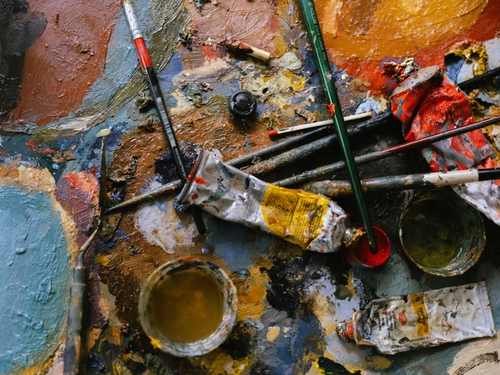
Oleksandr: Clearly, it's routine work. I work almost every day. Sometimes even when I shouldn't and have other tasks to do. At times I put important things aside and go to the studio when I should be somewhere else. It's a place I'm attached to, where I constantly interact with the process, and it's daily meticulous — yet fascinating — work.
Themes don't appear spontaneously. They likely come from the literature I read, the people I talk to, my personal thoughts that I write down. Then I try to give them context — to place them within a historical background or a personal observation. This material becomes the foundation of all my work.
A key trait is observation and the ability to capture thoughts. It's a large part of the work — noticing details around you and giving them meaning. Making ordinary things more complex in an attempt to understand myself better — that, essentially, is the thematic core of my practice. I don't know how to simply explain where themes come from…
Lesia: From the constant thinking process?
Oleksandr: One could draw that conclusion just by reading the titles of my works.
Lesia: Speaking of titles — do they come to you after the work is finished?
Oleksandr: Usually after, though sometimes during the process. At that point, a sense appears of what the work is about. Often I add two or three paragraphs to the title — a more detailed description of the piece. And I don't do it for viewers, to explain things better to them, but for myself — to preserve the chain of connections between different works through format, colour, focus. These texts help tie everything together and build a structure for a series. A certain series emerges — a summary of a period. For example, half a year might pass, and I'll see I've made around fifteen works. I can then unite them through the titles I give, the texts I write, and the thoughts I record while painting.
Lesia: Do you have any rituals while working — like сoffee, cigarettes or something else?
Oleksandr: I wouldn't really call it a ritual. Perhaps it has something in common with a certain sacredness, but it's more of an added layer. Ideally, I'd like to come in and start working right away. For example, if I were painting portraits — full-length or just faces — I would probably arrive and immediately begin, because I'd know what I'm dealing with. But with my work, I often need to put effort into finding the right emotion, image and composition.
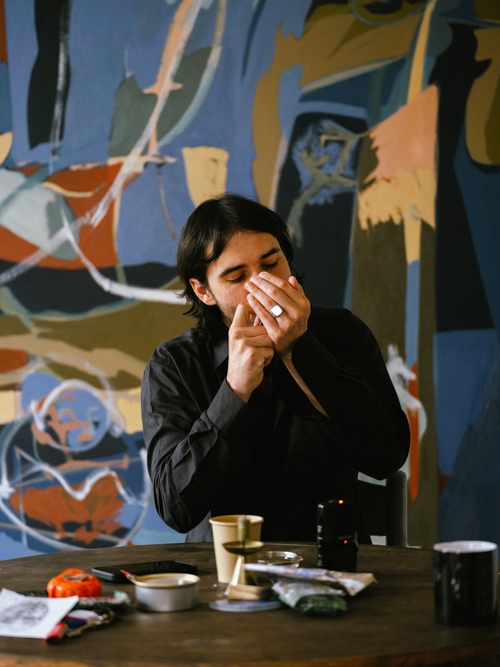
In my case, there are ten works started, frozen at a certain stage, and I can't continue until I understand where exactly to move next. Then I move forward, realise that's not it. I wait, then I change things. These are processes that can be difficult to enter. You can't immediately understand what needs to be done. And perhaps the only ritual here is waiting — something that arises spontaneously. You're set to finish, continue or begin something, and when that intention aligns with the right mood and possibility, that's when you start working on a piece.
My relationship with the works is a kind of dialogue. I don't know what it will be from A to Z. It's a wordless conversation where I layer things, add, remove, change. Then I write text if thoughts appear. Then I switch to another piece without finishing the previous one. Constant changes, constant communication with forms, objects, colour, lines, format. It all alternates. So perhaps the only ritual is that moment of blankness, when you don't know what to do — and you realise you can't do anything here right now, but you can elsewhere. By the way, did you mean rituals before starting work or in general?
Lesia: Overall. Maybe there are some rituals before starting, or maybe you just don't have them or don't perceive them that way.
Oleksandr: I need to think about that.
Lesia: So perhaps the real question is whether you perceive it as a ritual.
Oleksandr: Well, if I were to see it as a ritual, then probably not. It's my work and part of my life. If you think of life itself as a ritual, then yes. But if we talk specifically about my activity as an artist, there's little ritual in it. It's more global. Working on particular things is more about understanding, exploration, trying to explain something to myself better, establishing communication with the outside world through my practice, maintaining communication with myself, and constantly discovering something new. Many functions are overlaid onto what I do.
Lesia: In one of your previous interviews, you mentioned that art for you is a way to reflect on ontological issues. If I understand correctly, at that time you were reading Kierkegaard, Kant?
Oleksandr: Perhaps. I think it's less about a Western philosophical foundation and more about my interest in religiosity, in the very foundation of creation — the act of doing something to create. What a person creates can have only an indirect connection to themselves. And, of course, this also draws on literature, which in my case is mostly that bordering on philosophy and psychology.
Lesia: Do you, as an artist, feel this tension between the being of an "ordinary person" in Martin Heidegger's sense of "das Man" — the least problematized way of living — and the urge to engage with deep ontological questions that concern you? How do you reconcile the two? Are there gaps or ruptures that push you toward this reflection?
Oleksandr: Honestly, I didn't quite understand the part about ruptures.
Lesia: I meant that you talk about ontological issues, but most people in daily life don't think about them. They have their own lives, routines and work. Yet something prompts them, at certain moments, to turn to more complex questions. In your case, what could that be?
Oleksandr: I never specifically cultivated the ability to explain things in complex terms or approach life from a philosophical or existential perspective. I just had, since childhood, a feeling that I didn't understand who I am, what I am, where I'm going. And this wasn't only about myself — my surroundings were also confusing to me. The world seemed disoriented. Literature probably confirmed my thoughts: I realized that all this has names, that people have been exploring these questions for thousands of years, that there are various ways of understanding — religious, sacred, traditional, from which people draw conclusions.
So I simply began to analyze for myself what it all meant. And that's probably how art appeared in my life as a tool, a way to record certain things for myself, to discover something new, and try to integrate it with my reflections on what was happening around me. I gradually realized that when we talk about these topics, maintaining a clear line is difficult, and everything becomes rather chaotic and abstract…
Lesia: You can speak however is comfortable for you; that's perfectly normal. The question was about what prompts someone in routine life to think about something greater. You said that the questions "Who am I?" and "Who else has asked this?" have interested you practically since childhood.
Oleksandr: There isn't really a chronological starting point. I could start from childhood and never leave it, then try to overlay it onto the present, and it would produce many gaps, a disconnected story.
Lesia: How do you analyze this for yourself in general? It doesn't have to be a linear narrative, just your conclusions.
Oleksandr: Analyze what, my life or my artistic practice?
Lesia: Both. Because artistic practice is an important part of your life.
Oleksandr: But I don't analyze my life. I just live. You live, and you have a sense that something is behind you, something ahead. And it doesn't matter what a person does — art or not. I think most people have this feeling. Some can rationalize it for themselves. Maybe it's a different form of communication with oneself. It can be complex or simple, necessary or unnecessary at a particular time. The human need to draw conclusions, analyze oneself, think about past and future — this varies greatly. And I remember having this feeling.
I realized fairly late what I wanted to do concretely. It was satisfying to recognize that I had found an activity for myself. Since then, I have been constantly discovering new things and categories. But I can't say there's a fixed point, a single turning moment. This happens organically. In fact, the less you analyze the past and your path, the better.
Lesia: Do you ever experience so-called creative crises?
Oleksandr: Well, there is life, and there are crises, personal or collective… Many of them. But if an artist says they're experiencing a creative crisis, it would be a bit audacious. What kind of creative crisis? There's work to be done. If one piece of work isn't happening, another one is. What matters is constantly encountering something and engaging with it. It's not always a progressive technical process, where you're continuously occupied with projects. It's the ability to occupy yourself with something that will eventually find a resolution or a form of expression. In my life, it works like this: you do something, and over time it creates bridges — bridges for communication with people, bridges in your career. It works toward the future. I don't always think about the present; I just do something, and that’s it.
Lesia: And how does your artistic practice coexist with the reality of war? Is it more a form of discipline, a positive distraction, or does it, on the contrary, provoke more pessimistic reflections?
Oleksandr: But my practice didn't begin with the war. It started in peaceful, beautiful times, when there was a certain lightness…
Lesia: You mentioned that historically crises emerge, and the war has also become such a crisis. How has it affected your work?
Oleksandr: What existed before Russia's full-scale invasion was a completely different world for me, as it was for many of us. The past is something you can't return to. Only memories remain, the supports on which everything rests. Perhaps that past gives the strength to exist and work now. It created a foundation and tempered me.
War profoundly changes people. Primarily because you try on (it's a gentle term; I simply mean you imagine or construct in your mind) very different possible outcomes for your life. Today you do one thing, and tomorrow you could find yourself in a completely different social position. Everything can change; life is, in a sense, under threat. I mean this not as fear, but as a sense of instability. It has an effect. And for me, art has now become an island that preserves the utopia of the future. It allows me to project a direction where everything will be fine, where everything will function, because everything is working and we are functioning.
Galleries are opening in Kyiv, exhibitions are taking place, new artists are emerging, representing themselves both in Ukraine and abroad. Their ideas and observations are very interesting. And I notice among my students, how the younger generation (and in some ways this is concerning) sometimes barely even notice that the war exists. For them, it has become something overly familiar. For me, it is familiar too — we've all adapted. But I see the before and after, while they may only know the now. They have grown up during the full-scale war. They think in terms of development: what to do next, how to move forward. The changes are certainly noticeable, but I remain focused on the positive outcomes within this context.
Lesia: We all hope for that. But do you often encounter audiences not understanding your work? How important are feedback and responses to you? Do they influence your future work, or do you simply see it as a person's right to have their own perspective?
Oleksandr: I'll start by saying that I myself don't fully understand my own work. To criticize others for not understanding something I don't understand myself would be the height of some kind of pseudo-perfection. I often ask myself questions about it.
Regarding feedback, I honestly haven't felt that people are criticizing or misunderstanding my work. It seems that my art is somewhat different, it doesn't necessarily clash with anyone's perspective because it's not immediately obvious; you can't instantly grasp what it's about. Only during direct, face-to-face communication with someone differences can arise. But I'd say those are always good dialogues. They might not always be entirely positive, yet they remain interesting conversations and debates, which are part of life. And that's great.
I have a lot of interactions with people who are far from the art world, like business entrepreneurs. Someone might come and share their own associations, something completely personal, which might not resonate with me at all. But I can't limit people in their views on visual art, even if they just discovered today that such a phenomenon exists. That's fine. I accept it, understand it, and I'm ready to talk and perhaps, through such dialogue, explain the ideas embodied in a particular work. I have no problem with that. The question was specifically about criticism or rather…
Lesia: About how you perceive the audience's misunderstanding. Do you encounter it at all?
Oleksandr: I rarely hold exhibitions, and that's important too. If I were doing, for example, a solo or group exhibition every three months, there might be more instances of misunderstanding. But I do it quite rarely.
A year ago, Natasha Tkachenko and I held an exhibition at the Peremoga space on Yaroslaviv Val Street. There was also a show at Vienna Contemporary in Austria with Vasia Tkachenko, where we worked on a project together. Overall, the opportunity to visit a gallery and see my works in person is minimal, almost everything can only be seen in my studio. When someone gets to know me personally, it seems to minimize the risk of criticism or negative reactions to my work. I'm quite communicative, and those who know me can, in my view, associate my artistic practice with my personality. So perhaps critical attitudes don't arise. Although, maybe they do and I just might not be aware of them.
Lesia: And if you look back for a moment, which of your works feels the most important to you right now?
Oleksandr: You don't even need to look back very far. There's the series Dreams, which is very important to me because I started it right when the full-scale war began. At that time, I was experiencing a lack of ideas, so I began reviewing my notes just to create something based on what I had written before. Usually, I don't work this way, I just come in and start making things, analyzing afterward. But then there was a crisis, a crisis of mobility: it was difficult to start anything. And I needed something concrete.
I found many notes on dreams I've been keeping since 2017 and simply began drawing them. When reality dictates one thing, you start drawing dreams that dictate something completely different. The key realization was that they really dictate something, they became a different vector of observing my personal history, which helped me; in a way, they saved me from passivity, pause and confusion. This became a key series, which I continue and will perhaps show at an exhibition soon.
There's also a series of graphic drawings in a Soviet-era notebook, which I formally call a "diary", though they are small charcoal sketches.
Lesia: Soviet notebooks — are they literally Soviet?
Oleksandr: Yes, old notebooks. I lived in Lviv in an apartment where the previous owners — Azerbaijanis who were doctors — had lived. There were many old notebooks, and I took about half of them for myself. About a year ago, I started making drawings in them. I just started, and then realized that this could have been a diary. We used to have a free, carefree life. It could have been a diary reflecting new perspectives on life, new images. I could have explored something in the characters of these drawings, found something for myself. But then you realize that everything is a bit different. It could have become a diary, but it won't.
Now, in Ukraine, we all need only one desired outcome, for which most of us are willing to give the most precious thing we have. But for now, unfortunately, it doesn't exist, because there is one fundamental change missing — that all Russians would no longer be on our land forever. Of course, there are important driving changes, but the result we've long hoped for is not here. Plus, there is the constant threat and anxiety. And this diary, perhaps, became the development of one complex, burdensome thought, which simply manifests itself in different characters and compositions. The drawings are very diverse, but they all tell me one thing: this is a diary of our time. A diary of the unchanging, constantly recurring state.
Lesia: You mentioned that you rarely exhibit, and mostly people come to your studio to get acquainted with your works. How important is promoting your personal brand to you in general? And which methods do you think are the most effective? Which ones actually work for you?
Oleksandr: I actually learned the term "personal brand" about six months ago. Before that, I didn't know what it meant. Essentially, I lived in Lviv for 12 years. I discovered a lot there for myself: different people, experiences, personal qualities. I lived there from the age of 17. And when I moved to Kyiv, I began to understand myself somewhat differently.
Before that, it seemed to me that I was a reserved person, guided only by my own goals and personal achievements, striving to develop independently. Pavlo Hudimov would constantly come to my studio in Lviv and say: "Go out to people, don't just sit here by yourself! You can't exist like this. Artists need to go to exhibitions, communicate with people, meet new contacts and move forward. I invite you, come to the gallery". And I would answer: "No, I'll stay in the studio". It was quite a closed and difficult format for me. I thought of myself as a person who reads books, reflects on things…
Lesia: An introverted person?
Oleksandr: Well, of course, I knew I was an extrovert. It's just that at that time, society made me feel distrustful, and I didn't feel the need to communicate. People irritated me, annoyed me. I wasn't really in a positive mindset toward others, but neither was I negative — rather indifferent.
Lesia: Could it have been a crisis moment?
Oleksandr: Both a crisis moment and Lviv itself, which is quite a closed city — it's difficult there. But it was an important period in my life. And when I moved to Kyiv, I realized that I love people. I enjoy inviting guests and interacting with them. I'm interested in people who are engaged in something different from what I do. I like progressive people who have already achieved something. For me, these are life lessons, important observations. I understand how to transform them into my artistic practice.
I noticed that some artists get lost in basic questions — they can't clearly explain who they are and what they do. But I wanted to have objectivity regarding myself and what I create. I think a personal brand is, first and foremost, social skills. For me, it’s not a cool Instagram with tons of followers where all the works are sold. It's more about life and direct interaction with the outside world.
Lesia: But Instagram is precisely a tool for communication and self-presentation, the question is how you use it.
Oleksandr: Yes. There are simply well-known Instagram artists whom hardly anyone knows in real life. We don't know who they really are, but we see the image they've created on social media. And that works. For me, the bigger question is how far can an artist go? Who can they become? Selling paintings is clear. But what else? Collaborations. And what else?
Here we approach the question: what role does art occupy in the political and cultural life of society? How can it influence decisions and be part of them, rather than just a sector that constantly needs subsidies? For a long time, the assumption was: artists need support. But there are artists who will support anyone themselves. We shouldn't position this sphere as a niche that constantly requires support.
Somehow, in Ukraine, there's a problem when people live for years on minimal grants, and when those disappear, so does their independence. They don't know where to turn or what to do. If there were a story about a personal brand, or at least independent representation of the artist, or greater openness to communication, everything would be different. But I can't demand this from others. In Kyiv, I realized that I could do this myself. And it opened a new side of me.
Lesia: Actually, this is what interests the younger generation, in particular your students. Speaking about the financial side of art, who usually buys your works? Could you outline a portrait of your collector?
Oleksandr: A specific portrait — probably not. But I do keep a list of all the names, of course. (Just so you know: you're all written down!) Well, maybe not all — about 80%. I even have an idea to note down everyone who visits my studio. One day I'll want to look back and see who came, what happened here.
My works are purchased by very different people, from Ukraine and abroad. Often it happens after long communication, discussing various interests and ideas. I appreciate that the people who buy my works are not just those with a good financial standing, but also those who develop their own business or field of interest, investing a lot of effort and resources — which is a trait artists often share, especially those who devote their life to something valuable and meaningful.
So there is interaction here, and a great potential for growth. Someone discovers art, someone — the environment of people who create it. Therefore, if we speak about the portrait of a collector or a client, it's a group of people who possess qualities such as determination, curiosity, and a sensitivity to life in all its diverse manifestations, even in this challenging period of our contemporary history.
Lesia: I won't ask about the very first work you sold, but I'll ask something else. Do you remember the feeling when you moved from occasional or symbolic sales to more official purchases from collectors? Do you recall the moment when you thought: "Now they're buying my work, I am a successful artist"?
Oleksandr: If they're buying — it definitely doesn't mean I'm already successful [laughs]. I don't remember a specific moment when it happened, but I clearly remember when people I didn't know personally started buying my works. And that was important. Before that, I more or less knew — or even knew very well — who was buying. And suddenly I had no idea who these people were. We would meet, they would choose the works, ask many questions — and that was a completely different level of interaction.
Lesia: And you don't even know how they found out about you?
Oleksandr: Usually, I do know where people come from. Again, someone appears through someone else, but that's also an important signal. It's clear that it's no longer my friend directly, but someone who heard about me from somebody, someone showed them my works. That's how this whole story grows.
So there wasn't a single moment when I clearly realized that things had changed. My friends still buy my works. But there are new people who come for the first time to acquire something. I also often place works in showrooms or public spaces. So it's a constant combination of different connections.
I haven't created a fixed buyer profile, because that's more of a dealer's task: to understand which category or audience a particular work might be for. Sometimes I recommend works by other artists, but personally I'm only involved in selling my own art. And I don't have a specific portrait of a collector, because that could be limiting. It's more exciting when someone new appears and adds to this story — when a work ends up in an unexpected collection.
Lesia: And how realistic is it to live solely off art for you and for your colleagues? Do artists need to do something else as well? Let’s put teaching aside for now.
Oleksandr: Of course it's possible. I've been living solely from my art for about five years now. It's absolutely achievable even in Ukraine, without entering the international market. You just need to dedicate time and attention to the financial side of your practice. I think many would agree with that. But the question is how to hold it all together, how to…
Lesia: Manage it properly.
Oleksandr: Yes, how to plan, how to operate your finances, invest in your own development and so on. You can't just expect money to come in while you're simply painting, it doesn't work like that anymore. As much as we might wish it did.
Lesia: And if art didn't bring any income, would you still do it?
Oleksandr: Yes, of course. I realized that back when I quit my first job. I had worked in a bar for five years. I saved some money, enough for three months as I calculated, and then I just quit. I knew I would keep doing art even if it brought nothing. Still, I couldn't step completely into the void with that idea.
I set a timeframe for myself — five years: during that time I hold on, and then we'll see. I already had a studio then, and I wanted to spend all my time working there. I understood that I would continue no matter what, because I had thought long and hard about that decision. And my teacher, Serhii Matiash, was an example that it was absolutely possible, so my worries gradually faded.
I kept this pace for about a year, and then Pavlo Hudimov offered me a job in his gallery. It contradicted my principles of not taking any side jobs, but I decided that if I wanted to do art seriously, I needed to understand better how a gallery works, who the artists are, what the conditions of cooperation look like, pricing, contracts, and so on. And I gained that experience with Pavlo when I worked at Ya Gallery for over a year.
Lesia: As a curator?
Oleksandr: I was doing almost everything there — from organizing digital archives, managing Pavlo's collection and processing documents, to restoring the gallery space and installing/dismantling exhibitions. I met collectors who bought works by remarkable artists, such as Andrii Sahaidakovskyi, Uliana Yaroshevych, Dmytro Moldovanov, Ihor Yanovych, among others. And I realized that it was interesting, that there was potential in it. Not that I clearly saw potential in myself at that time, but I understood that it existed, and that helped me worry less about the future. Plus, my communication with Pasha was a great support for me back then.
Lesia: Regarding entering the foreign market. You mentioned that this isn't important for all artists. But it seems that for you it still matters, especially considering that this year your works were presented at Vienna Contemporary. Could you tell us how that invitation came about?
Oleksandr: Actually, I've been planning an exhibition abroad for about two years, but I haven't been able to realize anything yet. For example, I arranged an exhibition in London. But everything there is planned well in advance, and they offered an exhibition two years from now. And that's normal for Western Europe, particularly the UK. But for me, two years is too far ahead — I understand that…
Lesia: It's difficult for Ukrainians to plan two years in advance.
Oleksandr: Yes. They wanted to fix specific works and make an exhibition with them in a year and a half or two. I said no, that wouldn't work, because I would either exhibit or sell these works somewhere else, and who knows what would happen to them afterward. So nothing could be planned.
Then I was offered an exhibition in Milan, but the communication with the Italian gallery felt a bit condescending. It's an old gallery, operating since the late 1990s, and I didn't want that kind of attitude toward me. The collaboration terms were strange: at first, I agreed, but then decided it didn't suit me.
After that, I wanted to organize an exhibition in Los Angeles and tried for a long time to establish contacts with the Ukrainian galleries there. But everything was scheduled far in advance as well — maybe a year later or even later. We'd say, "Okay, let's do it in a year", but by then everything changes a lot, and no one keeps their word — neither I, nor the gallery, nor the intermediaries. These attempts were not so much about entering the foreign market as simply about holding an exhibition abroad. Here, I roughly understand my audience, but there — I don't. I don't know who it is.
Then I went on a residency in Finland, where I also showed my works, but there was no exhibition, it wasn't part of the program. I tried to arrange something, but the conditions didn't allow for a proper exhibition. It would have been an incomplete show.
So this ambition has existed for a long time. Although many people abroad have bought my works and still do, these are private collections and not about entering the market. Someone saw them, someone recommended them. I have friends in New York and California who helped promote my works. By foreign market, I primarily meant not the financial aspect, but rather…
Lesia: Representation?
Oleksandr: Yes, exactly, representation through a foreign gallery. That's genuinely interesting to me. Together with Natasha Tkachenko, we organized an exhibition at Vienna Contemporary and are currently planning something else. It might be in the U.S. or London; right now, we are in the discussion stage. I think sometime in 2026 we will get closer to realizing a foreign project. At the moment, there aren't any solid concrete offers from international galleries. There is interest, but nothing has developed further yet.
Lesia: What overall significance did Vienna Contemporary have for you? What kind of feedback did you receive?
Oleksandr: There was a lot of feedback, of course. About half of the works remained in Austrian collections, which is interesting, because Austria is quite closed off to foreign art. They usually buy a lot of domestic work, and almost nothing else interests them. Yet they acquired both my works and Vasyl Tkachenko's, and left very positive feedback. A few visitors even wrote personally to me and Vasia. That was very pleasant.
For me, participation was important because it's an art fair, and contemporary art fairs are a completely new phenomenon for me. How does it work? Is it purely commercial — you bring 15 works, sell everything, and leave with a pile of money? Or is it something else? I didn't want it to be just a buy-sell format. It turned out that there are actually many interesting opportunities for collaboration: for example, proposals from the Czech Republic, as well as possibilities in Austria and several other European galleries.
Looking at the proportional breakdown of people interested in our works, it's roughly 40/40/20: 40% collectors, 40% galleries and museums (including, for example, the Albertina), and 20% artists and photographers. This gives a rough picture of Vienna Contemporary visitors. I understand now that the art fair as a phenomenon works quite well. In three days, you get an extraordinary number of contacts and communications. There's a lot of feedback, and many recorded contacts of people who want updated information, portfolios, to see new works, or to propose projects. Sometimes they reach out not directly to us, but to Natasha's gallery — they are also interested in her activities. The feedback is positive, and I'm satisfied that we did it.
Lesia: Great! I have another question about the artistic community.
Oleksandr: Toxic community? [laughs]
Lesia: Well, that too, eventually. But firstly: how do artists of your generation (if we can put it that way) influence each other? Is it a productive exchange of ideas and support, or hidden (or not so hidden) competition?
Oleksandr: Personally, I don't see any competition. Most artists are already independent, they've found their place; they're already collaborating with someone, have made agreements, have certain plans, and so on. There's no real rivalry because everyone has organized their activities in a way that gives people something to do and someone to interact with.
Lesia: And toxic or draining moments? What's difficult to work with in the art community?
Oleksandr: Well, maybe I'd even like there to be some, but they're not abundant. In our artistic community, communication is good with everyone. Even if someone isn't particularly friendly, it's never like, "Oh, I'll just avoid that exhibition!" Everyone moves freely, everyone interacts. If someone doesn't appreciate the art, they might still appreciate the person and vice versa. That's normal. People are open and take things reasonably.
As for influences: they go far beyond the work of living contemporary artists. Influences can be absolutely varied. We often share thoughts with each other about artists who worked a hundred years ago. Just recently, I met with Nikita Kadan, and he said he's currently very interested in artists from the times of the First and Second World Wars, trying to understand their experience. And you can also discuss that, because it's an interesting historical parallel, even though that experience differs from what we're living through now in Ukraine.
So these influences are just like those between people: I don't see a distinct artistic specificity in communication. When you meet with people and exchange ideas — that itself is an influence. Right now, as we're talking, this also affects what I will think about later and what we'll do next. Such interactions are an inseparable part of social communication, and even more so with people in creative professions. Sometimes it manifests in joint exhibitions or projects, or the creation of a collaborative work and its presentation. I have such initiatives. There are people I share ideas with, and we plan to realize a joint project in the future.
If we talk about influences, ideally they lead to interactions. But in everyday life, people simply share their thoughts. I think we all lack communication right now, and it's at least pleasant when it happens. The fact that no one is closed off, that you can meet and just talk, share news — that brings people together.
Lesia: I would like to mention Marharyta Polovinko, who has left a notable mark on contemporary art. What was the most valuable thing for you in your collaboration with her?
Oleksandr: Well, I'm not sure I would call it a collaboration. We dated and were a couple for about a year. It wasn't a collaboration. We lived and worked together for a year.
Lesia: I'm sorry, I didn't know about that. If it's uncomfortable for you, we don't have to talk about it.
Oleksandr: It's okay, we can continue. The focus on collaboration completely shifts once you realize that we were a couple. For me, she was an incredibly close person. We could just work together, create something — and it was wonderful. I’m glad we had the chance to do that. It left a significant mark on both my practice and my life.
It was fascinating to observe each other, since we come from completely different parts of Ukraine. Although we shared many things in common, different ideas would emerge. Once, we spent several days in the Carpathians, sculpting a ram and creating some joint drawings; we also spent a lot of time in my studio in Lviv and in her studio in Kryvyi Rih.
Marharyta could take anything in her hands, and it would become something important and valuable. Until then, I hadn't met anyone like that. I truly appreciate this experience. I value that this person was in my life, and I feel that our communication continues even now.
Lesia: I'm very sorry.
Oleksandr: This is a loss. It is an extremely great loss for everyone — not just personally for me. It is an enormous loss overall, on a global scale. And, unfortunately, it is not the only one we are facing today.
Lesia: I also wanted to ask how you assess the importance and prospects of digitizing art, its virtual representation and online accessibility. What does this mean for you? Why are you interested in collaborating with UFDA, and what can you gain from it?
Oleksandr: It's a large digital archive that is being formed, both a museum archive and an archive of contemporary artists. For me, it's logical and reasonable to be part of it, and I'm glad I was invited. Even on a basic level, I understand its purpose: some works get lost, some can simply disappear as physical objects over time or due to the circumstances of war. After digitization, they will remain, and people will be able to see them.
There is real potential here: digital works can exist as a virtual museum, where you can both view and read about them. This helps fill gaps in the history of the future — the gaps we have now when we look back — simply because such technology didn't exist before. It also reduces future disputes over what, when and how, because everything will be recorded. That's why digitizing art is necessary; it's an important phenomenon. As for how it might work from a market perspective, sales or monetization, I don't try to predict that in advance.
Lesia: I would rather call it a pleasant bonus. After all, the main goal is to create a large platform where artworks can be viewed in high quality. This is especially valuable for people who live on the periphery and don't have the opportunity to visit galleries regularly.
Oleksandr: Yes, absolutely. The innovative nature of this process is obvious. It really is a step forward. We are making many steps ahead now, but this archive in particular is a step ahead of its time. It can become very useful in the future and is both reasonable and relevant now, because we are losing a lot of art, either through legitimate means, by selling it, or through destruction as a result of attacks.
Lesia: Or through theft.
Oleksandr: Exactly, that's why the value of this process is clear to me.
Lesia: And finally, what gives you hope and strength in such a sorrowful time? You seem, despite everything, to maintain an optimistic outlook. Earlier, you noted that you still believe things will get better.
Oleksandr: It seems to me that the war teaches us to value what we have now and not to cling too tightly to life. In doing so, we can feel more fully each moment, our activities, our role. We become more significant to ourselves and to society. This creates certain anchors: hope, self-confidence. Although, of course, it can also be destructive, disorienting. Within these contrasts, one can find personal strength and their own way of interacting with the world.
I probably maintain an optimistic mindset because, while reality is difficult to view optimistically, there is also the desired future that we must simply hold in our minds and hearts. And that future has the right to exist.
Perhaps right now, my source of hope and strength is communication with people — my friends whom I see regularly, with whom I can interact and create something. Or do nothing at all and just enjoy the fact that we have this opportunity (an opportunity that exists primarily thanks to our military). Despite everything, most of our people preserve their individuality and a broader sense of purpose: to act, to exist, regardless of how life may change.