
Flight into One's Own Abyss: Artist Petro Bevza on Creativity, Love, and Light

Lesia Liubchenko
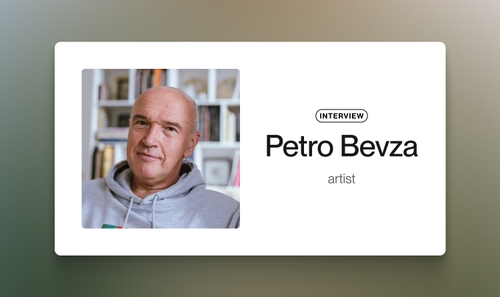
Interview conducted by Lesia Liubchenko, Content Lead of UFDA.
This interview is also available in Ukrainian. Click here to read it.
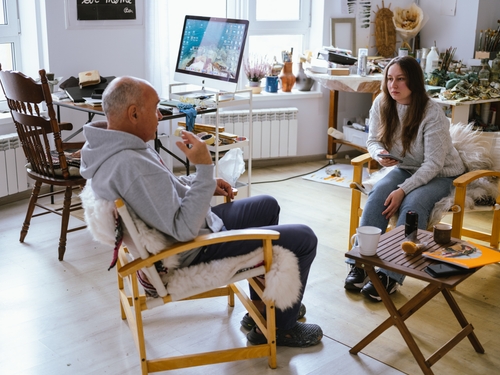
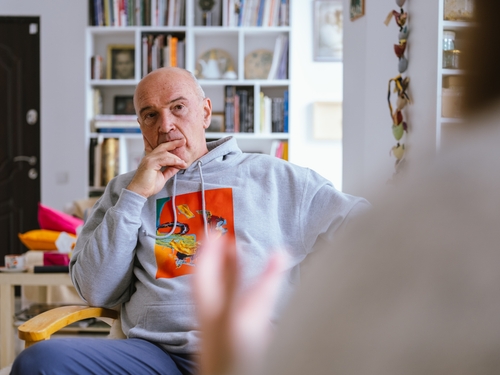
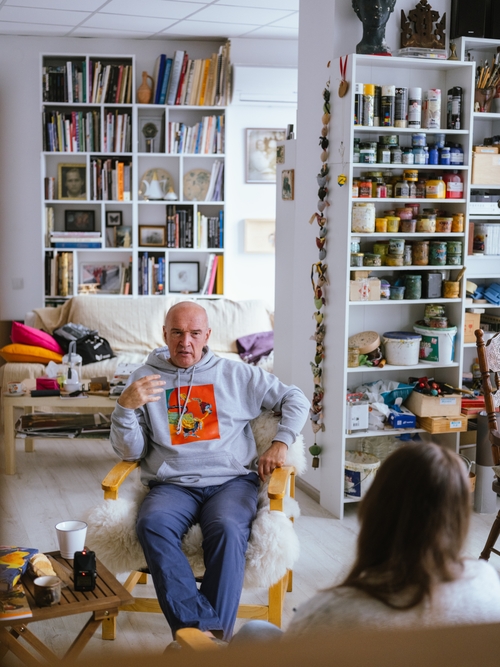
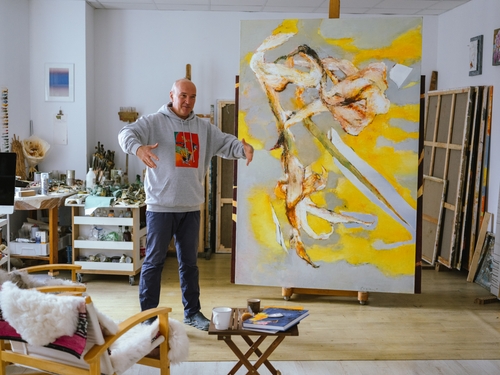
Petro Bevza's studio is a space where time slows down and attention sharpens. Here, external noise gives way to inner perception, and creativity becomes a gesture of responsibility and action. In this conversation, the artist reflects on his own practice through the lens of a vertical generation as a continuous dialogue with the classics, on paying tribute to the defenders of Ukraine in art, and on the light that sustains a person even in times of destruction.
Lesia: Mr. Bevzа, first of all, thank you very much for inviting us into your studio. To my mind, a studio reveals the artist's rhythm — the rhythm of their work. Could you please tell us what this space means to you? Perhaps you have certain rituals that help you immerse yourself more deeply in the working process and approach more closely what you wish to create?
Petro: Thank you for this thoughtful question. Indeed, rhythm is a very important concept for me. External rhythms — the bustle of the city, political or social events — inevitably affect us and our emotional state; they trail behind us like a wake and sometimes break in as noise through the windows. The studio is a place where, in order to tune the creative process, I have to tame both external and internal chaos.
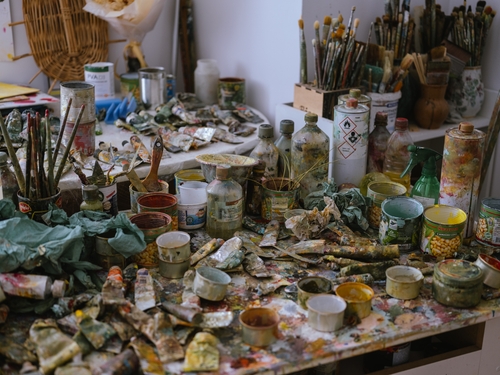
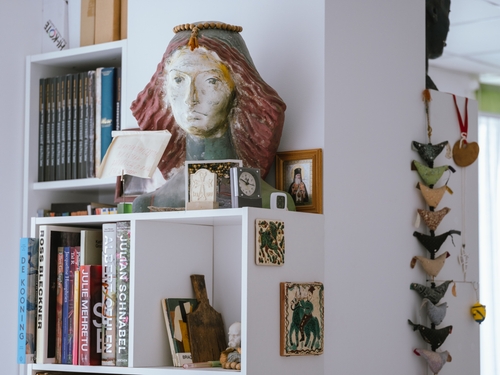
How do I do this? Sometimes, within that chaos, I find an impulse that allows me to build my own structure. At other times, I seek a resonance between my inner sensations and the vibrations of the external world. And sometimes it becomes necessary to switch off external influences and stimuli altogether, immersing myself in my own hermetic world — a world whose place and embodiment is the studio itself. This space both helps and disciplines: the smell of paint and solvent, the canvases, the books — you have come here to work, so it is time to work.
Yet at times it takes a while to switch my internal settings. I arrive at the studio from home and notice that I perceive everything as dimmer, greyer. Then I allow myself a longer or shorter meditation in order to restore my inner calibration.
Lesia: Does stress, then, affect vision even on a physiological level?
Petro: Yes, in particular our reactions. And the studio offers a chance to move into a different mode — not one of interaction with society, but of action as such. Every artist is, in a sense, practically God — just as every human being is. We are God manifested through the networking and interaction of the human community via ideas, energies, and meanings. The main task is to remember this.
Lesia: So for you the studio is a space of this memory?
Petro: Yes, but most importantly, for me the studio is a space of action. We are all one whole and we create our world together. In conditions of external aggressive, destructive processes directed against us, it can be difficult at times to concentrate and to continue the act of creation. In the Old Testament it is written that the creation of the World lasted seven days. I believe it continues endlessly — and we are part of it as well.
Lesia: One of the key images in your recent work has become the falcon, which also gave its name to a series of works. What does it represent for you?
Petro: In the first days of the full-scale invasion, I caught COVID-19. Despite feeling weak, I tried to be useful. The image of the falcon — the fastest bird in Ukraine — became, for me, a symbol of the Armed Forces of Ukraine. The first bird was white. The white color symbolized the purity of our defenders' intentions. At the request of my friends who were fighting, I created about 200 patches based on this image. Over time, I came to realize that other artists make incredibly powerful patches — much better than I could ever create. So I began working on a series of paintings dedicated to my friends in the military. In part, I painted them as a kind of portrait. It may seem somewhat wild or surreal, but when I visited Volodymyr Rashchuk in the hospital — an actor at the Lesya Ukrainka National Academic Drama Theatre and the company commander of the Svoboda Battalion — it was extremely important for me to understand what shape the wings of his falcon would take.
Lesia: By the way, you recently had an exhibition, The Summer of Saint Martin, at the Triptych Art Gallery. Could you tell us a bit about it: how the idea came about and what served as its starting point?
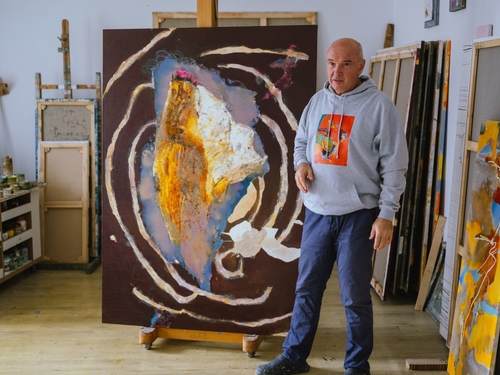
Petro: This series became, in a sense, a continuation of the Falcons. There came a moment when the question arose: what comes next? That's when the idea of lines of force appeared to me. In the Falcons, they were already present, but seemed embedded within a larger system. I realized that I wanted to convey the line of a bird's force in a single stroke. If in the Falcons the universe existed within the bird, then the line in The Summer of Saint Martin was meant to symbolize the energy of flight. I painted a generalized form, dedicated to the titans on whose shoulders we stand.
Lesia: So this is no longer about a specific image, but rather about heritage and memory?
Petro: Yes. These titans include Oleksandr Bohomazov, Petro Levchenko, Alla Horska, and Yov Kondzelevych. But not only them.
In Frankfurt (Oder), there is a cathedral — the Marienkirche, or Saint Mary's Church — which houses 14th-century stained glass. A stained glass window is always a process; a story unfolds within it. In this cathedral, there are three windows: in the center — Jesus Christ, evidently ending with the crucifixion; to the left — Moses; to the right — the Devil. And it is the only sacred place I know where there exists an apology of the Devil.
What happens in the stained glass? Moses, Jesus Christ, and the Devil are born. Tiny children, all with halos. All three live, distribute bread, and as they grow, they heal the sick and raise the dead.
And then a turning point occurs: instead of a halo, the Devil grows horns. He begins to doubt — is humanity worth healing? Should that dead person have been revived? Gradually, he starts to do exactly the opposite. If Jesus helps people, the Devil harms them. Like Mephistopheles in Goethe's Faust: seemingly offering eternal life — here you go, take it. But you sell your soul and continue to act as if you never had one.
These narratives struck me. Later, I read a very precise thought by the great Polish writer and Nobel laureate Czesław Miłosz. He wrote that Russia is a huge caterpillar. And what will emerge from it — a beautiful butterfly, or a nightmare — no one knows. He then added: "I suspect it will be a nightmare".
Lesia: How striking!
Petro: The "valiant" Red Army stole these stained glass windows in 1945 and took them away. Only in 2009 did they suddenly "resurface" in the Hermitage Museum, after which they had to be returned to the Germans. They were reinstalled in the cathedral. These were pieces of colored glass that restorers sometimes assembled as they saw fit, since pre-war photographs were of poor quality and it was difficult to make out details.
When I saw these windows, I realized: the cracks and joins — they are like cobwebs drifting in the late-summer sun. Back in the 1990s, I was quite engaged in literature, and at that time an image came to me: "On a cobweb, a little spider, alone between space and time, the earthly bow of celestial strings" [Ukrainian: "На павутинці павучок, один між простором і часом, небесних струн земний смичок"]. And then I understood: the Armed Forces of Ukraine and we all ourselves are now on this cobweb. Really. The situation is such that we could be killed at any moment, every day. Five years ago, for most people, it would have been hard to believe in such a reality because it seems so wild. Now, it seems, we have supposedly grown accustomed to it. But that is not the case.
Life goes on. It flies, like a moment and like eternity — like cobwebs drifting in the late-summer sun. I had the chance to observe them in the Poltava region — where once Fedir Krychevskyi worked, and now Sashko Babak.
Lesia: In Shyshaky?
Petro: No, nearby — in Velykyi Pereviz. There is a hill above the Psel River. I was fortunate: I arrived at a moment when it was possible to observe the sky filled with entire streams of late-summer cobwebs from that hill. And I realized that there is something greater than fear. It is love. Everything else is secondary. And if we remember love and try to multiply it a little, we continue the act of creation.
So in this series of works, I wanted, on one hand, to pay tribute to the remarkable artists who created the stained glass windows in the Saint Mary's Church — which is why the paintings are so rich. I wanted them to glow, like the stained glass itself. On the other hand, there is the energy of the falcons.
And in the process, the blue color appeared. At the beginning of the full-scale invasion, I gave an interview to a Spanish newspaper and said that our task is to fill the wounds of war with the immensity of the sky. One could have said "with spiritual energy", but I chose this metaphor. Blue became a form of salvation for me, so that everything would not feel sad or overly dramatic — because why should I traumatize you? An artist traumatizes himself in any case. But people need light. That is what this exhibition is about.
The title came from the phrase Indian summer — which, by the way, Joe Dassin sang about in France in the 1970s — do you remember?
Lesia: L'Été indien, yes.
Petro: But that's what the American Indians call it. Why? It refers to the summer of the Iroquois and the Apaches, not French at all. In France, it is called Saint Martin's summer. Saint Martin was one of the first canonized saints and a favorite character of many artists, including Simone Martini and Duccio di Buoninsegna. He lived in the 4th century and was the bishop of Tours.
He lived a long life, and when he died, the people of Tours decided to bring his body to the city. When the procession entered Tours, people saw bushes and flowers blooming all around. This happened on November 11 — the very day my exhibition opened. If one avoids the romantic view, one could simply say: during Indian summer it is warm, and the trees "thought" it was spring, so they bloomed. But the faithful concluded that it was because the saint's body had been brought to the city.
Lesia: So the title of the exhibition also has a symbolic meaning?
Petro: Yes. Saint Martin was the founder of chaplaincy, an officer, a Roman official. He asked the emperor, "May I not carry the sword, but serve with Christ?" — and he was told: "You are a warrior and must serve with the sword". Then Saint Martin proposed a compromise: his weapon would be an idea — spirit, not matter. The emperor agreed, and he became the first chaplain. Under his guidance, this movement began.
When I wrote the text about this series of works for the Triptych Art Gallery exhibition, I thought about what it means to be a saint. For example, today we have thousands of saints — those who serve in the Armed Forces of Ukraine. You could even name them individually. The question is: who canonizes them? I do. The artist canonizes them, people canonize them. The Church will do it when it decides to. But sainthood is love, the absence of fear. Not completely, because then one would have to be Buddha or Jesus, but to a greater extent.
So the exhibition is about the idea that we create Saint Martin's summer ourselves. And we are aided by those who give their lives for us.
Lesia: In 2024, your exhibition The Vertical of Time was held at the Kyiv History Museum, featuring works created over the past 30 years. How did the metaphor "vertical of time" come about? Why is it important to you?
Petro: I am convinced that the transmission of what is essential happens vertically. For example, one person is 20 years old and another is also 20 — that is a generation. But another person is 50, and between them there seems to be a 30-year chasm. There is no contact: some have already forgotten, others have not yet learned. But I think it is not quite like that. In reality, everything moves through the vertical generation, because we stand on the shoulders of titans.
There is no problem if we want to speak with them: with Bohomazov, Taras Shevchenko, Hryhorii Skovoroda. For example, through their works. Or, if you are a believer, with Alypius of the Caves, whose reliquary is in the Kyiv Pechersk Lavra. Alypius was one of the first Ukrainian artists.
Lesia: So the vertical of generations is about a connection to the past?
Petro: Yes. The dedications I make help me, because it's as if I can communicate with whoever I want.
The earliest work of mine in the exhibition was from 1994, and the latest from 2024. I wanted to establish a connection between them. Of course, technology, imagery, and style change. But there are things that do not change. Once they are discovered, you spend your whole life clearing the space around them to bring them into focus. Layers of time rise and overlay everything. If something is important to you — hold on to it.
When I got married, my grandfather gave me advice. Seeing my future wife, he said: "You've found something important; protect it, don't spoil it, don't break it". He gave me a whole lecture, with points like commandments. For an artist, it's the same: don't let time, traffic jams, informational noise, or wild attacks clutter and obscure what is most essential.
Lesia: What guided you, or what did you focus on when selecting works for the exhibition? After all, you have a substantial body of work.
Petro: It was a matter of intuition. Firstly, each specific space stimulates certain actions. For example, the ceiling height. I have works that are 3.6 meters tall. If the ceiling is three meters high, it's physically impossible to exhibit that work. Or, for example, at the Zaporizhzhia Regional Art Museum, there is a work 5.5 meters long. To display it, you need a flat wall.
The walls in the halls of the Kyiv History Museum are dark gray, almost black. I thought about how to construct the space so as not to say anything unnecessary, but to convey only the main idea. I don't know if I succeeded, but I tried.
Then there is the emotional aspect. Some works make you want to speak softly, while others demand a voice. And an exhibition is when both coexist — quiet and loud, when there is balance, a wave. But it shouldn't be like The Great Wave off Kanagawa, which crashes over everyone. The Japanese think right to left, and in their perception, the fishermen face death. Europeans think left to right: the wave drives them, but they can swim out.
So it's also a matter of structure: how best to organize the exhibition, where to place the entrance and where the exit. We decided: here will be the entrance, and right there — the earliest work, the very first. Then — through the 1990s, followed by Theodosics, Tski, Flight into One's Own Abyss, and finally, the works of recent times.
Lesia: Looking back at your work, which periods would you consider pivotal? Or do you avoid such terms altogether?
Petro: It's a question of allowing oneself to say it. I don't believe you can find something once and then spend your whole life doing the same thing. That doesn't happen. So, without a doubt, there are turning points.
The first turning point came when I met a wonderful woman and got married. Life gained a different color. It's hard to explain. Probably, once again, love.
Then there were communities. Meeting my colleagues and friends — Tiberii Szilvashi, Marko Geyko, Anatolii Kryvolap, Petro Lebedynets, Oleksandr Zhyvotkov, Oleksii Lytvynenko. These are powerful personalities who accelerated my creative process. Later, I was the curator of the exhibition Rencontres Franco-Ukrainiennes (Ukrainian-French Meetings), which featured French artists. One of them — the remarkable Georges Autard, a classic from Marseille — constantly presented controversial ideas. He made me see the Ukrainian art scene as if in slow motion.
Lesia: And how did this affect you?
The project lasted only a month, but I felt as if I had lived ten years. Sometimes we communicated without sleep. There were two translators, taking turns: one slept while the other translated. The level of communication was incredible! But ethical dilemmas arose as well. Once, I had to choose: either be with the ambassador at the presidium or with a visiting artist in a seat to the side. I chose the artist — everyone was already jostling around the ambassador anyway. And then, unexpectedly, a translator appeared: the daughter of the then Ukrainian ambassador to France. She understood that we needed translation — otherwise, how would we communicate? Just like that — and a third person appeared. A turning point. That was 1994.
Later, I visited Feodosia in 2002. Walking up the serpentine path toward the Büyük-Yanyshar ridge, I realized: these mountains are God. For five years, I went there twice a year (in April, when the almonds were blooming, and in autumn) and worked on the series Theodosics.
Another turning point was the moment of encountering a flower. There had been a large exhibition in Moscow; I was returning by train, thinking about how logocentric Russian art is — it is mostly from the mind. Why is Ilya Repin a Ukrainian artist? Because he paints from the heart; his painting is sensual. The next morning, already at home, I went out into the yard. The day before, my eldest son had planted some young irises, and I saw an iris with such a "belly", like a child about to be born. It was a rare moment. The sprout grows, the flower appears, it wilts, it dries — but it is beautiful in every stage. I must admit, I fell in love with irises. For me, they embody the strength of the spirit.
Lesia: And how has your attitude toward the concepts of color and form changed over the years?
Petro: It hasn't changed so much as deepened. Why? Because prejudices and fears appear. When you're young, there are no fears: you just do what you can — and that's it. Later, you begin to analyze. Doubt arises, and gradually there is a danger of dryness, of something being drained of life.
Emotion becomes extraordinarily important here. Many people seek it in extreme experiences — jumping off a bridge, drugs, alcohol, and so on. I am not an adherent of that. It's not the way, because, in reality, we already have everything we need. The question is only how to open that channel. It may seem that a sip of alcohol could help. But what will you do if you can't control the process? Then you are just a puppet.
Difficulty also arises when there is too much information and you need to constantly filter it. Again, impulse, emotion, helps here. Once, I was on a bus, and a woman with dyed golden hair sat with her back to me. The bus turned, and a beam of light fell on her hair. And suddenly — a traffic jam. I thought: "God, let this last as long as possible, and just don't let her turn around!" That's the kind of emotion I mean. I ran to the studio so I could preserve the vibration of the shades in her hair before it slipped from memory.
Lesia: Besides painting, you also work in sculpture and land art. What draws you to these forms, and what themes unite all these media?
Petro: My sculpture is rather conceptual; they are more like objects. Sculptors are special people, and I wouldn't dare call myself one. It's more about the sense of challenge.
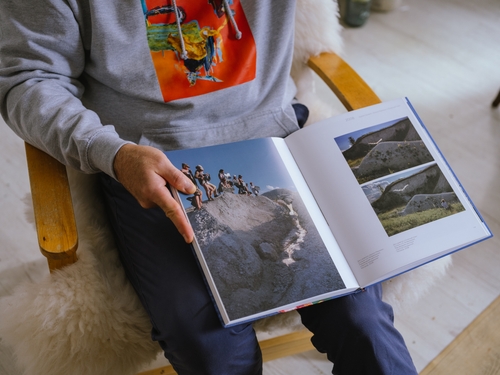
The first such work we did was with my friend Oleksii Lytvynenko in 1999. It was called Heritage. It was a large wooden structure, 12 by 4 by 1.2 meters, with strings stretching upwards. The main idea was to ask what our heritage really is. In the 1990s, society felt lost: what is good, and what, like ballast, needs to be "thrown off the ship"? The Soviet Union — bad, the Soviet legacy — bad. But there was no conscious understanding of the other forms of heritage in society, even though they always exist and there is a demand for them. How to express this? The object emerged as a kind of ship's framework.
Our subsequent works gradually evolved into land art, because I became interested in working directly with the environment — but in a way that created interaction. Not just casting an object in bronze and placing it somewhere. The idea arose to integrate it into the natural environment, into processes that are already happening, as if in collaboration with the Creator.
For example, a work we made with Oleksii Lytvynenko, called Cretaceous Period. There is a village called Mohrytsia in the Sumy region, almost on the border. There was a chalk quarry, where we dug out a white triangle sloping downward. Nearby was red clay, which we poured over the triangle from above, expecting the rain to wash it away — like an hourglass.
About 400 meters away was the Psel River. We were tired and went to swim, and that's when the rain started. I have an initial close-up photo of our work, but no final one — the rain poured so hard it would have been a shame to risk the camera. In half an hour, the rain washed away all the clay, and eventually the entire object. Nature and time did their part of the work, though a bit faster than we expected.
There were also works with light, for example, Halos. My wife, children, and I made halos for every tree in a place where they were planning to cut them down. In the end, the trees weren't cut. Those old poplars are still pruned today, but they are alive.
Then there was the project Solar Bird: Oleksii Lytvynenko, my children, and I installed mirrors to create an optical illusion of a bird taking flight. In fact, nothing moved — only the sunlight reflecting in the mirrors, projected onto a chalk cliff, made it appear as if the bird was rising along with the sun setting on the horizon.
Or, for instance, Mackenna's Gold: a dried-up spring, with artists standing above it holding mirrors that reflected the sun's rays. They illuminated the riverbed that remained, as if the light itself were the spring.
Lesia: Yours are sunlit bunnies, but in Italy they are crafted from wool and straw. In Piedmont, there is a land art installation — a large pink rabbit, placed in an open area 20 years ago. It gradually decomposed and eventually merged with the landscape, leaving only faint outlines. One could observe it disappearing.
Petro: Interesting. I set myself different kinds of challenges. In Estonia, for example, we realized an environmental piece called White. Open on the island of Saaremaa. The winds there are incredibly strong. I was deeply impressed. Oleksii Lytvynenko and I made a heart out of tree branches, suspended it, and it pulsed: stretched with the gusts of wind, creating the effect that it was alive.
The same goes for photography. In Luxembourg, there was an exhibition of the series Cicerone. I worked with photographs, painting over them. There was also an emulsion layer on top: if moistened, the top layer could be scraped away. The photograph alone wasn't enough — I enhanced it. There was nothing radically new in this; avant-garde artists, including Man Ray in the 1920s, did the same. But when instant color photography appeared in the 1990s, new possibilities opened up, including in the realm of collage.
Lesia: You approach your audience with great warmth. How important is it for you that they understand your idea? Or do you, on the contrary, leave space for free interpretation?
Petro: Absolutely, there is space for interpretation. When people say an artist works for themselves… maybe they're right, but I don't think so. If I work for myself, then I also work for you — if you choose to receive it. It's a matter of communication.
Speaking simply, without pathos, I've always had concrete viewers in mind. For example, my mother dreamed that I would become an artist, and I think in many ways I oriented myself toward her. When my children were born, of course, I began working for them as well. They even helped me. Sometimes I'd show an abstract work and ask, "What do you see here?" — "A tiger". I don't see a tiger, but the child does. I think: great, the image exists.
Later in my life, the philosopher Serhii Borysovych Krymskyi appeared. I have generally been fortunate to meet great people. He wanted to write about me, and the result was the article Palimpsests of the Being. In it, Serhii Borysovych seemed to lay out a program for my future. So I worked for him, too.
Then new challenges and new viewers appeared: Georges Autard, Yurii Kochubei. I was preparing for an exhibition in Paris. I wanted to "show off": I studied French for a year, attended courses, and prepared a speech. The opening, a gallery in a prestigious location, I deliver my speech in French. Everyone applauds. Then comes the live conversation. They all spoke so quickly that I completely froze. I was so lost that I still remember the terror. Suddenly, a gray-haired man appeared beside me and quietly said, "I'll help you". That was our ambassador to France, Yurii Kochubei. He acted as my interpreter for the entire evening. I was terribly embarrassed, and he said, "It's my job. I am the ambassador of Ukraine, you are Ukraine. So I am here".
Not long ago, there was a charity exhibition of Ukrainian artists in Vienna. As the organizers told me, some works were bought by the descendant of Hetman Rozumovskyi, Gregor Rozumovskyi. He is Austrian, but with what inner fire he perceived what he saw! By the way, the works from The Summer of Saint Martin I painted also for him, as he is now my viewer, too.
I also work for the guys who are fighting. Sometimes personal pieces. For example, for a driver who, before the war, transported our artworks. He now holds the rank of Chief Sergeant. He is also my viewer.
Lesia: And after the full-scale invasion began, did you notice any changes in your artistic practice? Perhaps a shift in your approach to certain techniques or formats?
Petro: I often talk about love in my interviews, but sometimes fear is paralyzing. At a certain point, you simply can't do what needs to be done: your muscles won't obey, your body doesn't respond. And then everything comes out differently from how you imagined it should be.
In such periods, it's important to try to step out of these constraints — those dictated by your brain, your eyes, your ears. To step away from what you can't stop thinking about. Even being in paradise with too much beauty around isn't necessarily good: you get used to it too quickly. But you also shouldn't get used to the opposite. And getting used to such an opposite is incredibly difficult. I sincerely hope that we can go through this path with as little traumatic experience as possible.
Undoubtedly, the war has a profound impact. As for techniques and formats — that will only be possible to analyze later.
Lesia: I'd like to talk about your exhibition The Synergy, which took place in 2022. It featured the Falcons series we've already mentioned, as well as earlier cycles — Myriad Structures and Theodosics. How did they resonate with the contemporary, already new context?
Petro: The main idea of Myriad Structures was connected to something Serhii Krymskyi once told me: "An artist's creativity is a flight into one's own abyss". Not Picasso's abyss, not Bohomazov's abyss, but your own. And that's very challenging. In someone else's abyss, you have reference points set by others; you roughly know where you're flying. In your own abyss — you don't.
Myriad Structures consists of works from 2021. They depict petunias, and it's as if you fly inside the flower, like a bee. Theodosics, on the other hand, provided stability to the exhibition, so that everything didn't feel too fleeting. I saw people coming in, and some would start to cry. I realized the exhibition needed to be grounded, stabilized. First, through horizontals: Theodosics are horizontal. Second, through the color palette: very restrained, with no sharp contrasts. For example, one long work from Theodosics hung next to the Falcons — it created a horizontal line and almost allowed viewers to exhale. You can't keep inhaling all the time — otherwise, you suffocate.
Every exhibition is its own organism. I wanted it to feel harmonious, cohesive. Very different people came — for example, on their way to the front, Myroslav Otkovych and Hena Chasovyi stopped by. They saw the Serebrianskyi Forest in Theodosics, even though it couldn't have existed in a painting made in the early 2000s. But in that moment — they exhaled.
An exhibition is, in essence, a story. The viewer moves from work to work, assembling meanings, sensations, impressions.
Lesia: Have you ever experienced moments when art seemed to lose its meaning for you? If so, what helped you regain it?
Petro: An artist loses meaning when they step out of the capsule of the familiar — of what they have already done. This was shown very elegantly by director Pavlo Ostrikov in his film U Are the Universe. There is one person, then another — two of them. And the Creator is the third. The voice of the other becomes a point of orientation. And the protagonist flies off to save that voice. He saves an image without even knowing what lies behind it — after all, he created it himself.
We are constantly, every second, changing, and we need new points of orientation in our creative work, when old ways of embodying an image are no longer relevant, and new ones have not yet been found. Different factors help us navigate this transition. For example, information. You come to an exhibition that everyone says is great, but you see that it isn't — that it's a profanation, purely a business venture. Then your compass breaks. You think: "How is this possible? Is this a lie? I'm being told this is true, but I see that it isn't".
I used to react to such things more sharply. Now I don't care who does what. There are people I love, people I want to help. Liars don't interest me. I am interested in those who carry truth and light. And the moment you remember that you can help someone — your bearings return.
Of course, it matters when someone praises you, when your work resonates with a viewer whose opinion you value. Sometimes you really need someone to say a kind word — and then you think, "Well done, me". But an artist always knows whether they have done well or not, even if they pretend otherwise. They may be praised, their works may sell for thousands, but they know whether they truly succeeded. When you've been through hell and high water, the next trial is fame itself.
Losing one's bearings is the greatest challenge, because it is a phase of creative transformation. And in our artistic environment, for a long time, telling the truth was not customary at all. A hundred years ago, artists suffered from the opposite — when a painting was exhibited and everyone laughed, pointed fingers, and said how bad it was.
Lesia: Perhaps it's because people hadn't seen anything like this before and simply hadn't had time to get used to the style.
Petro: Exactly. Everything new initially provokes laughter and rejection. The word Impressionism was originally an insult, and today it names an entire movement. At the time, people weren't even ready to pay a single sou — they found it ridiculous. But the artists simply kept working — Claude Monet among them.
Lesia: By the way, in the episode of The UFDA Podcast with my colleague Anna Avetova you mentioned the idea of "letting go" of artworks. You said that it's important for you to understand where your works end up. Do you try to keep track of who buys your works or which collections they enter? And what does this act of letting go mean to you — essentially, the beginning of a new life for the artwork in a different context?
Petro: Let me tell you one telling story. In 1995, I had a solo exhibition at the National Art Museum of Ukraine. It was an incredibly important experience for me — one I still consider a gift of fate. During that exhibition, one of my paintings was sold, and I was supposed to deliver it to the buyer myself.
Everything looked perfect: the work was sold, the price was fair, and it was going to hang in a large apartment in the center of Kyiv. The distance from my studio was literally 300 meters. Why take a car? My friend Oleksii Lytvynenko and I simply picked up the painting and carried it there on foot.
When we arrived, the owner greeted us and said: "I need to settle the payment with you. You go inside, and he can wait in the hallway". I replied that this was my friend, and that he had helped me carry the painting. She insisted. Nothing overtly dramatic happened — everyone has their own rules — but I sensed a note of contempt. I refused to sell the painting. We took it back to the studio.
I thought: my painting would belong to a person who allows herself to treat others this way. How is that even possible? That's why it's so important for me to understand where a work ends up. When a gallerist sells the work, that's a different situation. But when I know the buyer personally, everything depends on the presence — or absence — of a human connection.
It's very touching when people send me photos saying, "I hung it here". That's feedback. It makes me realize that I haven't lived part of my life in vain — that someone is deriving genuine pleasure from this work.
Or another example. During the exhibition The Vertical of Time, I decided to donate a work to the museum — one that they would choose themselves. This was part of my concept. The museum handled everything with great dignity; the exhibition was beautifully realized. They chose a small work, 100 by 70 cm, titled Saint Luke.
The museum director and the chief curator selected it intuitively. Only afterward I told them why this painting was special to me: archbishop Luke Voyno-Yasenetskyi, known in secular life as Valentyn Feliksovych, was an artist, a physician, and the inventor of regional anesthesia. He took his monastic name in honor of the first artist in Christianity. He studied at Kyiv University and lived in Kyiv. So the Kyiv History Museum is the ideal place for this work.
Visitors later called me and said: "We saw your painting in the museum — it's exactly where it belongs". When things align like that, it's a great happiness.
Lesia: And what challenges do you face today, both as an artist and as a citizen?
Petro: If you had asked me six months ago, I would have said that challenges are shaped by circumstances. For example, I had a creative evening, and Yurii Lutsenko came. He had served in the army for two years, but by that time he had already been discharged. And he spoke to me directly: "Create for me an image of what people are fighting for". I had to respond to that challenge.
At that moment, I formulated for myself that the key question in art today is a question of scale and proportion.
Back in 1990, when the Declaration of State Sovereignty was adopted, how did we imagine Ukraine on the map? For a long time, there was this strange red blot called the Soviet Union, and somewhere inside it — the Ukrainian SSR. And when the map of Ukraine itself appeared, Georges Autard said to me: "You are a big country, but you paint as if it's small". He saw something we ourselves couldn't realize: we hadn't truly claimed our own country. I listened to him then and understood that we really are a large country — not only in terms of territory or population, but there is something greater that unites and inspires us.
The younger generation of Ukrainians today — they are amazing young men and women, with fire literally in their hands. They inspire me by what they do and by how effortlessly they do it. The older generation needs more effort — it is more self-conscious. But the ease of the young makes me strive to be light as well.
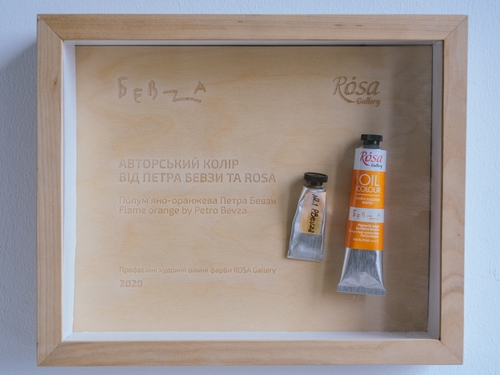
These are the challenges — challenges of scale and proportion. Specifically, the scale of the challenges we set for ourselves. We need to reach a social agreement: whatever we decide we want to be, that is what we will become.
Lesia: And how do you see the future of Ukrainian art? In your view, what opportunities does the present moment offer?
Petro: There was a period when art was actively reflecting on the concepts of globalization and localization, and the tension between them. Today, globalization works instantly: you write in Ukrainian — and the text is immediately translated into English, the request automatically enters the right system. Yet at the same time, there inevitably arises a need for the local — a search for identity, for something deeply your own. Because if you take that away, a simple question emerges: who are you?
We live in a time when Ukraine is maximally present on the global stage. And simultaneously, we see internal contradictions. Therefore, the question of the future is about finding a balance between the global and the local. This is felt particularly acutely in art.
In this context, the question of national art arises. When an American newspaper once wrote that Oleksandr Arkhypenko was a Ukrainian artist, he responded ironically: "I am as Ukrainian as I am Chinese". He wanted to be a global artist — and he was. The Ukrainian community wanted to see him as "ours", while American galleries said, "What is Ukraine? It doesn't exist, there is the Soviet Union". The current war, in essence, is a war for Ukraine's very existence. Contemporary artists today start from this given fact. Arkhypenko, however, began at a time when he alone was Ukraine.
Today, we have a digital reality, AI, the art market as a powerful and often harsh mechanism, different types of audiences, various communities, and the presence or absence of financial flows. In this situation, each artist independently decides how to work.
So, in my view, the main question today is a question of inner harmony and finding one's own model of existence.
Lesia: And in light of this, what kind of support from institutions or foundations do you think is necessary for young artists just starting out?
Petro: First and foremost, we need a network of Ukraine-centered institutions. Ukraine still does not have a state museum of contemporary art — only private initiatives exist. In Switzerland, by contrast, every small town has a contemporary art museum: each canton has a cantonal museum, and there are also separate city museums. There are hundreds of them. I have visited around thirty such museums — and all of them were fascinating.
Here, however, we have only one private museum in Lutsk, created by Viktor Korsak. And even that is already a challenge for communities. It is precisely the communities that must take responsibility and create such institutions. Currently, there is no state museum of contemporary art in Kyiv, nor in Lviv. Such systems need to be built in any case.
Second, there is decolonization — the updating and reclamation of our cultural and historical heritage. This is extremely important. Most people simply do not know their own history or their own art. A clear definition and rethinking are needed — not what someone invented long ago, often during Soviet times, and which we mechanically repeat, but a personal engagement with the material. And this is where a new era of Ukrainian art begins — when we formulate answers ourselves, rather than repeating what was once imposed on us.
Education is, of course, essential. For example, Oleksandr Bogomazov, as early as 1914 in Boiarka, wrote a treatise on painting that remains largely unknown to the public, yet anticipated the ideas of Kandinskyi and Malevich. It must be researched and studied. Only then young people will have space to breathe; they will feel: "This is mine, I have something to build on". And this is just one example.
Lesia: And what would you advise directly to young artists who are just starting out?
Petro: Curiosity and self-education. Today, there are countless opportunities. The problem is that many young people are not interested in either their own history or the history of the world. They often confidently do things that have already been done many times before, in different countries. And this is not just our problem — it's a global situation.
Equally important is connecting with peers. Exhibitions take place — one must have the courage to attend openings and get to know people.
Lesia: You often refer to the image of light in your work. But speaking more broadly, what today serves as that light for you — the light that gives you strength to move forward, both in life and in your work?
Petro: First of all, for me, it's physical light. In youth, everything is perceived differently. Later on, you start to feel the lack of direct, physical contact with light.
There was an interesting moment when collectors came to me and asked, "You mention God so often. Are you a religious person?" I replied that, probably, yes, although I don't belong to any particular church or denomination. The three of us were standing there, talking. I reached out my hand and said that the Creator is with us. And at that very moment, a sunbeam fell on me! They were immediately taken aback, went silent — and the question of why I pay so much attention to this simply disappeared.
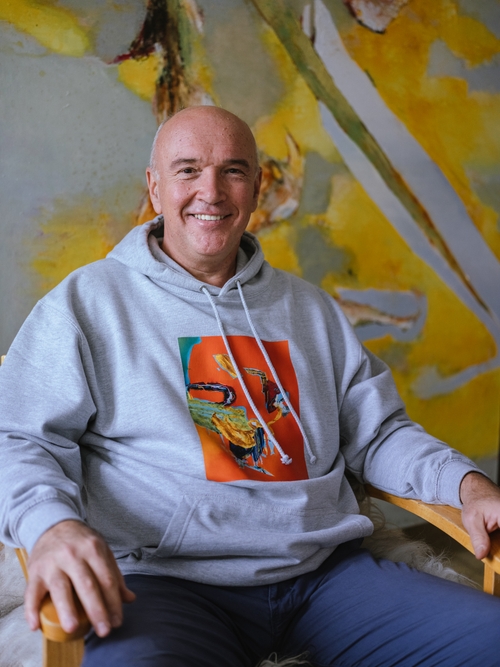
Second, it's the light in a person. Since 2022, I have been collaborating on charitable projects with wonderful curators and volunteers. When their eyes shine — that is the light, the spiritual light. There is also the light of synergy — of connection and community. That is why networking is so important. If you lack something, you can take it from someone who has it in abundance. But only when there is harmony and when you truly want and can both take and give something in return. Even a smile can be light.