
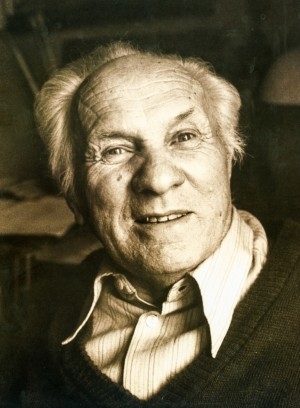
Zoltan Sholtes
Zoltan Sholtes biography
Zoltan Sholtes was a distinguished Ukrainian painter and a representative of the second generation of artists from the Transcarpathian School of Painting.
Summary of Zoltan Sholtes
Zoltan Sholtes's paintings are held in museum collections across Ukraine, Japan, Canada, Slovakia, the Czech Republic, Hungary, Romania, Poland, Germany, and the Netherlands.
Biography of Zoltan Sholtes
The artist was born in 1909 in the village of Prjekopa, located in present-day Slovakia. His family was of humble background — his father was a village schoolteacher.
He studied at the Uzhhorod Art School in the classes of Y. Bokshai and A. Erdeli. It was Yosyp Bokshai who introduced Sholtes to the Public Drawing School.
In 1929, Sholtes enrolled at the Uzhhorod Greek Catholic Seminary, and upon graduating in 1933 was appointed as a priest to the village of Uzhok in Transcarpathia. The upper Uzh River valley — where his friends from the drawing school were also working as teachers — soon became a hub for plein air painting. That same year, Sholtes held his first solo exhibition.
From 1945, he became a regular participant in republican exhibitions, and from 1946 in all-union art exhibitions as well.
In August 1946, together with his colleagues, he co-founded the Transcarpathian branch of the Union of Artists of Ukraine.
In 1961, the artwork of Zoltan Sholtes was featured in his solo exhibition in Kyiv.
In 1965, Sholtes became Chief Artist of the production workshops of the Art Fund, and from 1965 to 1972 he headed the Art Council of the Art Fund of the Union of Artists of the Ukrainian SSR.
In 1975, he was awarded the title of Honored Artist of the Ukrainian SSR.
The artist died in Uzhhorod in 1990, and is buried at the city cemetery.
Zoltan Sholtes's Famous Paintings: Humanized Nature
In many of the artist's canvases, the composition and painterly style reflect Sholtes's desire to convey as much as possible about people's lives and the distinctive character of the natural world. Alongside landscape painting, thematic works also emerged from his brush.
Among Zoltan Sholtes's original paintings of the post-war period are Crossing the Uzh (1945), Hauling Timber (1946), Cottages in Winter (1952), Old Church in the Village of Kostrino (1953), and Village Outskirts (1954).
A vital role in the figurative expression of the artist's works is played by the presence of human beings or the traces of their labor. This humanized nature, as art historians note, is the defining characteristic of the artist.
Sholtes's landscapes include: Spring (1945), Winter in the Verkhovyna (1953), Winter Evening (1956), Verkhovyna (1958), Winter in Zhornava (1959), Kolochava in Spring (1960), Rakhiv Mountain Pastures (1962), and Storm over the Beskyds (1968).
UFDA digitized Autumn Beneath the Polonyna (1983) by the artist from the collection of the Regional Communal Museum of Local History in Borshchiv. This painting is now available for viewing on the fund's website.
Zoltan Sholtes’s Art Style
A student and follower of Yosyp Bokshai, Sholtes developed his own distinctive visual style. It is a poetic realism in which color expresses a deep admiration for the beauty of nature. It carries the spirit of Impressionism, yet with an expressive, gestural brushstroke. Ultimately, it is a style that belongs distinctly to the Carpathian landscape — an authentic interpretation of it.