
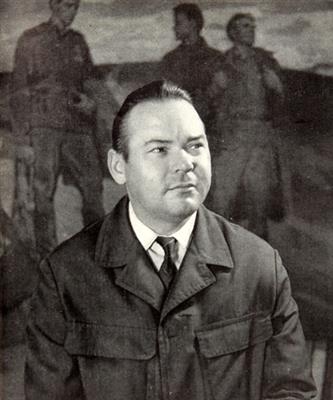
Viktor Shatalin
Viktor Shatalin biography
Viktor Shatalin was a distinguished Ukrainian artist who worked in the field of easel painting.
Summary of Viktor Shatalin
His body of work encompasses dozens of landscapes, portraits, still lifes, battle scenes, and thematic compositions. Viktor Shatalin’s paintings have been represented in republican exhibitions from 1954, in all-union exhibitions from 1957, and in international exhibitions abroad from 1959.
Biography of Viktor Shatalin
The artist was born in 1926. From 1939 he studied at the Leningrad Art School attached to the USSR Academy of Arts. At the age of sixteen he went to the front of the German-Soviet War, becoming a "son of the regiment" of the First Ukrainian Front. His wartime experience shaped the worldview of the future artist in ways that would prove lasting.
After the war ended, he attended drawing classes at the Republican Art Secondary School in Kyiv, studying under Petro Drachenko.
From 1947 to 1953 he studied at the Kyiv Art Institute under Karp Trokhymenko, Hennadiy Tytov, Kostiantyn Yeleva, and Mykhailo Sharonov.
He lived and worked primarily in Kyiv. From 1966 to 2003 he taught at the Kyiv Art Institute. An album of his works was published in 1974, and a catalogue in 1991.
The artist passed away in 2003.
Viktor Shatalin’s Famous Paintings: Power and Scale
Viktor Shatalin's creative path began with the recognition of his own calling as a battle painter and historical artist. As early as 1957 he produced the painting Through Valleys and Hills, which immediately placed him among the acknowledged masters of historical and revolutionary subject matter.
Particular depth marks his 1964 work The Earth, in which the artist turned to one of the most tragic chapters of Ukrainian history — the collectivisation of the countryside.
Among Viktor Shatalin’s original paintings stand out Combat Assignment (1960), Lenin Has Died (1967), The Young Fighters' Detachments Were Gathering (1969–1970), In the Battles for Moscow (1974), The Rains Come (1981), At Dawn (1990), and many others.
UFDA digitized The Thaw (1985) by the artist from the collection of the Regional Communal Museum of Local History in Borshchiv. This painting is now available for viewing on the fund's website.
Viktor Shatalin’s Art Style
He worked in the field of easel painting, producing landscapes, portraits, still lifes, battle scenes, and thematic compositions.
Military subject matter occupies a central place in the artwork of Viktor Shatalin, arising organically from his own frontline experience. His war canvases are not mere reconstructions of battle scenes, but deep explorations of human nature under extreme conditions — an examination of how the best and worst of human qualities emerge under the pressure of life's trials.
In the 1970s and 1980s the range of the artist's creative enquiry expanded considerably. He turned actively to contemporary themes, producing multi-genre compositions, landscapes, and still lifes. Every work was imbued with profound compassion for human fate and an awareness of art's historical responsibility to society.
Viktor Shatalin's creative method was characterised by a synthesis of academic training and an individual vision of historical processes. The artist paid particular attention to the psychological portrayal of his figures. His subjects are not abstract symbols or illustrations of historical events, but living people with their own specific fates, experiences, hopes, and disappointments.