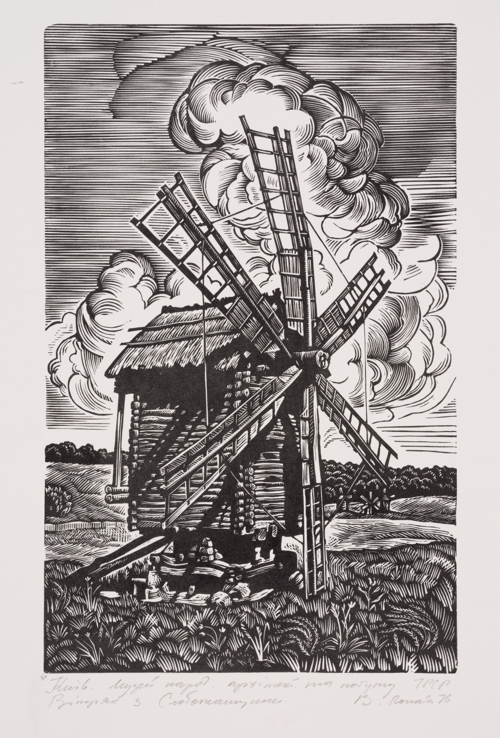
Autumn in Vydubychi
1982, Print, Linocut, Realism
Verified Authentic
This is a Digital Original of the artwork, digitized
using technology, and exists as a unique exemplar.
Each Digital Original is verified and secured through blockchain technology, providing full rights to exclusive digital ownership.
using technology, and exists as a unique exemplar.
Each Digital Original is verified and secured through blockchain technology, providing full rights to exclusive digital ownership.
This artwork is not available for sale at the moment, but you can submit a request to purchase it.
This painting belongs to the collection of the Regional Communal Museum of Local History in Borshchiv, Ternopil Oblast.
 281 Trillion Colors
Oleksandr Hubariev was a Ukrainian painter and graphic artist, an outstanding master of watercolor and linocut.
Most of the artist's works are regularly exhibited and always enjoy success among fans of fine art. Oleksandr Hubariev’s paintings and graphic works are kept in the country's finest museums and in foreign collections.
Biography of Oleksandr Hubariev
The artist was born in 1926 in the city of Dnipropetrovsk (now Dnipro). Although the boy showed an interest in painting and drawing from an early age, the Hubariev family had no formal academic background. Traditionally, children from the part of the city where Oleksandr was born were expected to work at the metallurgical plant.
However, at the age of eight, young Oleksandr lost his left arm as a result of a pyroxylin cartridge explosion. Consequently, his family decided to seek formal art education for the young artist, as he could not obtain any other type of work.
The young artist was introduced to local artist Ivan Horbonosov, who taught Hubariev the basics of artistic techniques for two years. After that, he was sent to the Palace of Young Pioneers to continue his studies.
However, his studies were interrupted by the Second World War. A new life began for the young artist. The occupying German authorities allowed students to continue their education under strict supervision. However, in 1943, there was a dramatic turn of events. The Red Army launched an offensive, and the Nazis forced the residents of the left bank of the Dnipro River to move to Kryvyi Rih, intending to later deport them to Germany.
Their part of the city, located near an important railway bridge, was burned to the ground by airstrikes. Hubariev and his mother, separated from the rest of the family, managed to hide in the German-occupied village of Ternivka. They remained there until January 1944, when the Red Army began liberating large parts of Ukraine. When they returned to their home, they found only their shed remaining—it would serve as their shelter for several years. Hubariev began working as a sign painter and graphic artist wherever possible, usually in service to the military.
The Palace of Pioneers reopened in 1944, and after successfully passing his exams, Hubariev entered the Dnipropetrovsk Art College. In 1949, Hubariev graduated from the college with honors and immediately enrolled in the Faculty of Graphics at the Kyiv State Art Institute.
He graduated with honors in 1955. His teachers were V. Kasiian, O. Pashchenko, and I. Pleshchynskyi. Until 1961, he worked as an illustrator for the magazine "Ukraina", and from 1961 onward, he focused on his own creative work.
From 1968 to the present day, around 40 solo exhibitions of the artwork of Oleksandr Hubariev
have been presented in Ukraine and abroad.
The artist passed away in 2021.
Oleksandr Hubariev’s Famous Works: Ukraine at the Heart of the Subject
His body of work includes more than 500 magazine drawings. He also illustrated 32 books.
The central theme in the master's work was Ukraine: he celebrated the beauty of his native country in various series of linocuts, including "Folk Ballads of Transcarpathia" (1966), "Ukrainian Love Songs" (1967), "Carpathians" (1971), and "My City" (1972), among others.
Among Oleksandr Hubariev’s original graphic works iare more than 90 ex-libris (bookplates), which became benchmarks for this unique form of graphic miniature.
UFDA digitized Autumn in Vydubychi (1982) by the artist from the collection of the Regional Communal Museum of Local History in Borshchiv.
- Resolution
- 407 MPX
- Dimensions
- 23296x17472
- Medium
- DNG
- Device
- FUJIFILM
- Device model
- GFX100 II
- Lense
- FUJIFILM
- Lense model
- GF63mmF2.8 R WR
- Color space
- Uncalibrated
- Color profile description
- 48 bit color depth, 281 Trillion Colors
- Metering mode
- Multi-segment
- F number
- 11
- Exposure program
- Manual
- Exposure time
- 0.5
- Focal length
- 63
- Photographer
- Digital Original Studio